




How many laser hair removal sessions are needed?
If you are planning laser hair removal, one of the first questions is usually how many sessions you will need.
There is no single number that applies to every person or every body area. The number depends on the treatment area, hair thickness and colour, skin type, hair growth cycle, hormonal factors and how strongly the follicles respond to treatment.
For many body areas, six to eight sessions are a useful starting range. Sessions are generally spaced several weeks apart, commonly around four to six weeks, although the exact interval can vary according to the area and individual hair growth pattern. The American Academy of Dermatology states that most patients need a series of treatments and that many patients can have treatments every four to six weeks.
Facial hair can require more sessions, especially when hormones are contributing to continued growth. Maintenance treatment may also be needed after the initial course.
The important point is that laser hair removal should be planned as a course of treatment followed by monitoring and maintenance, rather than as one fixed number of appointments.
Why does laser only work on hair in the active growth phase?
Hair follicles do not all grow at the same time.
At any given point, some follicles are actively producing hair while others are resting. Laser treatment targets pigment in the hair and transfers heat toward the follicle. The treatment is most effective when the follicle is in the active growth, or anagen, phase. Because different follicles are at different stages, several treatments are necessary.
This is the main reason for the laser hair removal session gap.
A treatment performed today cannot effectively target every follicle that will eventually produce visible hair. Another group of follicles may become active several weeks later. The next session is therefore planned to catch more follicles at a suitable stage.
This also explains why hair grows back after laser during the treatment course. Some of the visible hair may come from follicles that were not in the appropriate growth phase during the earlier treatment.
The goal of repeating treatment is to progressively reduce the number of active follicles producing noticeable hair.
How many sessions do the face, underarms, legs and bikini area typically take?
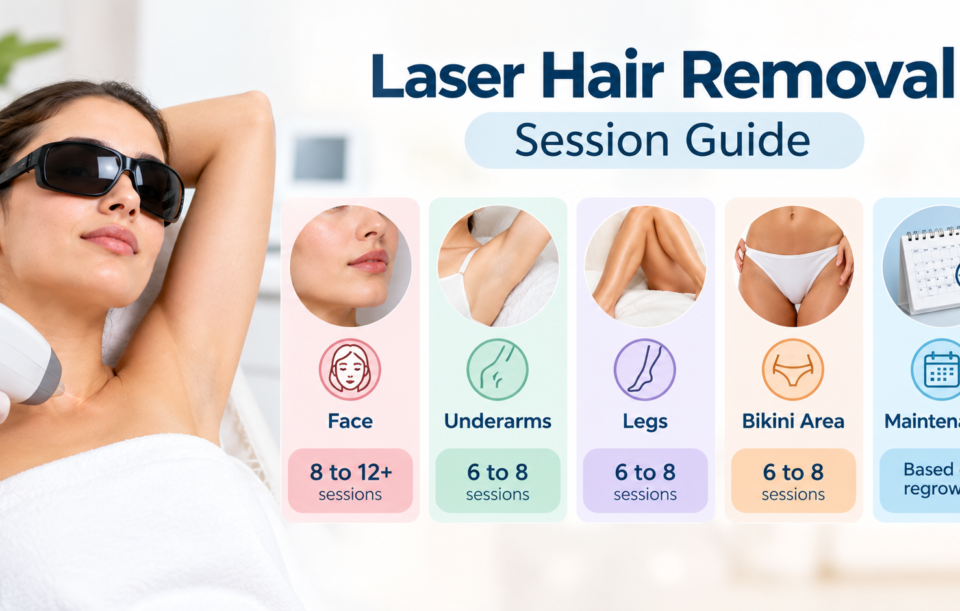
The exact number varies, but the following table gives a practical starting guide.
Laser hair removal session count by body area
| Body area | Typical session range | Gap between sessions | Maintenance frequency | What changes the number |
|---|---|---|---|---|
| Face | 8 to 12 or more | About 4 to 6 weeks | Periodic maintenance may be needed | Hormones, PCOS, hair density, thickness and response |
| Underarms | 6 to 8 | About 4 to 6 weeks | Occasional maintenance | Hair thickness, density, growth cycle and response |
| Legs | 6 to 8 | About 4 to 6 weeks | Occasional maintenance | Hair density, growth cycle and individual response |
| Bikini area | 6 to 8 | About 4 to 6 weeks | Occasional maintenance | Hair thickness, density, growth cycle and response |
These are planning ranges, not guaranteed results. The American Academy of Dermatology notes that treatment response varies with hair colour, hair thickness, treatment area, laser type and skin colour.
Why does facial hair need more sessions?
Facial hair often needs a different treatment plan from body hair.
Hormonal stimulation can continue to influence facial hair growth. This is particularly relevant when someone has excessive facial hair associated with conditions such as polycystic ovary syndrome, or PCOS.
A 2024 systematic review of laser and light based treatment for hirsutism in women with PCOS found evidence that these treatments can help reduce unwanted hair, while also noting limitations in the available evidence. Some studies found better results when laser treatment was combined with appropriate medical treatment for the underlying hormonal condition.
This is why laser sessions for facial hair may continue beyond the initial six to eight sessions.
It does not mean every person needs twelve or more treatments. Instead, the number should be based on how much hair remains, how quickly it returns and whether hormonal factors are continuing to stimulate growth.
Which hormonal conditions change the session count?
Hormonal conditions can change both the amount of hair and how long the treatment course needs to continue.
PCOS is an important example in women with facial hirsutism. Other hormonal or endocrine problems can also contribute to excessive hair growth.
If facial hair becomes noticeably heavier, progresses rapidly or occurs alongside symptoms such as irregular menstrual cycles, a medical assessment may be appropriate.
In people with PCOS, laser treatment can still be useful, but controlling the underlying hormonal influence may form part of the overall management plan. Research has found that laser or light treatment can be effective for PCOS related hirsutism, although the evidence is not uniform and individual response varies.
Therefore, someone with a hormonal cause may require more treatment or more frequent maintenance than someone whose body hair is not being influenced by an ongoing hormonal problem.
Why is it called reduction rather than permanent removal?
Laser hair removal is often described casually as permanent hair removal, but permanent hair reduction is a more useful way to understand the expected outcome.
Laser can significantly reduce the number of hairs and make remaining hairs finer and lighter. However, not every follicle responds in exactly the same way, and new or previously inactive follicles may become noticeable later.
The AAD explains that after multiple treatments, most patients experience substantial long term reduction, while regrowth can still occur and maintenance laser treatments may be needed.
Cleveland Clinic similarly explains that laser hair removal is not guaranteed to be permanent and that some hair can return after treatment, usually with reduced thickness or visibility.
So the realistic objective is:
Less hair, finer hair, slower regrowth and longer periods without noticeable hair.
For many people, that reduction can be substantial. It should not, however, be presented as a promise that every treated follicle will permanently stop producing hair.
How are maintenance sessions planned after the main course?
Maintenance is planned according to regrowth, rather than automatically giving every patient the same number of sessions every year.
After the main course, some patients may remain satisfied for months before noticeable regrowth appears. Others may require an additional treatment sooner.
AAD states that when hair regrows, maintenance laser treatments may be needed to maintain the result.
Some clinical guidance describes maintenance approximately every six to twelve months for certain patients, but this is not a universal schedule. Facial and hormonally influenced hair can require a different plan.
A maintenance session laser plan should therefore consider:
- How much hair has returned
- Whether the returning hair is thick or fine
- Which body area is involved
- How long the previous result lasted
- Whether hormonal factors are present
- Whether another session is likely to provide useful reduction
The objective is to treat meaningful regrowth rather than automatically repeating treatment simply because a certain number of months have passed.
Is laser hair removal permanent?
Laser hair removal can provide long lasting hair reduction and can produce permanent reduction in many treated body areas, but it should not be presented as a guarantee that every hair will disappear permanently.
The AAD specifically notes that hormonal factors mean results on a woman’s face are different from many other body areas.
After a successful course, regrowth is generally reduced and the returning hairs may be finer and less noticeable.
How far apart should sessions be?
For many patients, sessions are scheduled approximately four to six weeks apart.
The correct laser hair removal session gap depends on the body area and the individual’s growth pattern. The purpose of waiting is to allow another group of follicles to reach a stage where they can respond to treatment.
AAD states that most patients can have laser hair removal every four to six weeks, with the exact timing determined by the treating dermatologist.
Treating too frequently does not automatically produce faster results.
Why does hair return after finishing the course?
Hair can return for several reasons.
Some follicles may have been inactive during previous sessions. Some follicles may respond incompletely. Hormonal changes can also stimulate additional facial hair growth.
This is why why hair grows back after laser is an important part of setting realistic expectations.
Regrowth does not automatically mean that the treatment has failed. If the returning hair is significantly less dense, finer and slower growing, the treatment may still have produced the intended reduction.
Maintenance can then be used when the remaining hair becomes noticeable enough to justify another session.
How many maintenance sessions per year are typical?
There is no universal annual number.
Some patients may need only one or two maintenance treatments in a year, while others may need more frequent sessions. Facial and hormonally influenced hair is particularly likely to require ongoing maintenance.
A maintenance plan should therefore be based on the patient’s actual regrowth rather than promising a fixed number of annual sessions.
Does hormonal imbalance change the plan?
Yes.
Hormonal imbalance can affect facial hair growth and may increase the amount of treatment required.
PCOS is one important example. Studies of women with PCOS show that laser and light based treatments can reduce hirsutism, although treatment response varies and the evidence has limitations.
When excessive facial hair develops together with other symptoms of hormonal imbalance, treating the underlying condition may be an important part of the overall plan.
FAQs
Laser hair removal can provide long lasting and substantial hair reduction. However, some regrowth can occur, and maintenance may be needed. Facial hair in women can be particularly affected by hormonal factors.
Many treatment plans use a gap of approximately four to six weeks. The exact timing depends on the treatment area, hair growth cycle and individual response.
Facial hair can be influenced by hormones. Conditions such as PCOS can cause continued or recurrent facial hair growth, which can mean additional sessions and maintenance are needed.
Some hair may return. Follicles do not all respond at the same time, and hormonal changes can stimulate further growth. Returning hair is often finer and less noticeable after successful treatment.
There is no fixed number for everyone. Some patients may need one or two maintenance sessions per year, while facial or hormonally influenced hair may require a different schedule.
Yes. Hormonal conditions can influence hair growth and may increase the number of sessions or maintenance treatments required. When excessive facial hair is associated with other hormonal symptoms, medical assessment may also be appropriate.
What should you check before starting a laser course?
The number of sessions should be decided after assessing the actual treatment area rather than simply choosing a package number.
A consultation should consider:
- Skin colour and sensitivity
- Hair colour and thickness
- Hair density
- Treatment area
- Previous hair removal methods
- Hormonal symptoms
- Previous laser treatment
- Expected session interval
- Likely initial course
- Possible maintenance requirement
AAD recommends discussing the expected number of treatments, likely results, possible side effects and the provider’s experience with your skin colouring before treatment.
For darker skin tones in particular, appropriate laser selection and experienced treatment are important because incorrect treatment settings can increase the risk of burns or pigmentary changes.
Final takeaway
There is no universal answer to how many laser hair removal sessions are needed.
For many body areas, six to eight sessions with approximately four to six weeks between treatments is a reasonable starting range. Facial hair may need more sessions, particularly when hormones are involved. After the initial course, maintenance is planned according to actual regrowth.
Laser works because it targets suitable follicles during their active growth phase. Because follicles grow at different times, several sessions are necessary. The realistic goal is long term hair reduction, not a promise that every follicle will disappear permanently.


Category
Latest From Blog
Small Black Warts on Face and Neck: Removal and Recurrence
Can Facial Ageing Be Treated Without Surgery?
Red Veins On The Face: What Causes Them And Which Vascular Laser Fits