




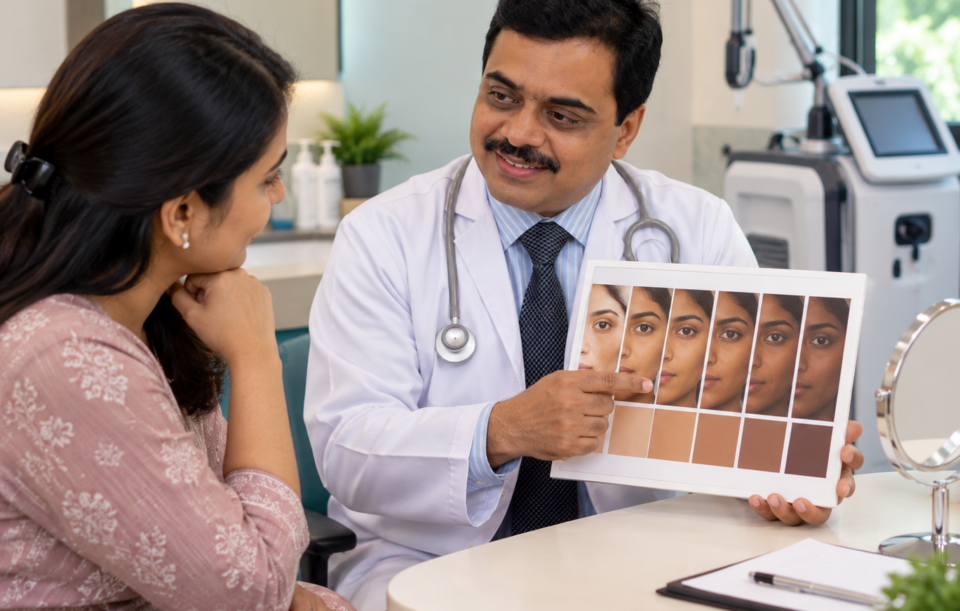
Laser bleach is not a chemical bleach and does not permanently change your natural skin colour. The term is often used for procedures such as laser toning or carbon laser peel, which may improve the appearance of certain types of pigmentation, uneven tone and dullness. Results depend on the treatment, skin condition and individual response. Be cautious of promises of permanent fairness or guaranteed whitening after one session.
What is actually done in a “laser bleach” session?
“Laser bleach” is a marketing term rather than the name of one standardised medical procedure. A clinic may use it to describe laser toning, a carbon laser peel or another laser-based facial treatment. Before booking, ask exactly which device and procedure will be used.
The treatment matters because different lasers target different skin concerns.
Laser toning: Certain laser settings are used to target selected pigment concerns. The suitability of the device and settings depends on the type of pigmentation, skin tone and medical assessment.
Carbon laser peel: A carbon-based lotion is applied to the skin before a suitable laser is used to remove the carbon particles. This procedure may help with oily skin, visible pores and selected texture or tone concerns. It is not the same as every type of pigmentation laser.
Pigmentation laser treatment: A suitable laser may target specific unwanted pigment, such as some sun spots or freckles. Melasma and pigmentation caused by inflammation can behave differently and may worsen with unsuitable treatment.
Before treatment, ask the practitioner to explain the procedure, expected benefits, possible risks, number of sessions and aftercare. Do not assume that every treatment advertised as “laser bleach” works in the same way.
For more detail, read the clinic’s guides to Laser Bleach and Laser Carbon Peel.
What can laser face bleach lighten, and what can it not?
The most important distinction is between acquired pigmentation and your natural baseline skin colour.
Acquired pigmentation develops or becomes more noticeable after factors such as sun exposure, inflammation, acne or certain hormonal changes. Depending on the diagnosis, a suitable laser may help improve some forms of excess pigment.
Natural skin colour is largely influenced by genetics and the amount and type of melanin produced by the skin. Cosmetic laser toning is not a reliable way to permanently change this natural baseline.
| Skin concern or claim | What is realistic? |
|---|---|
| Recent sun tan | Some treatments may improve the appearance of acquired pigmentation, but results vary |
| Selected sun spots or freckles | Certain pigment-targeting lasers may help after assessment |
| Uneven skin tone | Improvement may be possible if the cause is suitable for the chosen treatment |
| Acne-related dark marks | Treatment depends on the type of marks and whether active acne or inflammation is present |
| Melasma | Requires careful assessment because heat and unsuitable procedures can worsen pigmentation |
| Natural genetic skin colour | Laser toning is not a reliable method for permanently changing it |
| Permanent fairness in one session | This is not a realistic or medically responsible guarantee |
A treatment that makes a tan or dark spot less visible may make the complexion look more even. That is different from changing the skin’s natural colour.
How is laser bleach different from a chemical bleach cream?
The names can sound similar, but the methods are different.
A chemical bleach product typically acts on the skin’s surface or on the appearance of hair above the skin. Products sold for pigmentation may contain other active ingredients, so the exact formulation matters.
Laser treatments use controlled light energy. Depending on the device and settings, the energy may target selected pigment or other structures in the skin. A carbon laser peel also involves a carbon-based preparation.
Neither the word “bleach” nor the use of a laser automatically makes a treatment effective or safe. The actual product, device, treatment settings and the person’s skin condition determine the likely benefits and risks.
Before using a skin-lightening cream, check its ingredients and follow professional advice. Avoid unlabelled products and products containing potentially harmful ingredients, particularly if their concentration or origin is unclear.
What are the side effects if laser bleach is overdone?
Laser procedures can cause side effects even when performed for a cosmetic concern. Risk depends on the device, energy settings, skin type, practitioner experience, the condition being treated and aftercare.
Possible side effects include:
- Temporary redness
- Swelling or tenderness
- A warm or stinging sensation
- Temporary darkening or lightening of treated areas
- Burns or blisters
- Post-inflammatory hyperpigmentation
- Hypopigmentation, where patches become lighter than the surrounding skin
- Scarring in uncommon but serious cases
People with darker skin tones can be more vulnerable to pigment changes after certain types of skin injury. This does not mean that every laser is unsuitable for darker skin; it means the device and settings need to be selected carefully for the individual.
Repeated treatments without an appropriate review can increase the chance of irritation or pigment problems. More sessions or higher energy do not necessarily produce better results.
Can laser bleach cause white patches?
Yes, some laser procedures can cause unwanted lightening of the treated skin, although this is not inevitable. Hypopigmentation may occur if pigment-producing cells or their function are affected. The appearance, severity and duration depend on the cause.
Unexpected pale patches, blistering, persistent redness or worsening pigmentation should be assessed by a qualified medical professional. Do not attempt to correct a new pigment problem by immediately undergoing another laser session.
How should you judge whitening claims in adverts?
Treat advertisements promising permanent fairness, guaranteed whitening in one session or absolutely no side effects with caution.
Before agreeing to treatment, ask these questions:
- What is the medical name of the procedure being offered?
- Is the target a tan, a specific pigment problem, skin texture or something else?
- What improvement is realistic for my skin?
- What risks apply to my skin tone and medical history?
- Who will assess my skin and perform or supervise the procedure?
- How many sessions may be needed, and what will each session cost?
- What happens if my pigmentation worsens?
- What aftercare and sun protection will I need?
- Are the before-and-after images genuine and photographed under comparable conditions?
- Is there a clear plan for follow-up if side effects occur?
The Advertising Standards Council of India (ASCI) issued its 2014 guidelines for advertising skin-lightening or fairness-improvement products to address advertising that presents darker skin as inferior or undesirable. The guidance says such advertising should not promote discrimination or negative stereotypes based on skin colour. It is an important reminder that cosmetic advertising should communicate realistic benefits without suggesting that one natural skin tone is better than another.
Myth versus fact: What laser bleach really does
| Claim | What is true? | What the treatment actually does |
|---|---|---|
| “It gives permanent fairness.” | Unsupported as a general claim | Selected procedures may improve particular acquired pigmentation, but do not reliably change natural skin colour |
| “One session guarantees whitening.” | There is no universal guarantee | Response depends on the skin concern and treatment; multiple sessions may be advised |
| “There are no side effects.” | Incorrect | Redness, irritation, burns and unwanted pigment changes are possible |
| “It removes every tan completely.” | Not guaranteed | Improvement varies; ongoing sun exposure can cause tanning and pigmentation to return |
| “Every laser bleach treatment is the same.” | Incorrect | Laser toning, carbon peel and pigment-targeting procedures differ |
| “Darker skin cannot have laser treatment.” | Too broad | Some procedures may be appropriate, but careful selection and settings are important |
The best treatment plan is based on a clear skin diagnosis and a realistic goal, such as reducing a particular dark spot or improving uneven tone, rather than trying to achieve an entirely different natural complexion.
Is laser bleach safe before a wedding or major event?
A cosmetic laser procedure should not be scheduled at the last minute simply because an event is approaching. Even a treatment with little expected downtime can cause temporary redness, irritation or an unexpected pigment change.
Allow enough time for assessment, treatment and recovery. The appropriate interval depends on the procedure and your skin. If the event is close, discuss the timing with a qualified practitioner rather than assuming a single session will provide a predictable glow.
Avoid experimenting with new active skincare products immediately before an event. Follow the clinic’s instructions about sun exposure, cleansing, moisturisers and sunscreen.
How can you care for your skin after laser treatment?
Aftercare helps protect the skin while it recovers. Follow the specific instructions given for the procedure performed.
- Use gentle skincare recommended by your practitioner.
- Apply broad-spectrum sunscreen as advised and limit unnecessary sun exposure.
- Avoid scrubbing or picking at irritated or peeling skin.
- Do not restart strong exfoliating products or active ingredients until advised.
- Avoid additional cosmetic procedures on the treated area until the practitioner says they are appropriate.
- Report blistering, increasing pain, persistent redness, new pale patches or worsening dark pigmentation.
Sun protection is particularly important because ultraviolet exposure can contribute to tanning and the return or worsening of some pigment conditions. Sunscreen does not change genetic skin colour; it helps reduce further sun-related damage.
Who should have a skin assessment before laser treatment?
A proper assessment is important if you have melasma, a history of pigmentation after irritation, active skin inflammation, a recent tan, a tendency to develop raised scars or a previous adverse reaction to a cosmetic procedure.
Tell the practitioner about your skincare products, medicines, previous peels or laser treatments and any history of skin reactions. They can determine whether the proposed procedure is appropriate, whether another approach would be safer or whether treatment should be postponed.
A patch test may be considered in selected circumstances, but it cannot guarantee that a full treatment will be free of side effects.
Where can you ask about laser bleach near Udhna?
If you are considering laser bleach near udhna, ask the clinic to clarify whether the service means laser toning, a carbon peel or another procedure. Request an assessment of your specific concern, an explanation of realistic outcomes and a discussion of possible pigment changes before consenting to treatment.
You can review the clinic’s information on laser treatment for pigmentation and laser treatment for a tan that will not fade. These pages can help you understand the different concerns the treatments are intended to address, but your own suitability needs to be assessed individually.
If you are considering laser treatment to improve uneven tone, start by understanding which procedure matches your skin concern. Read about our Laser Bleach treatment to learn what the service involves, explore the Laser Carbon Peel for its different approach to skin cleansing and texture, and review our guide to Laser Treatment for a Tan That Will Not Fade for information about persistent tanning. You can also learn about Laser Treatment for Pigmentation and discuss which option, if any, is suitable for your skin with a qualified practitioner.
Frequently asked questions
Laser bleach is not a standardised procedure, so permanence depends on what treatment is actually performed and what condition is being treated. Some acquired pigmentation may improve, but new tanning or pigmentation can develop later. No responsible provider should guarantee permanent fairness or a permanent change in genetic skin colour.
Laser treatment cannot reliably change a person’s natural, genetically determined skin colour. Selected procedures may improve particular dark spots or uneven pigmentation, but they can also cause unwanted lightening or darkening. Treatment should focus on a diagnosed skin concern, with realistic expectations and suitable precautions.
There is no fixed number for everyone. The number of sessions depends on the type of laser, the depth and cause of the pigmentation, the skin’s response and the treatment plan. A practitioner should explain the likely range and review progress rather than promising complete tan removal.
It may be appropriate for some people, but a new cosmetic laser treatment can cause redness, irritation or pigment changes. Do not schedule it at the last minute. Discuss your event date, skin history and recovery time with a qualified practitioner before deciding whether to proceed.
Not necessarily. “Laser bleach” is a marketing term that may refer to different procedures. A carbon laser peel involves applying a carbon-based preparation and using a suitable laser, while laser toning and pigment-targeting treatments use different approaches. Ask the clinic which procedure and device will be used.
Unwanted light patches can occur after some laser procedures if pigmentation is affected. This is not inevitable, but it is a recognised possible complication. Seek medical assessment if pale patches appear after treatment, and do not undergo another procedure to correct them without professional advice.
Ask what procedure is actually being offered, which concern it is intended to treat, how your skin type affects the risks, how many sessions may be needed and what side effects to watch for. Confirm who will assess and supervise the treatment and what follow-up is available if pigmentation worsens.


Category
Latest From Blog
What Is Laser Bleach? What It Can and Cannot Change
Small Black Warts on Face and Neck: Removal and Recurrence
Can Facial Ageing Be Treated Without Surgery?