




Written by Dr. Ashutosh Shah, M.Ch., DNB (Plastic Surgery)
Founder & Director, Elegance Clinic, Surat
Dr. Ashutosh Shah is a Board-Certified Plastic, Cosmetic, Reconstructive and Hair Transplant Surgeon with more than 22 years of surgical experience. He completed his M.Ch. in Plastic Surgery from The M.S. University of Baroda and holds a DNB in Plastic Surgery. He has advanced training in microvascular and cosmetic surgery and has performed thousands of cosmetic and reconstructive procedures.
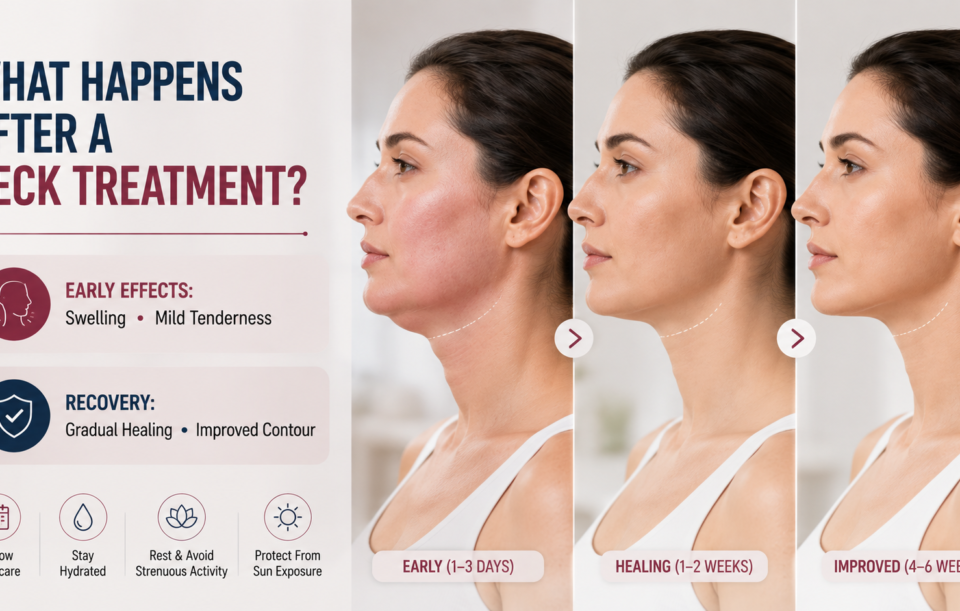
What happens after a neck treatment depends mainly on which procedure you have received. A non-surgical treatment may cause temporary redness, tenderness, swelling, or bruising, while procedures such as neck liposuction or a surgical neck lift involve a longer healing process. Results also appear at different speeds: some treatments create relatively early changes, while others depend on swelling settling or gradual tissue remodeling.
“Neck treatment” can describe several procedures used for concerns such as loose skin, excess fat below the chin, neck bands, wrinkles, or reduced jawline definition. These include injectable treatments, energy-based skin tightening, liposuction, and neck-lift surgery. Because these treatments work differently, there is no single neck treatment recovery timeline that applies to everyone.
After treatment, the most useful questions are usually: Is this swelling expected? When can I return to normal activities? When should I expect results? And which symptoms should I report?
For surgical neck procedures, the American Society of Plastic Surgeons (ASPS) notes that swelling and bruising can occur during recovery and that the final result becomes clearer as these effects settle.
The safest approach is to follow the aftercare plan provided for your specific procedure rather than comparing your recovery with someone who had a different neck treatment.
Key Takeaways
- Recovery after neck treatment varies considerably by procedure.
- Temporary swelling, redness, tenderness or bruising may occur after many treatments.
- Surgical neck treatments generally involve more recovery than non-surgical procedures.
- Some results appear as swelling settles, while collagen-based treatments can develop more gradually.
- Neck treatments do not all address the same problem; skin laxity, excess fat and muscle bands may require different approaches.
- Final results should not be judged during the earliest stage of recovery.
- Increasing pain, significant swelling, fever, drainage or other unexpected symptoms should be reported promptly.
What Happens Immediately After Neck Treatment?
Immediately after neck treatment, the treated area may look or feel different because of swelling, redness, tenderness, bruising or temporary tightness. The exact response depends on whether treatment involved injections, an energy-based device, fat removal or surgery.
The appearance immediately after treatment is therefore rarely a useful measure of the final result.
For example, swelling can temporarily hide jawline definition after surgery or liposuction. With some non-surgical treatments, there may be little visible change at first because improvement develops gradually.
Downtime: The period after a procedure when treatment-related effects may limit normal work, exercise or social activities.
How Does Recovery Differ Between Neck Treatments?
Recovery varies because different neck treatments affect different tissues. Injectables may involve limited surface recovery, energy-based procedures create controlled tissue effects, liposuction removes fat through small incisions, and a neck lift surgically repositions deeper tissues and removes or redrapes excess skin.
| Treatment | Common Early Experience | Recovery Consideration | Results |
|---|---|---|---|
| Injectable treatment | Swelling, tenderness or bruising may occur | Usually less downtime than surgery | Depends on product/treatment |
| Energy-based tightening | Redness, swelling or sensitivity may occur | Varies by technology and intensity | Often develops gradually |
| Neck liposuction | Swelling and bruising are common | Compression may be prescribed | Definition improves as swelling settles |
| Neck lift | Swelling, bruising and tightness | Surgical healing required | Develops progressively during recovery |
This is why advice designed for someone who received an injectable should not automatically be followed by someone recovering from neck surgery.
Which Changes Can Be Normal During Early Recovery?
Temporary swelling, bruising, tenderness, tightness or altered sensation can occur after certain neck treatments. These effects should generally trend toward improvement, although their severity and duration vary according to the procedure and individual healing.
After surgical neck lifting, ASPS describes swelling and bruising as expected parts of recovery. A compression garment may also be used to help minimise swelling and support the treated tissues.
A patient may initially feel that the neck looks fuller rather than slimmer because swelling masks the underlying result.
Temporary numbness or unusual skin sensations can also occur after some surgical procedures. Any symptom that is severe, worsening or unexpected should be discussed with the treating clinician.
When Can You Return to Normal Activities?
Return to routine activities depends on the treatment performed and how the individual is healing. Some non-surgical treatments involve relatively little interruption, while neck liposuction and neck-lift surgery usually require greater restrictions during early recovery.
Patients should receive procedure-specific instructions regarding work, exercise, sleeping position, bathing, skincare, compression garments and other activities.
For surgical procedures, increasing activity gradually is generally different from being fully healed. Feeling comfortable enough to return to work does not necessarily mean deeper tissues have completed healing.
Avoid using another patient’s recovery as your timeline.
When Do Neck Treatment Results Become Visible?
Neck treatment results can appear immediately, gradually over several weeks or months, or after postoperative swelling subsides. The timeline depends on how the treatment works and which structures—skin, fat, muscle or soft tissue—were treated.
After Non-Surgical Treatment
Some injectable effects may appear relatively early, while treatments intended to stimulate collagen remodeling may produce gradual changes.
Collagen Remodeling: The gradual process through which existing collagen changes and new collagen formation contributes to tissue structure after certain treatments.
After Neck Liposuction
Fat removal occurs during the procedure, but swelling can temporarily conceal the new contour. Definition becomes easier to assess as healing progresses.
After a Neck Lift
Early changes can be visible despite swelling, but the final contour develops progressively. ASPS advises that results become clearer as swelling and bruising subside.
How Long Do Neck Treatment Results Last?
The duration of neck treatment results depends on the procedure. Injectable treatments may require maintenance, some energy-based treatments produce gradual changes that can diminish with ageing, while surgical procedures can create longer-lasting structural changes without stopping the natural ageing process.
This distinction is important.
A temporary injectable result should not be compared directly with surgical tissue repositioning. Likewise, a treatment that improves mild skin laxity cannot necessarily reproduce the degree of correction possible with surgery.
Ageing, weight changes, skin quality, sun exposure and individual anatomy can influence how the neck changes over time.
What Can Affect Neck Treatment Recovery?
Several factors can influence recovery, including the extent of treatment, age, skin quality, general health, smoking, medications and individual healing response.
Following the clinician’s instructions matters because recovery recommendations are designed around the actual procedure performed.
For surgical treatment, ASPS notes that smoking can adversely affect healing and surgical outcomes.
The goal should not be the fastest possible recovery, but safe healing with appropriate follow-up.
What Are the Possible Risks or Side Effects?
Every neck treatment has its own risk profile. Temporary swelling, bruising, tenderness and redness may occur with less invasive procedures, while surgical treatments carry additional risks such as bleeding, infection, scarring, fluid accumulation, altered sensation and anaesthesia-related complications.
ASPS lists risks of neck-lift surgery including bleeding, infection, fluid accumulation, numbness or changes in skin sensation, prolonged swelling, scarring and the possibility of revision surgery.
The likelihood and significance of complications depend on the specific treatment, medical history, anatomy and technique.
Which Symptoms Need Medical Attention?
Contact your treating clinician if recovery is not progressing as expected or if you develop increasing pain, rapidly increasing swelling, significant bleeding, fever, unusual drainage, worsening redness or another symptom specifically identified in your postoperative instructions.
After surgery, sudden breathing difficulty, chest pain or other severe symptoms require urgent medical attention.
Patients should receive clear instructions about whom to contact after a procedure and which symptoms require emergency care.
When Should You Follow Up With Your Specialist?
Follow-up allows the clinician to check healing, assess swelling, review treatment response and identify problems early.
It is particularly important after surgical neck treatment because the visible skin is only one part of the healing process.
If results appear uneven during early recovery, avoid assuming the final outcome has been reached. Swelling can resolve at different rates on each side.
Conclusion
What happens after neck treatment depends on what treatment you actually had. Mild redness or swelling may follow some non-surgical procedures, while neck liposuction and neck-lift surgery involve a more significant healing process.
Results also develop differently. Some treatments provide relatively early changes, collagen-based improvements can develop gradually, and surgical contouring becomes clearer as postoperative swelling resolves.
The most important point is not to compare recovery between completely different procedures. Your treatment type, anatomy, health and individual healing response all influence what happens next.
Follow procedure-specific aftercare instructions, attend recommended follow-ups and report unexpected or worsening symptoms. Professional assessment is also important before treatment so that the procedure selected actually matches whether your concern comes from skin, fat, muscle or deeper neck anatomy.
About Dr. Ashutosh Shah and Elegance Clinic
Dr. Ashutosh Shah, M.Ch., DNB (Plastic Surgery) is a Board-Certified Plastic, Cosmetic and Reconstructive Surgeon with more than 22 years of surgical experience and is Founder and Director of Elegance Clinic, Surat.
Elegance Clinic, established in 2014, provides cosmetic and plastic surgery, dermatology, hair restoration, laser and reconstructive treatments through centres in Adajan and Vesu, Surat.
Considering neck treatment or have questions about recovery after a procedure?
Book a personalised consultation with Dr. Ashutosh Shah at Elegance Clinic, Surat, to understand the expected recovery, results and aftercare for your specific treatment.
Frequently Asked Questions
Yes, swelling can occur after many neck procedures, although the amount and duration depend on the treatment.
There is no single timeline. Non-surgical and surgical neck treatments have very different recovery periods.
Some changes appear early, while others become visible gradually or after swelling settles.
It depends on the procedure. Follow the activity restrictions provided by your treating clinician.
Compression may be recommended after certain surgical procedures or liposuction, but it is not required after every neck treatment.
Not all are. Some treatments require maintenance, while surgical changes may be long-lasting but cannot stop natural ageing.
Report severe or worsening pain, rapidly increasing swelling, significant bleeding, fever, unusual drainage or other unexpected symptoms.


Category
Latest From Blog
Small Black Warts on Face and Neck: Removal and Recurrence
Can Facial Ageing Be Treated Without Surgery?
Red Veins On The Face: What Causes Them And Which Vascular Laser Fits