




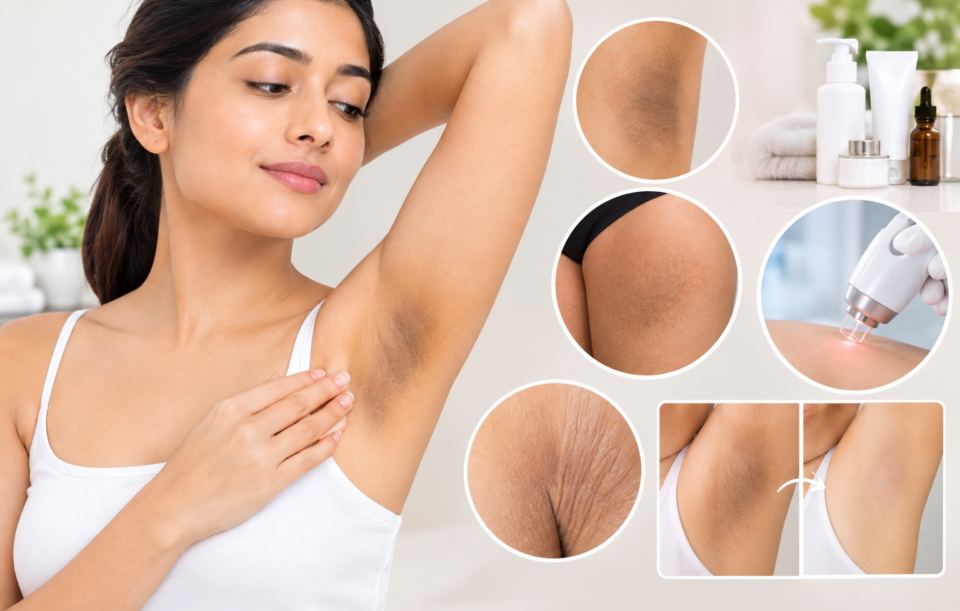
Underarm and inner thigh darkening is common and can have several causes. Friction, shaving, tight clothing, repeated irritation and some deodorants can contribute to pigmentation. In some people, darker skin that looks thicker or velvety—especially when it also appears around the neck—can be associated with acanthosis nigricans, which may occur with insulin resistance.
The most effective approach is not simply to lighten the skin. It is to identify the cause, reduce ongoing irritation and then choose an appropriate treatment.
What Causes Dark Underarms And Inner Thighs?
Several everyday factors can contribute to pigmentation.
Friction
Repeated rubbing between the thighs or from clothing can irritate the skin and trigger post-inflammatory pigmentation.
Tight clothing, frequent movement and skin-to-skin contact can all contribute.
Shaving
Repeated shaving can cause irritation, small injuries and inflammation. Ingrown hairs can add further inflammation and leave darker marks.
Changing shaving technique and reducing irritation can therefore be an important part of treatment.
Deodorants And Products
Some deodorants, fragrances or other personal-care products can irritate sensitive underarm skin.
If pigmentation appeared after regularly using a particular product, a clinician may recommend changing or stopping the suspected irritant.
Weight And Skin-Fold Friction
Higher body weight can increase friction in skin folds, including the underarms and inner thighs. Sweat and moisture can further increase irritation.
Addressing the mechanical cause is important because pigmentation can return if the same irritation continues.
When Can Darkening Be A Medical Sign?
Not all dark underarms are simply cosmetic pigmentation.
Darkening that is velvety, thicker than the surrounding skin and also present around the neck or other folds can be a sign of acanthosis nigricans.
Acanthosis nigricans can be associated with insulin resistance and other medical conditions. It does not mean that someone definitely has diabetes, but new or spreading changes should be assessed rather than treated only with cosmetic products.
If the appearance is new, widespread or associated with other health concerns, a medical evaluation may be appropriate.
Underarm Darkness Treatment: Start With The Cause
Treatment works better when the trigger is addressed at the same time.
| Likely cause | First step | Clinical option | Habit change needed | Review point |
|---|---|---|---|---|
| Friction | Reduce rubbing | Pigmentation-focused treatment if appropriate | Looser clothing and friction control | Review after several weeks |
| Shaving irritation | Reduce repeated irritation | Suitable topical or clinical pigmentation treatment | Gentler hair-removal routine | Review skin response |
| Product irritation | Stop suspected irritant | Treatment after inflammation settles | Use suitable products | Review after irritation improves |
| Post-inflammatory pigmentation | Identify the original irritation | Medical creams, peels or selected laser treatment | Prevent further inflammation | Review during treatment course |
| Velvety darkening with other affected areas | Medical assessment | Treat the underlying cause first | Address relevant lifestyle or medical factors | Clinical follow-up |
The appropriate treatment depends on skin type, pigmentation pattern and the underlying cause.
Can Laser Help Underarm Pigmentation?
Laser-based treatments may be considered for selected pigmentation problems, but they are not appropriate for every type of darkening.
The choice of laser, settings and treatment schedule should be determined by a trained clinician, particularly because darker skin can be more susceptible to post-inflammatory pigmentation after some procedures.
Laser treatment may be more useful when the cause has already been identified and ongoing irritation has been controlled.
It should not be presented as a permanent solution if friction, shaving irritation or an underlying medical condition remains untreated.
What About Chemical Peels?
Selected chemical peels may be used to address superficial pigmentation.
However, the skin of the underarms and inner thighs can be sensitive. An overly aggressive peel can cause irritation and potentially make pigmentation worse.
For this reason, treatment should be selected according to the individual’s skin type and pigmentation rather than using a strong peel simply because the area is darker.
What Role Do Medical Creams Play?
Topical treatments may be used for some forms of pigmentation.
The appropriate ingredient and duration depend on the cause and the patient’s skin. Stronger pigmentation treatments should not be used indefinitely or without appropriate supervision.
The aim is gradual improvement while avoiding additional irritation.
Why Does The Darkening Come Back?
Pigmentation can return when the original trigger continues.
For example:
- Continued friction can cause repeated inflammation.
- Frequent irritating shaving can create new pigmentation.
- An unsuitable deodorant can continue to irritate the skin.
- An untreated medical cause can continue to produce characteristic darkening.
This is why a treatment plan should include both pigmentation management and prevention of further irritation.
A Realistic Three-Month Approach
A three-month plan may involve different stages rather than one treatment performed repeatedly.
Month 1: Identify And Remove The Trigger
The first step is to determine why the skin is becoming darker.
This may involve reviewing shaving habits, clothing, deodorants, friction and the appearance of pigmentation elsewhere on the body.
If the pigmentation looks velvety or is also present around the neck, medical assessment may be appropriate.
Month 2: Treat The Pigmentation
Once ongoing irritation is controlled, an appropriate clinical treatment may be considered.
Depending on the diagnosis, this could include a topical treatment, chemical peel or selected laser-based treatment.
The treatment should be adjusted according to the skin’s response.
Month 3: Review And Maintain
The response should be reviewed rather than assuming that more treatment is always better.
If the skin is improving, the focus can shift towards maintenance and prevention of recurrent irritation.
If there is little improvement, the diagnosis and treatment plan may need to be reassessed.
Why Home Remedies Can Be Risky
The underarms and inner thighs are sensitive areas.
Harsh scrubs, undiluted acids, lemon juice, bleaching products or repeated rubbing can irritate the skin and potentially worsen pigmentation.
A product that causes burning or inflammation is not necessarily working. Irritation can itself produce more pigmentation.
A gentle routine and appropriate clinical guidance are safer approaches.
Can Dark Underarms Be A Sign Of Diabetes?
Dark underarms can sometimes occur with acanthosis nigricans, which may be associated with insulin resistance.
However, dark skin alone cannot diagnose diabetes.
If the pigmentation is velvety, thickened, spreading or also appears around the neck, it is reasonable to discuss it with a healthcare professional and determine whether medical evaluation is appropriate.
How Long Does Treatment Take?
Pigmentation usually does not disappear immediately.
The timeframe depends on:
- The cause of pigmentation
- How long it has been present
- Skin type
- Whether irritation has stopped
- The treatment selected
- Individual response
A gradual improvement is a more realistic expectation than complete clearance after one session.
What Can Help Prevent Further Darkening?
Simple changes can support treatment:
- Reduce repeated friction.
- Avoid unnecessarily tight clothing.
- Use a gentler shaving or hair-removal routine.
- Stop products that consistently irritate the skin.
- Avoid aggressive scrubbing.
- Follow the prescribed skincare routine consistently.
- Address an underlying medical condition when present.
Prevention matters because even an effective pigmentation treatment cannot permanently protect skin from repeated irritation.
When Should You See A Clinician?
Consider a clinical assessment when:
- The pigmentation is new or rapidly increasing.
- The skin has become noticeably thicker or velvety.
- The neck, groin or other folds are also affected.
- Pigmentation persists despite removing obvious irritants.
- There is significant itching, inflammation or another skin change.
- You are unsure whether the problem is pigmentation or another skin condition.
A correct diagnosis helps determine whether the priority should be medical evaluation, skincare, friction control or a cosmetic treatment.
FAQs
Even careful shaving can cause repeated irritation or inflammation. Other causes such as friction, products or pigmentation disorders can also contribute.
Laser treatment may help selected pigmentation problems, but it is not suitable for every cause and should be chosen according to the skin and diagnosis.
It can be associated with insulin resistance, particularly when the skin is thickened and velvety. It does not by itself diagnose diabetes.
Improvement is generally gradual and depends on the cause, product and individual response.
It can return if the original cause-such as friction, irritation or an underlying condition—continues.
Harsh home remedies can irritate sensitive skin and potentially worsen pigmentation. A gentle, evidence-based approach is preferable.
Related Resources
- Daag dhabba treatment guide
- Advanced laser skin treatment in Surat
- Laser facial hair removal in Surat
- Laser treatment services


Category
Latest From Blog
Small Black Warts on Face and Neck: Removal and Recurrence
Can Facial Ageing Be Treated Without Surgery?
Red Veins On The Face: What Causes Them And Which Vascular Laser Fits