




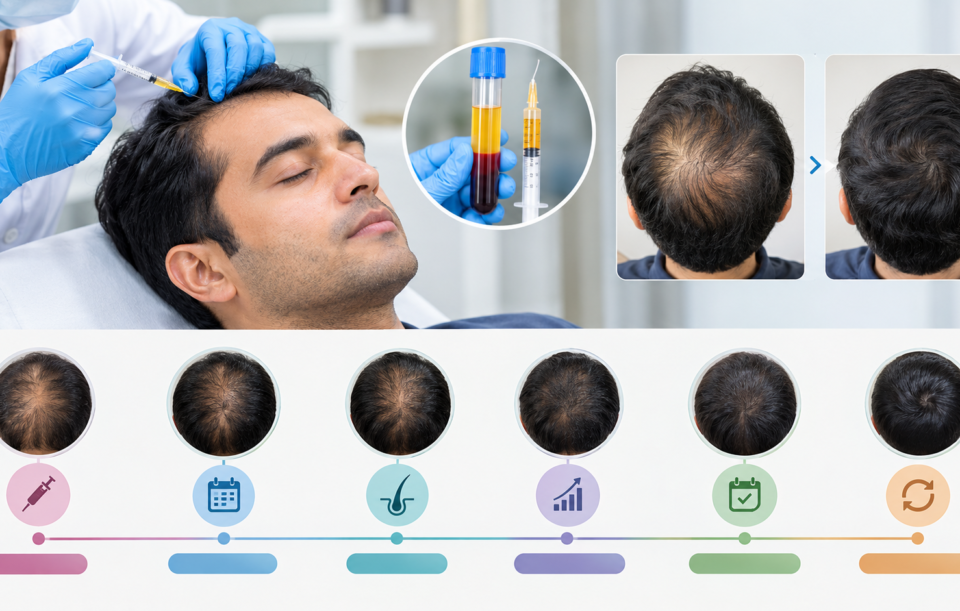
Hair fall can become frustrating when you keep noticing more hair on your pillow, in the shower, or while combing. Platelet rich plasma, commonly called PRP, is one treatment used for certain types of hair thinning, particularly androgenetic alopecia, also known as male or female pattern hair loss.
One of the most common questions is simple: How many PRP sessions are needed for hair fall?
There is no single number that works for everyone. A commonly used treatment plan starts with an induction course of about three to four sessions, usually spaced around three to four weeks apart. Some clinics may recommend four to six sessions depending on the degree of thinning, response to treatment, and the individual’s diagnosis. Research reviews have commonly evaluated three or more sessions separated by several weeks.
PRP is not an instant hair regrowth treatment. The goal is to support existing, weakened follicles and improve hair density over time. Results should therefore be assessed over several months rather than after one appointment.
What Does PRP Actually Do to a Thinning Hair Follicle?
PRP is prepared from a small sample of your own blood. The blood is processed to concentrate platelets and other components, and the prepared plasma is then injected into selected areas of the scalp.
Platelets contain growth factors that may support processes involved in follicle activity and tissue repair. Research has found that PRP can increase hair density in people with androgenetic alopecia, although studies have used different preparation methods and treatment schedules, so results are not identical for every patient.
The important point is that PRP is generally used to support thinning or miniaturized hair follicles. It should not be presented as a way to create new follicles where there are no functioning follicles.
If an area has been completely bald for a long period, or the hair loss is related to scarring that has permanently damaged follicles, PRP may not be an appropriate solution.
How Many PRP Sessions Make Up an Induction Course?
A typical PRP plan begins with several sessions rather than a single treatment.
A commonly studied schedule is approximately one session every month for three sessions. Other protocols use four sessions at intervals of around three weeks, while some treatment plans extend to four to six sessions. The exact schedule depends on the type and severity of hair loss and how the scalp responds.
A Typical PRP Course
| Treatment stage | Approximate timing | What happens | What you may notice |
|---|---|---|---|
| Session 1 | Month 0 | First PRP treatment is performed | Usually no immediate visible regrowth |
| Session 2 | Month 1 | Second treatment supports the ongoing course | Hair fall may still be present |
| Session 3 | Month 2 | Third treatment continues follicle stimulation | Early changes may begin over time |
| Session 4 | Month 3 to 4 | Additional session if recommended | Shedding and hair quality can be reviewed |
| Month 5 to 6 | Follow up | Hair density and response are assessed | Visible improvement may become easier to assess |
| Maintenance | Every few months if advised | Further sessions may be planned | Helps maintain the treatment plan |
This is a general timeline, not a fixed prescription. Your dermatologist or hair restoration specialist may recommend a different interval depending on your diagnosis and treatment response.
When Should You See a Change After PRP?
One of the biggest mistakes patients make is expecting visible regrowth immediately after the first PRP session.
Hair grows slowly, and changes in hair density take time. Clinical studies evaluating PRP for androgenetic alopecia commonly assess outcomes at three and six months, with evidence showing improvements in hair density over these time periods.
A practical way to understand the timeline is:
Month 0 to 1
The initial treatment course begins. Do not expect a major change in hair density immediately.
The scalp may feel tender or sensitive for a short period after injections. Your doctor can explain appropriate aftercare based on the technique used.
Around Month 2
The focus is still on continuing the treatment course and monitoring shedding.
Some people may notice that hair fall appears more stable, but this is not guaranteed. The amount of shedding can also vary naturally from week to week.
Month 3 to 4
This is when your doctor may begin looking more closely at early treatment response.
Photographs and other measurements can be useful because gradual changes can be difficult to notice when you see your hair every day.
Month 5 to 6
Hair density and overall response can be assessed more meaningfully.
Studies have reported increased hair density at three and six months after PRP treatment, although the evidence varies between studies and treatment protocols.
The goal is not simply to see new short hairs. Your doctor may also assess hair density, hair thickness, shedding, and the condition of the scalp.
Does PRP Work for Every Type of Hair Loss?
No. The cause of hair loss matters.
PRP has been studied most extensively for androgenetic alopecia, commonly called pattern hair loss. Research suggests that PRP can improve hair density in some people with this type of thinning, although the quality and consistency of the evidence remain variable.
PRP should not automatically be recommended simply because someone has hair fall.
For example, sudden or unexplained shedding may have an underlying cause that needs investigation first. Nutritional deficiencies, hormonal conditions, medications, illness, stress related shedding, scalp disorders, and other conditions can all contribute to hair loss.
PRP may also be unsuitable or unlikely to restore hair in areas where follicles have been permanently destroyed, such as some forms of scarring alopecia.
Alopecia areata is another condition where evidence for PRP is much less certain than for androgenetic alopecia. A systematic review found that evidence for PRP in different forms of alopecia is heterogeneous and often low quality.
This is why identifying the type of hair loss should come before deciding how many PRP sessions you need.
Can PRP Regrow Hair on a Bald Patch?
PRP is better understood as a treatment for selected cases of thinning rather than a method for creating new hair follicles.
If hair follicles are still present but have become smaller and weaker, there may be an opportunity to improve hair density. If an area is completely smooth and bald because the follicles have been permanently lost or scarred, PRP cannot recreate those follicles.
This distinction is particularly important when someone has a long standing bald area and expects PRP alone to produce full coverage.
A scalp examination can help determine whether follicles are still present and whether PRP is appropriate.
Are Maintenance PRP Sessions Necessary?
Maintenance treatment may be recommended after the initial course, but the schedule is not universal.
Some published treatment recommendations describe maintenance or additional treatment several months after the initial course. One commonly cited protocol recommends three monthly sessions followed by a three to six month maintenance period.
Your maintenance plan may depend on:
- Your original diagnosis
- How much improvement you achieved
- Whether hair shedding continues
- Your overall hair density
- Other treatments being used
- Your response to previous PRP sessions
PRP should therefore be treated as part of an ongoing hair management plan rather than a one time procedure.
Is PRP Painful?
PRP involves multiple small injections into the scalp, so some discomfort is possible.
Patients may experience temporary tenderness, sensitivity, redness, or mild swelling after treatment. The level of discomfort can vary depending on individual sensitivity, injection technique, and whether a numbing method is used.
A systematic review of PRP for alopecia found no serious adverse events related to PRP injection or control treatments in the included studies, although minor treatment related effects can occur.
Your doctor can explain what pain control or numbing options are appropriate before the procedure.
Can PRP Be Combined With Medication?
In some cases, yes.
PRP may be used alongside established hair loss treatments rather than being used as the only treatment. For androgenetic alopecia, studies have investigated PRP together with minoxidil, with some evidence suggesting better hair density outcomes when PRP was added to topical minoxidil. However, the studies also had limitations and varying levels of bias.
Medication is not suitable for everyone, and the correct treatment depends on the cause of hair loss, medical history, age, sex, pregnancy status where relevant, and other factors.
Do not start or stop a hair loss medication simply because you are undergoing PRP. Discuss the complete treatment plan with your doctor.
What Should You Review Before Starting PRP?
Before deciding on the number of sessions, the more important question is why are you losing hair?
A consultation may include:
- A review of your hair loss history
- Examination of the scalp and hair pattern
- Assessment of hair density and miniaturization
- Review of medications and medical history
- Consideration of other causes of shedding
- Discussion of PRP benefits and limitations
- A treatment and follow up schedule
Baseline photographs can also be useful. Taking photographs under similar lighting and from similar angles makes gradual changes easier to compare.
The Bottom Line
For suitable patients, PRP can be part of a treatment plan for hair thinning, particularly androgenetic alopecia. Research supports a potential improvement in hair density, but treatment protocols vary and the quality of evidence is not uniform.
A typical induction course may involve three to four sessions spaced around three to four weeks apart, while some patients may be advised to have four to six sessions. Visible changes usually require several months, with meaningful assessment often taking place around the three to six month period.
Maintenance sessions may then be considered depending on the individual’s response.
Most importantly, PRP is more appropriate for selected types of thinning where viable follicles remain. It is not a universal treatment for every type of hair loss and should not be expected to restore follicles that have been permanently destroyed.
If you are experiencing ongoing hair fall or thinning, a proper hair and scalp assessment can help determine whether PRP is appropriate and how many sessions may be reasonable for your particular condition.
Frequently Asked Questions
A commonly used induction course involves three to four sessions, usually spaced about three to four weeks apart. Some treatment plans use four to six sessions depending on the patient’s condition and response.
Hair changes take time. Early changes may become noticeable after several months, while hair density is commonly assessed around three to six months after treatment.
PRP is mainly used to support existing, weakened follicles. It cannot recreate follicles that have been permanently destroyed, so completely bald or scarred areas may not respond in the same way as thinning areas.
Maintenance may be recommended for some patients. The timing depends on the initial response and the individual’s hair loss pattern. Some published protocols describe maintenance treatment several months after the initial course.
PRP involves scalp injections and can cause temporary discomfort or tenderness. Numbing measures may be used depending on the treatment approach.
In selected patients, PRP may be combined with treatments such as minoxidil. The combination should be planned by a qualified doctor after assessing the cause of hair loss.
Related Hair Treatment Information
For more information about hair loss and treatment options:


Category
Latest From Blog
Small Black Warts on Face and Neck: Removal and Recurrence
Can Facial Ageing Be Treated Without Surgery?
Red Veins On The Face: What Causes Them And Which Vascular Laser Fits