




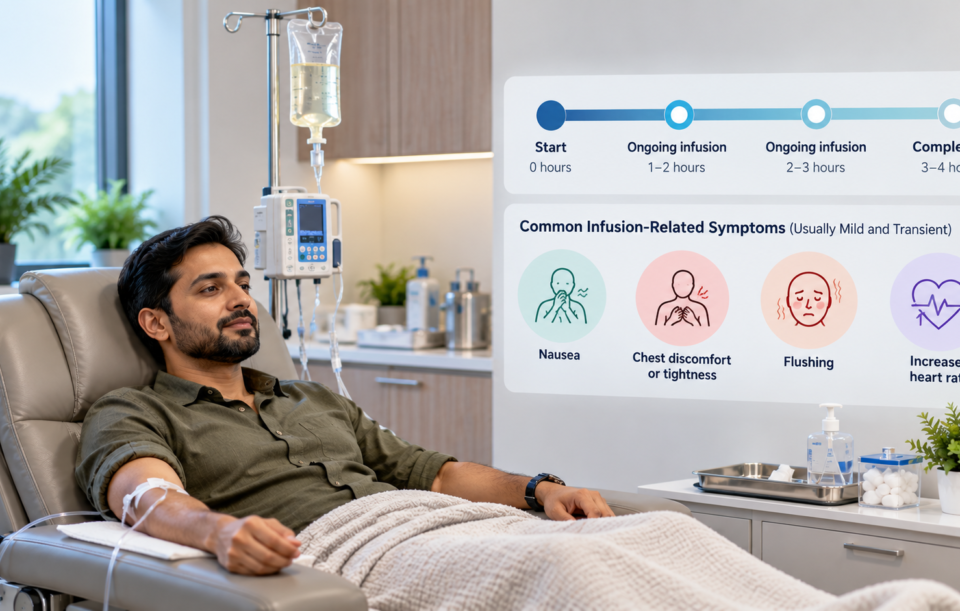
NAD IV therapy is increasingly offered as a wellness treatment for concerns such as low energy, mental focus, recovery and healthy ageing. The treatment is based on the role of NAD+ (nicotinamide adenine dinucleotide), a coenzyme found in cells and involved in energy metabolism and other cellular processes.
However, there is an important difference between what NAD+ does in the body and what NAD IV therapy has been proven to do in people. NAD+ is biologically important, but human evidence supporting intravenous NAD+ for general energy, focus or anti-ageing remains limited.
This article explains what NAD is, what NAD infusions are claimed to do, what current evidence supports, why sessions can take several hours, possible side effects and what screening should happen before treatment.
What Is NAD and What Does It Do in the Body?
NAD+ is a coenzyme that is present in cells throughout the body. It participates in oxidation-reduction reactions that help cells convert nutrients into usable energy.
NAD+ is particularly important in cellular metabolism and mitochondrial energy production. It is also involved in the activity of enzymes associated with processes such as DNA repair, cellular signalling and responses to metabolic stress.
Because of these functions, NAD+ has become an important subject in research into metabolism and ageing.
It is often stated that NAD+ levels simply decline with age. However, human research is more complicated than this statement suggests. NAD+ concentrations can vary according to the tissue studied, health status and other factors, and recent research has questioned whether a universal age-related decline occurs in all human tissues.
Therefore, the established fact is that NAD+ has important biological functions, while the clinical significance of changing NAD+ levels through IV treatment is still being investigated.
What Are NAD Infusions Claimed to Do?
NAD infusions are commonly promoted for several wellness goals, including:
- Supporting energy
- Improving mental focus
- Supporting recovery
- Promoting healthy ageing
- Supporting cellular metabolism
- Improving general wellbeing
These claims partly come from NAD+’s known role in cellular metabolism and from laboratory and early human research.
However, a biological mechanism does not automatically prove that an intravenous treatment produces a meaningful clinical benefit.
Research involving NAD-related treatments is still developing. Studies have investigated intravenous NAD+ as well as oral NAD precursors such as nicotinamide riboside (NR) and nicotinamide mononucleotide (NMN). Some studies demonstrate changes in NAD-related biomarkers, but that does not necessarily translate into improvements in energy, cognition, ageing or other health outcomes.
For IV NAD+ specifically, the human evidence remains early and limited. Larger, well-controlled clinical trials are needed before broad wellness or anti-ageing claims can be considered established.
What Does the Evidence Actually Support?
Current evidence supports several points about NAD+ itself.
First, NAD+ is essential to normal cellular metabolism. Second, NAD-related pathways are scientifically relevant to ageing, mitochondrial function and cellular stress. Third, researchers can influence NAD-related biology through different interventions.
What remains uncertain is whether NAD IV therapy produces clinically meaningful benefits in otherwise healthy people.
There is currently insufficient evidence to establish IV NAD+ as a proven treatment for:
- General tiredness or low energy
- Improved concentration
- Slowing biological ageing
- Extending lifespan
- Preventing chronic disease
- Improving athletic performance
This distinction is particularly important when evaluating NAD drip benefits. A change in a laboratory biomarker is not automatically the same as a noticeable or long-term health benefit.
Why Does a NAD Session Take Several Hours?
One of the unusual features of NAD IV therapy is that the infusion may be administered slowly.
A faster infusion can cause uncomfortable symptoms in some people. Reported reactions include nausea, abdominal or muscle discomfort, flushing, increased heart rate and chest pressure or tightness.
Because of this, healthcare professionals may reduce the infusion rate or pause treatment if symptoms occur.
Some NAD protocols therefore take approximately two to four hours, although the exact duration depends on the dose, product, infusion rate, clinical protocol and individual tolerance.
A recent real-world study of IV NAD+ reported infusion-related gastrointestinal symptoms, increased heart rate and chest pressure, with symptoms resolving after the infusion ended. The study also found that NAD+ infusions required longer administration times than IV nicotinamide riboside in that clinical setting.
A longer session does not mean that the treatment is necessarily more effective. In many cases, the slower rate is primarily about tolerability and monitoring.
What Does NAD Therapy Actually Feel Like?
The experience varies between individuals.
Some people may mainly notice the IV placement and the gradual administration of the infusion. Others may experience temporary symptoms during treatment.
Possible sensations include:
- Nausea
- Abdominal discomfort or cramping
- Flushing
- Chest pressure or tightness
- Increased heart rate
- General discomfort
If symptoms develop, they should be reported to the healthcare professional rather than simply tolerated.
The infusion rate may be adjusted according to the person’s response. This is one reason NAD therapy should be provided in an appropriate clinical environment with suitable monitoring.
NAD Infusion Side Effects
The most relevant side effects reported with NAD infusion are generally related to tolerability during administration.
These can include:
- Nausea
- Gastrointestinal discomfort or cramping
- Flushing
- Chest pressure or tightness
- Increased heart rate
- Temporary discomfort
The available human research has mainly focused on short-term effects and tolerability. There is less evidence about the long-term safety of repeated IV NAD+ treatments.
Intravenous treatment also carries the usual risks associated with an IV line, such as bruising, local irritation or infection.
Anyone who develops significant or persistent symptoms during an infusion should inform the healthcare professional immediately.
Who Should Have Screening Before NAD Therapy?
NAD therapy should not be treated as automatically suitable simply because NAD+ is naturally present in the body.
Before treatment, a healthcare professional should review relevant medical history, current medicines, allergies, previous reactions to infusions and the reason for considering NAD therapy.
Depending on the individual, additional assessment may be appropriate.
People who are pregnant or breastfeeding, have significant medical conditions, have experienced previous infusion reactions or take medicines that may affect treatment decisions may require particular consideration.
There is no single screening checklist that makes NAD IV therapy appropriate for everyone. Suitability should be determined on an individual basis.
How Many NAD Sessions Are Typical?
There is no universally established number of NAD IV sessions for general wellness or anti-ageing purposes.
Some clinics offer a series of infusions followed by maintenance treatments. However, these schedules should not be interpreted as scientifically established treatment requirements.
The appropriate approach depends on why the treatment is being considered, the person’s health, the product being used and the clinical protocol.
More sessions do not automatically mean greater benefit, particularly when the clinical effectiveness of IV NAD+ for general wellness remains uncertain.
NAD IV Therapy: Evidence and Expectations
| Claimed benefit | What the evidence shows | What to expect during a session | Possible side effects | Screening considerations |
|---|---|---|---|---|
| Energy | NAD+ is involved in cellular energy metabolism, but improved everyday energy from IV NAD+ is not firmly established | Slow, monitored IV administration | Nausea, cramping, flushing, chest discomfort or increased heart rate | Medical history and medicines should be reviewed |
| Focus | Early research exists, but IV NAD+ has not been established as a reliable cognitive treatment | Several-hour session may be used depending on protocol | Temporary infusion-related symptoms | Individual assessment |
| Anti-ageing | NAD biology is relevant to ageing research, but IV NAD+ has not been proven to slow human ageing | Slow infusion and monitoring | Nausea, discomfort, flushing and other reactions | Individual suitability should be assessed |
| Recovery | Evidence for broad recovery benefits remains limited | Rest during the infusion | Infusion-related discomfort may occur | Relevant health conditions should be considered |
| Cellular metabolism | NAD+ has an established biological role in cellular metabolism | No immediate visible effect should be expected | IV-related risks also apply | Clinical review before treatment |
Is Oral NAD an Alternative?
Oral NAD-related treatments are also being studied, although they are not necessarily equivalent to IV NAD+.
Research has particularly examined NAD precursors such as nicotinamide riboside (NR) and nicotinamide mononucleotide (NMN).
Some human studies have shown that these compounds can increase NAD-related biomarkers. However, evidence that these changes consistently produce meaningful improvements in health, ageing or physical function remains uncertain.
Therefore, oral NAD-related supplements should not automatically be described as either a proven replacement for IV therapy or a risk-free alternative.
Anyone considering an oral NAD-related product should discuss the specific product, dose, medical history and other medicines with a healthcare professional.
NAD Plus Therapy in Surat: Questions to Ask Before Treatment
For someone considering NAD plus therapy in Surat, asking the right questions can help clarify what is actually being offered.
Before starting treatment, ask:
- What NAD product is being used?
- Why is NAD therapy being recommended?
- How long is the infusion expected to take?
- How is the infusion rate controlled?
- What side effects should be reported immediately?
- What screening is performed before treatment?
- What evidence supports the proposed treatment goal?
- How many sessions are being recommended, and why?
- Are oral or other alternatives appropriate?
These questions can help distinguish established information about NAD biology from claims that are still being investigated.
Frequently Asked Questions
A NAD drip may take several hours. Some protocols use approximately two to four hours, although the actual time varies according to the dose, infusion rate, product and individual tolerance.
Some people mainly notice the IV administration, while others may experience nausea, flushing, abdominal discomfort, chest pressure or an increased heart rate. Symptoms should be reported during the infusion.
NAD+ has an established role in cellular metabolism, but broad benefits of IV NAD+ for energy, focus, anti-ageing or longevity have not yet been firmly established by high-quality human clinical evidence.
There is no universally established number of NAD IV sessions for general wellness. Treatment schedules vary between clinics and should not be considered medically proven simply because they are offered as a package or maintenance plan.
Reported infusion-related effects include nausea, gastrointestinal discomfort or cramping, flushing, chest pressure or tightness and increased heart rate. IV administration also has the usual risks associated with an IV line.
NAD precursors such as NR and NMN have been studied as oral approaches to increasing NAD-related biomarkers. They are not necessarily equivalent to IV NAD+, and their broader health benefits remain under investigation.
Conclusion
NAD+ is an important coenzyme involved in cellular energy metabolism and several other cellular processes. That biology has made NAD a significant area of research, but it does not by itself establish IV NAD therapy as an effective anti-ageing or general wellness treatment.
For now, the evidence is best described as promising but limited, particularly for intravenous NAD+. Anyone considering treatment should understand the expected session time, possible side effects, screening requirements and the difference between established NAD biology and benefits that still require stronger clinical evidence.


Category
Latest From Blog
Is There a Permanent Solution for Hair Fall? What Actually Works
How Much Hair Fall Is Normal, and Which Signs Mean It Is Not
NAD Drip Therapy: What The Evidence Supports And What It Does Not