




Written by Dr. Ashutosh A Shah, M.B.B.S., M.S., M.Ch., D.N.B., Board Certified Plastic Surgeon, Elegance Young Forever, Surat. Reg. no. [REG NO]. 22+ years in plastic and reconstructive surgery.
Medically reviewed by Dr. Ashutosh A Shah · Published 30 September 2026 · Last reviewed 30 September 2026
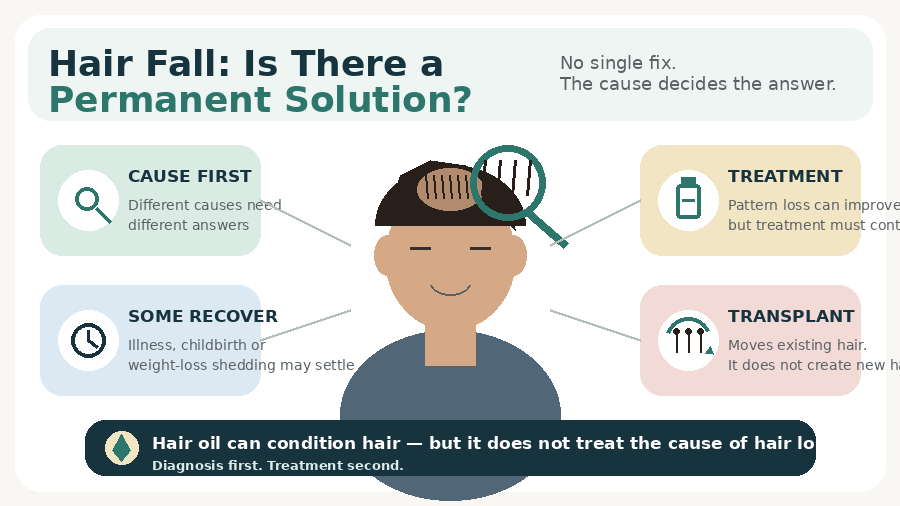
There is no single permanent solution for hair fall, because the right answer depends on the cause. Pattern hair loss can be slowed and partly reversed by treatment that has to continue to keep working, while a transplant moves existing hair rather than creating more. Hair oil alone does not stop hair fall.
That is the honest answer, and it is not the one most pages on this subject give.
The useful version of the question is not whether a permanent solution exists. It is what is causing your hair fall, because some causes resolve on their own and some need treatment that continues indefinitely.
Why is there no single permanent solution for hair fall?
Because hair fall is a symptom with several different causes, and they behave in opposite ways. Some recover completely without any treatment. One of the commonest does not have a cure at all.
The British Association of Dermatologists answers the cure question about pattern hair loss in four words: “No, there is no cure.”
The NHS draws the same division: “Some types of hair loss are permanent, like male and female pattern baldness”, while “Hair loss caused by a medical condition usually stops or grows back once you’ve recovered.”
So “permanent solution” is the wrong frame. The right questions are:
- Is this a type that recovers by itself? If so, the answer is time and patience, not products.
- Is this pattern hair loss? If so, there is no cure, but there is treatment that works while it is used.
- Is something else driving it that needs identifying and correcting?
How much daily shedding is actually normal, and at what point it stops being normal, is covered in our page on how much hair fall is normal. This page assumes you have already decided yours is more than it should be.
Does hair oil stop hair fall?
Not as a treatment for hair loss, no. Oil conditions the hair you already have, which is a real cosmetic effect, and that is a different claim from stopping hair falling out.
Here is how I can say that, stated plainly so you can judge the reasoning. There is no large trial that set out to prove hair oil fails, because nobody submits oil for that kind of evaluation. What there is instead is the absence of it from every authoritative treatment list.
The British Association of Dermatologists’ patient leaflet on male pattern hair loss sets out the treatments in detail and does not mention hair oil or oiling anywhere in it. The NHS page on hair loss lists the treatments that have evidence, and oil is not among them either.
That is an argument from what the sources do not contain rather than from a study showing oil does not work, and it is worth being clear about the difference. But when two major dermatology authorities describe the treatments for a condition and a product is absent from both, that absence is informative.
What oil does do, and why it feels like it is working:
- It conditions the hair shaft, making existing hair smoother and less prone to breakage during brushing and washing.
- Less breakage means less hair in your hand, which is not the same as less hair leaving the follicle.
- The massage involved is pleasant and people tend to be gentler with their hair while oiling.
None of that is nothing. If you like oiling your hair, there is no reason to stop. The problem is only when it is used instead of finding out what is causing the loss, because the conditions that need treatment continue progressing while you wait.
What are the common causes, and why does the cause decide the treatment?
Because the correct action ranges from doing nothing to starting treatment you will continue for years. Getting the cause wrong means either treating something that would have resolved, or ignoring something that will not.
| Cause | Typical pattern | Does it reverse on its own | What treatment targets it |
|---|---|---|---|
| Telogen effluvium | Diffuse shedding across the scalp, weeks to months after a trigger | Yes. BAD: usually gets completely better without any treatment | Normally none needed; address the trigger |
| Pattern hair loss | Gradual, in a recognisable distribution, progressive | No. BAD: there is no cure | Topical and oral treatment, continued indefinitely |
| Illness or medical condition | Varies with the condition | NHS: usually stops or grows back once you have recovered | Treating the underlying condition |
| Iron deficiency | Diffuse thinning | Once corrected, yes | Identifying and correcting the deficiency |
| After childbirth | Diffuse shedding, months afterwards | Yes, as a form of telogen effluvium | Normally none; reassurance and time |
| Marked weight loss or extreme dieting | Diffuse shedding after the event | Yes, once nutrition is restored | Addressing the cause, not the hair |
| Scalp conditions | Visible changes to the scalp itself | Depends on the condition | Diagnosis and treatment of the scalp |
Telogen effluvium deserves particular attention because it is the one most often treated unnecessarily. The BAD leaflet lists triggers including “childbirth, severe trauma or illness (especially if a high fever occurs), stressful or major life events, surgical procedures, marked weight loss and extreme dieting, severe skin problems affecting the scalp, starting new medications or stopping a hormone treatment”.
Its verdict is unambiguous: “There is normally no treatment required for telogen effluvium as the hair will naturally start to grow back.” If you had a major illness, a surgery, or a baby a few months ago, that is the first thing to consider, and it is the situation in which an expensive treatment package is least justified.
What does evidence based medical treatment actually do?
It slows the loss and can partly restore what has thinned, while it continues to be used. For pattern hair loss the two treatments with an established evidence base are topical minoxidil and oral finasteride.
What each does, described without going where a prescriber should:
- Topical minoxidil, applied to the scalp, which the BAD notes “needs to be used for at least 6 months before any benefit may be noted”.
- Oral finasteride, a prescription medicine, for which the BAD states “Continuous use for 3 to 6 months is required before a benefit is usually seen”.
This page does not give doses, strengths or frequencies, and it does not list side effects. That is deliberate. Whether either treatment is appropriate for you, at what strength, and what the safety considerations are in your particular case, is a decision for a clinician who has assessed you. Finasteride in particular has considerations that belong in a consultation where you can ask questions, not in an article.
What the NHS says about all of these treatments is worth holding onto: “No treatment is 100% effective.”
And its fuller description of the trade-offs, which is unusually blunt: “These treatments: do not work for everyone, only work for as long as they’re used, are not all available on the NHS, so can be expensive if you have to pay”.
Why does treatment have to continue to keep working?
Because these treatments suppress an ongoing process rather than correcting it. The underlying tendency does not go away, so when treatment stops, it resumes.
The BAD is explicit about this, and it applies across the board: “all of the topical and oral treatments only work for as long as the treatment is continued.”
On minoxidil specifically: “Any benefit is only maintained for as long as the treatment is used.” On finasteride: “Any beneficial effects on hair growth will be lost within 6 to 12 months of discontinuing treatment.”
Read that second sentence carefully, because it has a practical consequence people are rarely warned about. Stopping does not return you to where you started. It returns you to where you would have been had you never treated, which after a few years of progression is further along than where you began.
What that means for the decision:
- Starting treatment is a long term commitment, not a course you complete.
- Cost is ongoing, and worth calculating over years rather than months before you start.
- Stopping and restarting repeatedly is the least effective way to use these treatments.
- The decision to start is therefore worth taking slowly, with a clinician, rather than in response to an advertisement.
None of this means treatment is not worth having. It means the question is whether you want to be on it for years, which is a different question from whether it works.
What can a hair transplant do, and what can it not do?
It moves hair you already have to where you want it. The BAD describes the procedure as one “where hair follicles are taken from the back and sides of the scalp and transplanted onto the bald areas”.
The two things that follow from that, and which decide whether it is right for anyone:
- It redistributes rather than creates. Your total hair does not increase, so the result is limited by what you have available to move.
- It does not stop pattern hair loss continuing in the untreated areas, which is why medical treatment and transplantation are often discussed together rather than as alternatives.
The detail belongs elsewhere and we have written it elsewhere. What happens to hair in the months after a transplant, including the shedding phase that alarms people, is covered in hair fall after a hair transplant. What to sort out beforehand is in before a hair transplant. And synthetic hair implants, which are a different procedure entirely and carry risks worth understanding, are covered in artificial hair implant risks.
Which treatments are marketed far beyond their evidence?
Anything promising to stop hair fall permanently, regrow hair without continuing treatment, or work for every cause at once. The claim to test is whether the marketing distinguishes between causes at all.
What should make you cautious:
- “Permanent solution” or “cure”, when the BAD states plainly that for pattern hair loss “there is no cure”.
- A product sold for hair fall generally, without asking what is causing yours. The treatment depends entirely on the cause.
- Any claim of results without continuing use, against the BAD’s statement that treatments work only for as long as they are continued.
- Before and after photographs as the main evidence, which tell you nothing about how typical the result is.
- A package quoted before a diagnosis, which means the price was set before anyone knew what you had.
- Treatments offered for telogen effluvium, which normally requires no treatment because it recovers on its own.
That last one is worth naming clearly, because it is where money is most often wasted. If your shedding started a few months after childbirth, an illness, a surgery or significant weight loss, it will most likely settle without anything being bought, and any treatment started in that window will appear to have worked.
What should you have checked before starting any treatment?
A diagnosis, from someone who is not selling you the treatment. The NHS puts this in terms most hair clinics would never print.
Its advice, in full: “See a GP to get an idea about what’s causing your hair loss before thinking about going to a commercial hair clinic.”
That sentence is on this page because it is right, and because a clinic unwilling to publish it is telling you something.
What an assessment should cover:
- Which type of hair loss this is, stated as a diagnosis rather than as a description of what you already told them.
- Examination of the scalp itself, not just the hair.
- Whether anything reversible is contributing, including iron deficiency, thyroid problems, or a recent trigger for telogen effluvium.
- Blood tests where the picture warrants them, which a clinician decides.
- A clear statement of whether this type responds to treatment at all, before any product is discussed.
The NHS also says simply: “See a GP if: you’re worried about your hair loss”. Worry is a sufficient reason. You do not need to establish that it is severe enough first.
How soon can you judge whether something is working?
Not for months, and this is the single most common reason people abandon treatment that was about to work. The timeframes come from the treatments themselves.
The BAD’s figures: minoxidil “needs to be used for at least 6 months before any benefit may be noted”, and finasteride requires “Continuous use for 3 to 6 months” before a benefit is usually seen.
For hair recovering on its own, the timescale is similar. In telogen effluvium the BAD notes the shedding phase “lasts between 3 to 6 months”, and that afterwards “It may take many months for your hair to return to normal volume and thickness.”
What to expect, and when:
- Weeks one to six. Nothing visible. Judging anything here is meaningless, which is when most people conclude a treatment has failed.
- Three to six months. The earliest point at which any change might be apparent, and not reliably.
- Six to twelve months. Where a fair assessment becomes possible.
- Beyond that. Continuing for maintenance rather than for further gain.
Take a photograph in consistent light at the start. Memory is unreliable over a year, and the gradual nature of both loss and improvement makes it almost impossible to judge by looking in a mirror.
How is hair fall assessed at the clinic in Surat?
By establishing the type first, because that decides everything else, and by being willing to say that no treatment is needed. In our practice in Surat, a good number of consultations end without anything being prescribed.
The commonest version of that is someone who has been shedding for two or three months following an illness, a surgery, a delivery or a period of significant weight loss, who has been alarmed by the volume and has already bought two or three products. That pattern is usually telogen effluvium, and the honest answer is that it will most likely settle on its own.
Where the picture is pattern hair loss, the conversation is different and it is largely about commitment: treatment works while it continues, the benefit is lost after stopping, and it is worth deciding in advance whether that is something you want to be doing for years. People decide both ways and both are reasonable.
Where something reversible may be contributing, that gets looked for before anything is started, because treating hair while an underlying cause continues is the least efficient order to do things in. And in every case, the type is established before any product is discussed, not afterwards.
Next step
If you have been shedding for a few months after an illness, a delivery or significant weight loss, the likeliest answer is that it will settle on its own and you should not be buying anything yet. If the loss is gradual and following a pattern, that is worth assessing properly. Book a consultation with Dr. Ashutosh Shah in Surat, and expect a diagnosis before a recommendation.
This page is for education and is not a substitute for assessment. It does not give doses, strengths or side effect information for any medicine, because whether a treatment is appropriate for you is a decision for a prescriber who has examined you. Hair loss can be a sign of an underlying condition, so persistent or sudden loss should be assessed. Please consult Dr. Ashutosh A Shah or your own doctor about your situation.
Not a single one, because it depends on the cause. Some types recover completely on their own. For pattern hair loss the British Association of Dermatologists states plainly that there is no cure, though treatment can slow and partly reverse it while it continues.
Not as a treatment for hair loss. Oil conditions existing hair and reduces breakage, which is a real but different effect. The British Association of Dermatologists’ leaflet on pattern hair loss does not mention oil anywhere, and the NHS does not list it among treatments.
A transplant moves follicles from the back and sides to thinning areas, so it redistributes hair rather than creating more. It does not stop pattern hair loss continuing elsewhere on the scalp, which is why medical treatment is often discussed alongside it.
For pattern hair loss, effectively yes. The British Association of Dermatologists states that all topical and oral treatments only work for as long as treatment continues, and that finasteride’s benefits are lost within 6 to 12 months of stopping.
For pattern hair loss, topical minoxidil and oral finasteride have an established evidence base. Whether either suits you, and at what strength, is a decision for a clinician who has assessed you. The NHS notes that no treatment is 100% effective.
Some types, yes. Telogen effluvium usually gets completely better without any treatment, and hair loss from a medical condition usually stops or grows back once you have recovered. Pattern hair loss can be partly reversed by treatment, but only while that treatment continues.
NHS guidance is to see a GP if you are worried about your hair loss, and specifically to get an idea of what is causing it before going to a commercial hair clinic. Getting the diagnosis before buying a treatment is the order that saves money.

Category
Latest From Blog
Is There a Permanent Solution for Hair Fall? What Actually Works
How Much Hair Fall Is Normal, and Which Signs Mean It Is Not
NAD Drip Therapy: What The Evidence Supports And What It Does Not