




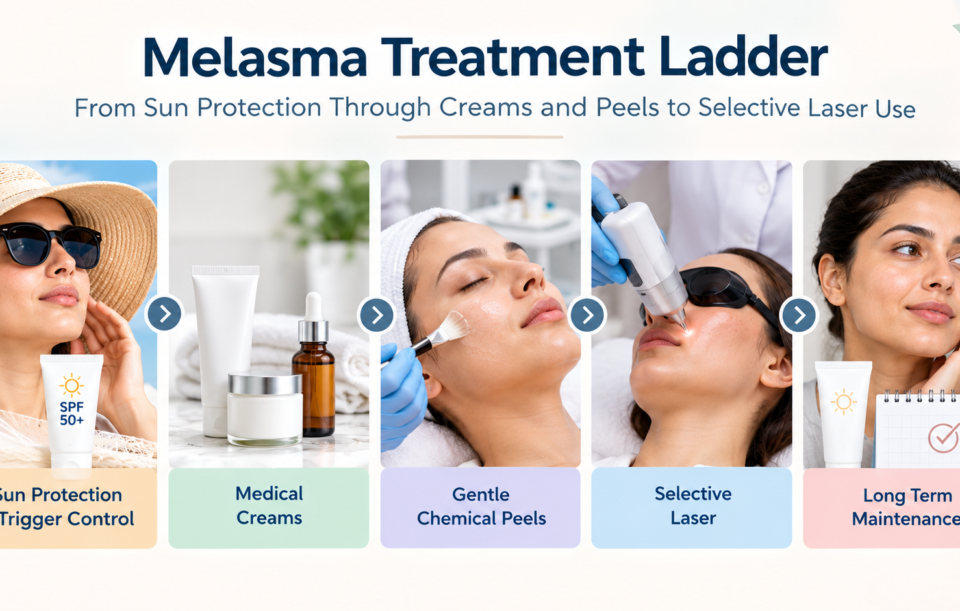
Melasma Is a Relapsing Condition, Not a One Time Stain
Melasma is a common pigmentation disorder that causes darker patches, usually on the face. It frequently affects the cheeks, forehead, upper lip, nose and jawline, often in a symmetrical pattern.
The biggest mistake is to think of melasma as a stain that can simply be removed once.
Melasma can improve significantly with treatment, but it can also return. Sun exposure is an important trigger, while hormonal factors, visible light, skin irritation and other individual triggers can contribute. Because the tendency to produce excess pigment can remain, treatment is better understood as control and maintenance rather than a guaranteed permanent cure.
That changes how treatment should be planned.
Instead of immediately asking, “Which laser will remove my melasma?”, the more useful questions are:
- Is this actually melasma?
- What is triggering it?
- How much sun and visible light exposure is occurring?
- Is the skin barrier irritated?
- Has medical topical treatment been tried correctly?
- Would a peel add value?
- Is a laser actually justified?
- What maintenance plan will prevent or reduce relapse?
The treatment sequence matters because aggressive treatment without controlling the underlying triggers can produce temporary improvement followed by recurrence.
Melasma vs Pigmentation: How Is Melasma Different From Tanning and Post Acne Pigmentation?
Brown pigmentation does not always mean melasma.
Melasma
Melasma commonly produces symmetrical brown or grey brown patches on areas such as the cheeks, forehead and upper lip. Hormonal influences and light exposure can contribute, and the pigmentation can become more noticeable after sun exposure.
Sun tanning
Tanning is a response to ultraviolet exposure and can affect larger exposed areas of skin. It does not necessarily have the characteristic distribution and pattern of melasma.
Post acne pigmentation
Post acne pigmentation is a form of post inflammatory pigmentation. It develops after acne or another inflammatory skin problem has damaged or irritated the skin.
This distinction matters because the treatment plan for post acne marks may not be the same as the plan for melasma.
There can also be overlap. A person can have melasma as well as post acne pigmentation or tanning at the same time.
What about hormonal pigmentation on cheeks?
Hormonal pigmentation on cheeks is a common way people describe the symmetrical cheek pigmentation associated with melasma. Hormonal influences can contribute to melasma, but the condition is usually multifactorial rather than caused by hormones alone. Pregnancy and hormonal medications can be associated with melasma, while sunlight remains an important trigger.
A proper assessment is therefore more useful than assuming every dark cheek patch is hormonal pigmentation.
Why Sun and Heat Control Come First
Photoprotection is the foundation of almost every melasma treatment plan.
Sunlight can stimulate pigment production and make existing melasma darker. The American Academy of Dermatology recommends daily broad spectrum sunscreen with SPF 30 or higher, along with shade and protective clothing. Tinted sunscreen containing iron oxide can provide additional protection against visible light, which can worsen melasma, particularly in darker skin tones.
For someone with melasma, sunscreen should not be viewed as something needed only during holidays.
Daily protection is important.
A practical protection plan can include:
- Broad spectrum SPF 30 or higher every day
- Tinted sunscreen containing iron oxide when appropriate
- Reapplication when outdoors for prolonged periods
- A wide brimmed hat
- Shade whenever practical
- Avoidance of tanning beds and unnecessary direct sunlight
- Gentle skin care that does not cause burning or irritation
Heat control can also be relevant for people who notice worsening with hot environments or repeated heat exposure. The evidence base for heat as a trigger is not as strong or universal as the evidence for ultraviolet and visible light, so heat avoidance should be individualized rather than treated as an absolute rule.
The key principle is simple:
Do not repeatedly expose pigment prone skin to the trigger while trying to treat the pigmentation.
Where Do Medical Creams Sit in Melasma Treatment?
After trigger control and photoprotection, medical topical treatment is commonly an important part of the plan.
Depending on the diagnosis, skin type, previous treatment and medical history, a dermatologist may consider ingredients such as hydroquinone, tretinoin, azelaic acid, kojic acid or other pigment regulating treatments.
International expert consensus published in 2025 identified supervised hydroquinone based triple combination treatment as a major treatment option, with alternatives such as azelaic acid and kojic acid also having roles. The same consensus emphasized daily photoprotection and placed procedural treatments after appropriate medical management.
Creams are not supposed to work by aggressively burning or peeling the skin.
Irritation can make pigmentation harder to control.
That is why a treatment plan needs to balance:
Pigment reduction + skin tolerance + trigger control + maintenance.
How Long Before Creams Show a Change?
Creams generally require consistent use over weeks to months rather than a few days.
The exact response depends on the depth and type of melasma, treatment used, adherence, sun exposure, hormonal influences and individual skin response.
If a cream causes significant burning, redness, peeling or worsening pigmentation, increasing the dose or frequency without medical advice is not necessarily the answer.
The treatment should be reviewed.
Where Do Gentle Chemical Peels Sit?
Chemical peels can be considered as an additional treatment in selected patients.
Superficial peels may help improve pigmentation and can sometimes be combined with topical treatment. They are generally not intended to replace daily photoprotection or long term maintenance.
The important word is gentle.
More aggressive treatment does not automatically mean better treatment.
Melasma prone skin can develop inflammation after excessive irritation, and inflammation can contribute to additional pigmentation. This is particularly important when treating darker skin types that may be more prone to post inflammatory pigmentation.
Recent international consensus supports chemical peels as an adjunctive option in appropriate patients, rather than positioning them as a universal first treatment.
Why Can Aggressive Laser Make Melasma Worse?
This is one of the most important parts of understanding the laser for melasma risk.
Laser devices can target pigment or alter the skin through controlled energy. However, the same energy can also cause inflammation.
In a patient who is prone to pigmentation, excessive inflammation can contribute to post inflammatory hyperpigmentation or aggravation of melasma.
This is why laser is not automatically the next step after seeing facial pigmentation.
An Indian expert consensus specifically concluded that laser should not be considered first line treatment for melasma. It may have a role as an adjunct in selected resistant cases after appropriate patient selection, counselling and, where appropriate, test treatment.
Reviews have also described recurrence and pigmentary complications after laser treatment. Low energy approaches may be preferred in selected cases because aggressive treatment can increase the risk of post inflammatory pigmentation and stimulation of melasma.
More recent evidence continues to show that laser results vary substantially according to the device, settings, patient characteristics and treatment protocol. A 2026 systematic review covering 52 studies and 1,058 participants found high heterogeneity and very low certainty for the overall evidence, while suggesting that some low fluence Q switched Nd:YAG approaches may have a role as adjunctive treatment.
So the correct message is not:
“All lasers are dangerous for melasma.”
It is:
“Laser should be selected carefully and should not automatically be treated as first line treatment for melasma.”
Melasma Treatment Options: Treatment Ladder
| Severity and trigger | First line step | Second line step | Maintenance step | Review interval |
|---|---|---|---|---|
| Mild melasma with clear sun trigger | Strict sun and visible light protection | Appropriate medical cream | Daily sunscreen and prescribed maintenance treatment | About 4 to 8 weeks |
| Mild to moderate melasma with recurrent pigmentation | Sun and heat trigger control | Medical topical treatment | Long term photoprotection and maintenance cream | About 4 to 8 weeks |
| Moderate melasma with incomplete response to creams | Continue strict photoprotection and topical treatment | Carefully selected gentle chemical peel | Topical maintenance and trigger control | About 4 to 6 weeks |
| Persistent melasma despite appropriate topical treatment | Continue photoprotection and medical treatment | Selected procedure such as a peel or other adjunctive treatment | Regular maintenance | Individualized |
| Resistant melasma after appropriate medical treatment | Continue trigger control | Carefully selected laser in suitable patients | Topical treatment and strict photoprotection | Close clinical review |
| Melasma that worsens after a procedure | Stop escalating treatment blindly | Reassess diagnosis, inflammation, treatment settings and triggers | Barrier support and controlled pigmentation treatment | Prompt review |
The review intervals are planning examples rather than universal rules. A dermatologist may shorten or extend them depending on the treatment, skin response and side effects.
How Is Relapse Managed Over Years Rather Than Weeks?
This is where melasma treatment differs from treating a temporary stain.
Suppose the pigmentation improves substantially after several months.
The next step should not automatically be stopping everything.
Melasma commonly requires maintenance.
A maintenance plan may involve:
- Continued daily photoprotection
- Tinted sunscreen when appropriate
- Trigger avoidance
- Intermittent prescribed topical treatment
- Gentle skin care
- Periodic clinical review
- Additional procedures only when clinically appropriate
The objective is to keep pigmentation controlled while avoiding unnecessary irritation.
Recent consensus recommendations emphasize that maintenance treatment and relapse prevention remain important because melasma is recurrent.
Why Does Melasma Return Every Summer?
Many people notice that their pigmentation becomes darker during summer.
There is a straightforward reason for this pattern.
Summer can mean increased ultraviolet exposure, more time outdoors and greater exposure to visible light. Some patients may also notice worsening when exposed to heat.
Even if treatment has previously produced excellent improvement, renewed exposure can stimulate pigment production again.
This is why the best results are not simply about what happens inside the clinic.
Daily behaviour outside the clinic matters too.
The American Academy of Dermatology specifically recommends daily sun protection, shade, protective clothing and tinted sunscreen containing iron oxide for people with melasma.
Can Melasma Be Treated Without Laser?
Yes.
Laser is not required for every patient.
In fact, current expert recommendations place photoprotection and medical topical treatment at the centre of management, with chemical peels and other procedures used selectively and lasers generally reserved for resistant cases.
This is important because many patients assume that a machine based procedure must be stronger than a cream.
For melasma, stronger does not automatically mean better.
The skin needs enough treatment to reduce pigmentation without creating unnecessary inflammation.
When Might Laser Be Considered?
A laser may be discussed when:
- The diagnosis is clear
- Photoprotection is consistent
- Appropriate topical treatment has been tried
- The pigmentation remains resistant
- The patient understands the possibility of recurrence
- The patient’s skin type and pigmentation pattern are suitable
- The clinician believes the potential benefit justifies the risk
Laser should generally be part of a broader treatment strategy rather than treated as a standalone permanent solution. Evidence reviews emphasize the importance of strict photoprotection and maintenance alongside procedural treatment.
For people researching different pigmentation treatments, the Daag dhabba door karva treatment guide can provide additional information.
If the pigmentation is actually related to tanning rather than melasma, see Laser treatment for stubborn tanning.
For patients being assessed for advanced device based treatment, Advanced laser skin treatment in Surat provides another relevant resource.
You can also explore Laser and skin treatments at Elegance Clinic for information about the wider range of skin and laser services.
Frequently Asked Questions
There is no guaranteed permanent cure for melasma. It can improve considerably, but it is a chronic and relapsing condition for many people. Long term photoprotection and maintenance are important even after the skin becomes clearer.
Laser can be considered in selected resistant cases, but it is not automatically appropriate for every patient. Incorrect patient selection or aggressive settings can increase the risk of inflammation, post inflammatory pigmentation and recurrence.
Increased ultraviolet and visible light exposure can stimulate pigmentation. Some people also notice worsening with heat. Consistent protection becomes especially important during periods of increased outdoor exposure.
Most medical creams require consistent treatment over weeks to months. The exact time varies according to the treatment, depth of pigmentation, adherence, trigger exposure and individual response.
Pregnancy related melasma may become lighter after pregnancy and hormonal changes settle, but it does not always disappear completely. Sun exposure can continue to maintain the pigmentation. Persistent melasma should be assessed before selecting treatment.
Sunscreen is essential, but established melasma may need additional treatment. Medical creams and, in selected cases, procedures can be used to control active pigmentation. Once improvement has been achieved, however, photoprotection is one of the most important parts of maintaining the result.
The Bottom Line
The most useful way to understand melasma treatment options is as a treatment ladder rather than a race toward the strongest procedure.
Sun and visible light protection come first.
Trigger and heat management come next.
Medical creams are commonly used for active pigmentation.
Gentle chemical peels can be considered in selected patients.
Laser is generally reserved for carefully selected resistant cases.
Maintenance continues after improvement.
Melasma is a relapsing condition, so the objective is not simply to remove pigment as quickly as possible. The objective is to control pigment production, reduce triggers, protect the skin and maintain improvement over time.
Aggressive laser treatment can sometimes create the opposite of the desired result by causing inflammation and additional pigmentation. Current evidence therefore supports a careful, individualized and multimodal approach rather than treating laser as a universal solution.


Category
Latest From Blog
Small Black Warts on Face and Neck: Removal and Recurrence
Can Facial Ageing Be Treated Without Surgery?
Red Veins On The Face: What Causes Them And Which Vascular Laser Fits