




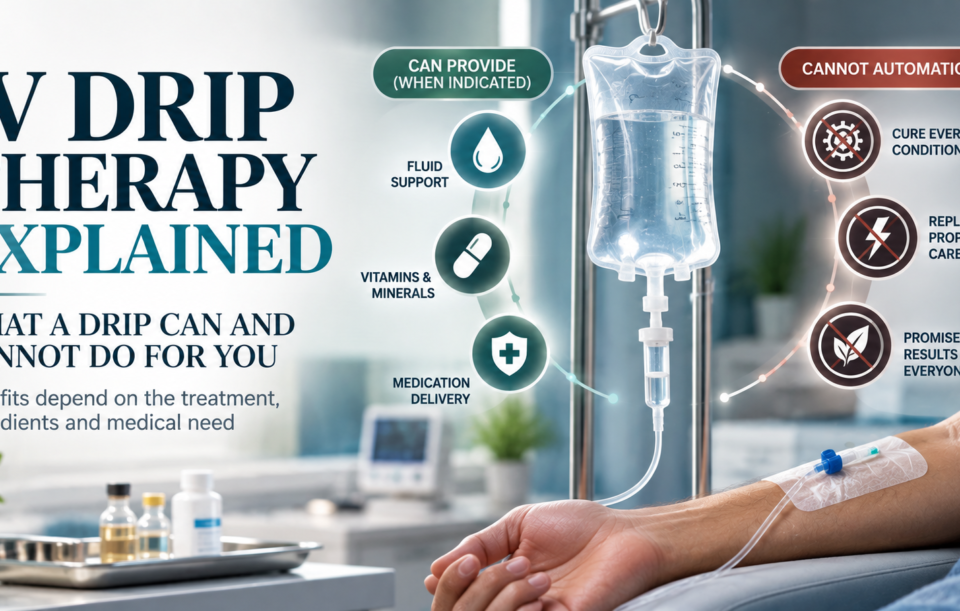
An intravenous drip delivers fluids, vitamins or minerals directly into the bloodstream, bypassing the digestive system. This can be useful when absorption is genuinely impaired or a documented deficiency requires appropriate correction. However, IV therapy is not a substitute for investigating unexplained tiredness, weakness or other symptoms before treatment begins.
At Elegance Clinic, Dr. Ashutosh Shah recommends assessing why IV therapy is being considered before planning treatment. Understanding the potential IV drip therapy benefits, limitations, medical history and relevant blood results helps determine whether an infusion is actually appropriate.
How is an intravenous drip different from taking the same nutrients orally?
The main difference between an IV drip and oral supplementation is the route by which nutrients enter the body.
With oral supplements, vitamins or minerals pass through the digestive system before they can be absorbed. Absorption can be influenced by the nutrient itself, gastrointestinal health, food, medications and other individual factors.
An IV infusion delivers its contents directly into the bloodstream, bypassing gastrointestinal absorption. This can be useful in selected circumstances where oral absorption is inadequate or oral treatment is unsuitable.
However, bypassing the gut does not automatically make IV treatment better. If a person can absorb and use a nutrient effectively through the oral route, an IV may offer no meaningful advantage.
Read more about intravenous therapy at Elegance Clinic.
Which situations genuinely justify a drip?
IV therapy has a clearer role when there is a genuine reason that fluid, medication or a particular nutrient needs to be delivered intravenously.
This can include clinically significant dehydration requiring IV fluid replacement, situations where oral intake is not possible or adequate, certain documented deficiencies where an appropriate IV formulation is medically indicated, or circumstances where gastrointestinal absorption is substantially impaired.
The reason for treatment matters more than simply wanting a quick wellness boost.
For vitamins and minerals, blood tests and clinical assessment can help establish whether a deficiency actually exists and whether IV replacement provides a meaningful advantage over oral treatment.
Oral Supplements vs IV Therapy
| Nutrient or Goal | Oral Route | IV Route | When IV Is Genuinely Preferred | What Evidence Supports It |
|---|---|---|---|---|
| Hydration | Usually adequate when a person can drink and retain fluids | Provides fluid directly into circulation | When clinically significant dehydration cannot be adequately managed orally | Established medical use for appropriate fluid replacement |
| Vitamin replacement | Often suitable for routine supplementation | Bypasses gastrointestinal absorption | When a documented deficiency requires IV treatment or absorption is significantly impaired | Depends on the specific vitamin, deficiency and clinical indication |
| Mineral replacement | Often suitable for mild deficiencies when absorption is adequate | Allows controlled intravenous replacement | Selected significant deficiencies or when oral therapy is unsuitable | Depends on the mineral and documented deficiency |
| Poor gastrointestinal absorption | May be less effective depending on the condition | Avoids the gastrointestinal route | When impaired absorption makes oral treatment inadequate | Depends on the underlying condition and nutrient |
| General wellness or tiredness | Nutritional correction may help only when an actual deficiency exists | Direct delivery does not identify the cause of symptoms | IV is not automatically preferred without an identified indication | The underlying cause should be investigated first |
The best route is therefore the one that appropriately addresses the diagnosed problem, not necessarily the route that delivers nutrients most directly.
What can a drip not fix, despite the marketing?
IV therapy cannot diagnose or correct every reason a person feels tired, stressed, weak or generally unwell.
Persistent fatigue may have many possible causes, including anaemia, thyroid problems, nutritional deficiencies, sleep problems, metabolic conditions, medication effects or other health issues.
Giving vitamins intravenously without identifying the cause can temporarily shift attention away from the underlying problem.
A drip also cannot replace balanced nutrition, adequate sleep, appropriate exercise or medical treatment for a diagnosed condition.
Claims that a standard IV formula can reliably provide detoxification, reverse ageing or permanently increase energy for everyone should therefore be approached cautiously.
Patients considering broader wellness care can also read about anti-ageing treatment in Surat.
What happens step by step during a session?
Before an IV session, the clinical team should first review the reason for treatment, relevant medical history, medicines, supplements, allergies and available laboratory results.
The planned formulation is then selected according to the treatment goal rather than using the same mixture for every patient.
An IV cannula is placed into a suitable vein and connected to the prescribed infusion. The drip is administered over an appropriate period while the patient is observed.
During the infusion, the IV site and the patient’s general condition should be monitored. Any unusual discomfort, swelling, dizziness or other symptoms should be reported immediately.
After the infusion is completed, the cannula is removed and the site is checked. Further sessions should be planned only when there is an appropriate reason to continue treatment.
Patients can meet the clinical team before deciding whether IV therapy is appropriate.
Which blood tests should be seen before the first drip?
There is no single blood-test panel required for every IV drip because testing depends on the formulation, treatment goal and individual medical history.
When IV therapy is being considered for tiredness or suspected nutritional deficiency, testing may help identify whether a correctable problem actually exists.
Depending on the symptoms and planned infusion, the clinician may consider relevant blood counts, vitamin or mineral levels, kidney function, liver function, electrolytes, glucose or thyroid-related testing.
The important principle is that iv vitamin therapy should not be used as a substitute for investigating unexplained symptoms.
If a particular deficiency is being treated, relevant laboratory results can also provide a baseline for deciding whether treatment is working and when supplementation should be reviewed.
Conclusion
The potential IV drip therapy benefits come mainly from delivering fluids or selected nutrients directly into the bloodstream when there is a genuine reason to bypass the gastrointestinal route. IV administration does not automatically make a treatment more effective than oral supplementation and cannot replace investigation of unexplained symptoms.
At Elegance Clinic, Dr. Ashutosh Shah can review the reason for treatment, relevant blood results and medical history before determining whether an IV drip or another approach is appropriate. Patients considering treatment can also book an IV therapy consultation.
Frequently Asked Questions
Not always. IV therapy bypasses the digestive system, but oral vitamins may be sufficient when absorption is normal. The better option depends on individual needs.
Session time varies depending on the IV formulation, volume and infusion rate. Your clinical team will determine the appropriate duration.
Not necessarily. Some people may notice improvement after hydration, while others may experience gradual or no immediate change depending on the underlying problem.
IV drips should not replace investigation of persistent tiredness. The underlying cause should be identified before deciding whether IV therapy is appropriate.
There is no fixed number. Sessions depend on the treatment goal, formulation, blood results and response, with reassessment before continuing a course.
Sometimes. Blood tests may help identify deficiencies or other causes of symptoms and determine whether IV therapy is appropriate.


Category
Latest From Blog
Small Black Warts on Face and Neck: Removal and Recurrence
Can Facial Ageing Be Treated Without Surgery?
Red Veins On The Face: What Causes Them And Which Vascular Laser Fits