




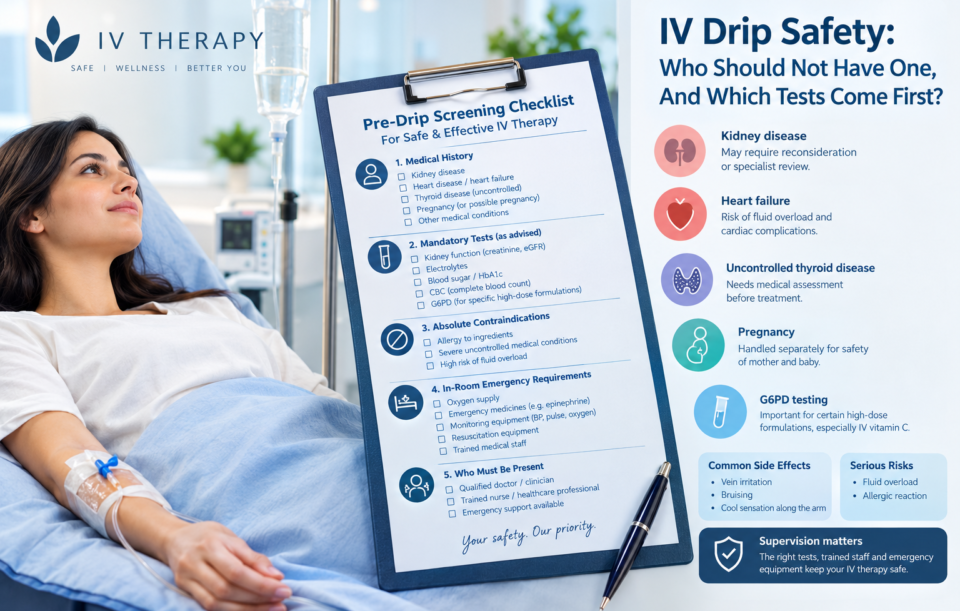
An IV drip may look simple because it involves a small cannula and a bag of fluid, vitamins, minerals or other ingredients. However, anything delivered directly into a vein reaches the bloodstream immediately. That makes appropriate screening, correct formulation, sterile technique and clinical supervision important.
IV therapy is not automatically suitable for everyone. A person’s kidney function, heart condition, thyroid status, pregnancy status, medicines, allergies and the exact contents and dose of the infusion all matter.
For example, people with kidney disease may have difficulty handling additional fluid or certain substances. People with heart failure can be vulnerable to fluid overload. Pregnancy requires separate medical consideration because safety depends on the ingredients and the reason for treatment. High dose intravenous vitamin C has additional safety concerns in people with kidney disease and G6PD deficiency.
The right approach is therefore not to ask whether every IV drip is safe or unsafe. The important question is whether a particular IV formulation is appropriate for a particular patient after medical screening.
Which medical conditions can make an IV drip unsafe?
There is no single list of conditions that makes every type of IV therapy contraindicated. The ingredients, dose, volume and reason for treatment change the risk.
However, several conditions deserve particular attention before an elective wellness or vitamin infusion.
Kidney disease
Kidneys help regulate fluid, electrolytes and many substances circulating in the body. People with chronic kidney disease may have reduced ability to handle excess fluid and may also be more vulnerable to electrolyte abnormalities.
IV fluids therefore need to be considered carefully in patients with impaired kidney function. Kidney disease is particularly important when an infusion contains substances that require renal clearance or when large fluid volumes are involved.
This means the answer to “Is IV drip safe for kidney patients?” is not automatically yes or no.
A patient with kidney disease should first have the formulation, dose, fluid volume, current kidney function, medicines and medical history reviewed by a qualified clinician.
High dose intravenous vitamin C requires additional caution because kidney complications, including oxalate related kidney injury, have been reported, particularly in patients with pre existing renal problems.
Heart failure or significant heart disease
The heart and kidneys work together to regulate fluid balance. A patient with heart failure may have limited ability to tolerate additional fluid.
Excessive IV fluid administration can contribute to fluid overload and pulmonary congestion, particularly in people with reduced cardiac reserve.
For this reason, an elective wellness infusion should be reconsidered in someone with heart failure or significant cardiovascular disease until the treating clinician has assessed whether the specific infusion is appropriate.
Uncontrolled thyroid disease
Not every thyroid disorder makes IV therapy unsafe.
However, uncontrolled thyroid disease should be medically reviewed before elective IV therapy, particularly when the patient has significant symptoms, abnormal heart rate or blood pressure, or is taking medicines that could interact with the proposed formulation.
The important distinction is between stable, treated thyroid disease and uncontrolled disease that has not been medically assessed.
Pregnancy
Pregnancy should be handled separately.
An IV formulation that may be acceptable for a non pregnant adult is not automatically appropriate during pregnancy. Safety depends on the individual ingredients, dose, indication and stage of pregnancy.
For elective wellness IV therapy, the safest approach is to disclose pregnancy or possible pregnancy before treatment and have the infusion reviewed by the appropriate clinician. Clinical sources also advise people who are pregnant to discuss IV vitamin therapy with their healthcare provider rather than treating it as routine wellness care.
Why does a G6PD test matter before certain high dose formulations?
G6PD, or glucose 6 phosphate dehydrogenase, is an enzyme that helps protect red blood cells from oxidative damage.
This becomes particularly important when certain high dose formulations are being considered, especially high dose intravenous vitamin C.
The National Cancer Institute notes that high dose IV vitamin C should be screened carefully in people with risk factors including G6PD deficiency, renal disease and kidney stones. Case reports have documented haemolysis after high dose vitamin C in people with previously unrecognized G6PD deficiency.
Therefore, a G6PD test should not be presented as a mandatory test for every possible IV drip.
Instead, it becomes particularly relevant when the proposed formulation and dose create a meaningful risk in people with G6PD deficiency.
This is an important distinction when discussing blood tests before IV drip.
Which blood tests may be needed before a first IV drip?
There is no universal blood test panel that applies to every IV therapy patient.
The tests should depend on the formulation, dose, medical history and reason for treatment.
A clinician may consider:
| Assessment or test | Why it may be needed | When it becomes particularly relevant |
|---|---|---|
| Kidney function, including creatinine and eGFR | Assesses renal function before substances or fluid loads that may stress or depend on the kidneys | Kidney disease, older age, previous abnormal renal tests, high dose formulations |
| Electrolytes | Checks sodium, potassium and other important electrolytes | Kidney disease, heart disease, medicines affecting electrolytes or repeated infusions |
| Blood glucose | Identifies abnormal glucose levels when relevant to the formulation or medical history | Diabetes, symptoms or specific treatment plans |
| CBC | Checks haemoglobin and blood cell counts when clinically indicated | Anaemia, chronic illness or specific medical history |
| G6PD | Identifies G6PD deficiency before formulations where oxidative haemolysis is a concern | Particularly important before certain high dose IV vitamin C protocols |
| Thyroid testing | Evaluates suspected or uncontrolled thyroid disease | Known thyroid disease or relevant symptoms |
| Liver function tests | Assesses liver status when clinically relevant | Known liver disease or formulations that warrant additional assessment |
| Pregnancy testing | Establishes pregnancy status when relevant | Patients who could be pregnant before elective treatment where ingredients have pregnancy related concerns |
These are not mandatory tests for every patient or every drip. The clinician should decide what is appropriate after reviewing the patient and the exact infusion.
What are the real side effects of an IV drip?
Many IV infusions cause no significant complication, but side effects can occur.
Common minor effects
Some patients may experience:
- Mild pain when the cannula is inserted
- Bruising around the injection site
- Vein irritation
- Mild redness
- A cool sensation travelling along the arm
- Temporary discomfort around the IV site
These effects are usually local and temporary, but they should still be reported if they become painful or progressively worse.
IV therapy also carries risks associated with inserting and maintaining an IV catheter. WHO guidance on peripheral IV catheters emphasizes appropriate insertion, maintenance and infection prevention practices.
More serious risks
More serious complications can include:
- Allergic reaction
- Severe infusion reaction
- Fluid overload
- Electrolyte disturbance
- Infection
- Medication or nutrient interaction
- Problems caused by an excessive dose
- Kidney complications with certain high dose formulations
IV vitamin therapy can also produce toxicity when excessive amounts of a substance are administered.
The risk therefore depends heavily on what is in the drip and how much is being given.
What must be present in the room during an infusion?
A safe infusion environment should have more than an IV bag and a chair.
The clinical team should have appropriate:
- Trained medical personnel
- Patient identification and treatment documentation
- Review of medical history and allergies
- Appropriate IV access equipment
- Hand hygiene and aseptic technique
- Blood pressure monitoring
- Pulse monitoring
- Oxygen saturation monitoring when clinically appropriate
- Access to oxygen
- Emergency medicines, including intramuscular epinephrine for anaphylaxis
- Equipment for airway and basic resuscitation support
- A clear emergency escalation or transfer plan
Anaphylaxis can progress rapidly, which is why clinicians providing treatments capable of causing allergic reactions need to be prepared to recognize and treat it. Current anaphylaxis guidance identifies intramuscular epinephrine as first line treatment and emphasizes appropriate monitoring and emergency support.
WHO emergency care standards similarly emphasize trained staff, oxygen, basic monitoring and resuscitation equipment where procedures can produce serious complications.
Who should be present during an IV infusion?
The patient should not be left without appropriate clinical supervision simply because the infusion appears routine.
The person responsible for the infusion should be appropriately trained to:
- Confirm the patient’s identity and treatment plan.
- Review allergies and relevant medical history.
- Confirm the prescribed formulation and dose.
- Establish and monitor the IV access.
- Observe the patient for an infusion reaction.
- Recognize symptoms of anaphylaxis or fluid overload.
- Stop the infusion when clinically indicated.
- Initiate appropriate emergency treatment.
- Escalate to emergency medical care when required.
The exact staffing model depends on the treatment and clinical setting, but the important principle is that a medical professional capable of responding to an adverse reaction should be available.
Why is pregnancy handled separately?
Pregnancy changes the risk assessment.
The question is not simply whether an IV fluid itself is safe. Each ingredient needs to be considered.
For example, a formulation containing vitamins or minerals may have a different safety profile from a formulation containing a medication or high dose antioxidant.
For elective wellness IV therapy, pregnancy or possible pregnancy should therefore be disclosed before treatment.
If IV treatment is medically necessary during pregnancy, the decision should be made by the clinician responsible for the pregnancy and the clinician prescribing the infusion.
Can people with kidney disease have IV therapy?
Sometimes, but it should not be treated as a routine wellness treatment without medical assessment.
Kidney disease can affect fluid handling and electrolyte balance. Some IV ingredients may also require renal clearance or have kidney related safety concerns.
High dose IV vitamin C deserves particular caution because kidney complications have been reported, and the National Cancer Institute specifically identifies renal disease as a risk factor requiring screening before high dose treatment.
Before treatment, the clinician may need recent creatinine, eGFR and electrolyte results, depending on the proposed formulation.
Can people with heart disease have an IV drip?
It depends on the heart condition and the proposed infusion.
Heart failure is particularly important because excessive IV fluid can worsen congestion and contribute to pulmonary oedema.
Someone with stable cardiovascular disease may have a different risk profile from someone with active heart failure, uncontrolled blood pressure or recent cardiac symptoms.
A medical review should therefore occur before elective IV therapy when significant heart disease is present.
Can IV drips be given at home safely?
Home IV therapy can be appropriate in selected medical situations when it is prescribed and delivered through an appropriate clinical service.
That is different from arranging an elective vitamin infusion at home without adequate medical assessment or emergency support.
The main safety question is what happens if the patient develops:
- Anaphylaxis
- Severe dizziness
- Low blood pressure
- Breathing difficulty
- Fluid overload
- An infusion reaction
- IV site complications
A setting without trained clinical supervision and appropriate emergency equipment can delay treatment when a serious reaction occurs.
What happens if I feel unwell during a session?
Tell the clinical team immediately.
Do not try to tolerate worsening symptoms simply because the infusion is almost finished.
Symptoms that require immediate attention include:
- Difficulty breathing
- Wheezing
- Throat tightness
- Facial or tongue swelling
- Widespread hives
- Severe dizziness
- Fainting
- Chest discomfort
- Sudden severe headache
- Confusion
- Severe nausea or vomiting
These may indicate an infusion reaction or another medical problem.
The infusion may need to be stopped while the clinical team assesses you. If anaphylaxis is suspected, epinephrine is the first line emergency treatment.
Pre drip screening checklist
| Safety check | What should be reviewed | When it may delay or prevent the drip |
|---|---|---|
| Medical history | Kidney, heart, thyroid, liver and other conditions | Significant uncontrolled disease or an unsafe formulation |
| Medicines | Prescription medicines, supplements and known interactions | Potential interaction or contraindication |
| Allergies | Previous drug, food or infusion reactions | Known allergy to an ingredient |
| Kidney function | Creatinine, eGFR and relevant electrolytes when indicated | Significant renal impairment or formulation specific risk |
| G6PD status | Consider before certain high dose IV vitamin C formulations | Known deficiency or insufficient safety assessment |
| Pregnancy | Current or possible pregnancy | Elective infusion not appropriate without pregnancy specific review |
| Blood pressure and vital signs | Baseline clinical status | Unstable vital signs or acute illness |
| Proposed formulation | Ingredients, concentration, dose and volume | Unclear formulation, excessive dose or unsuitable ingredients |
| Emergency equipment | Oxygen, emergency medicines, monitoring and resuscitation equipment | Infusion should not proceed in an inadequately equipped setting |
| Clinical supervision | Qualified healthcare professional available | No appropriate person available to monitor and manage complications |
IV drip safety starts before the cannula goes in
The safest IV therapy approach begins with the consultation, not the infusion.
A clinician should know why you want the drip, what ingredients will be administered, how much will be given, what medical conditions you have, what medicines you take and whether any screening tests are appropriate.
For some patients, the correct decision may be to proceed. For others, the formulation may need to be changed, the dose reduced, additional testing completed or treatment postponed.
Elegance Clinic presents its aesthetic services as patient specific and emphasizes safety and individualized planning.
You can explore All services at Elegance Clinic, learn more about Intravenous therapy at Elegance Clinic, or Meet the clinical team before deciding whether IV therapy is appropriate for you.
If you are considering treatment, you can also Book an IV therapy consultation to discuss your medical history, proposed formulation and any required screening.
Frequently Asked Questions
There is no universal blood test panel for every IV drip. Depending on the formulation and medical history, the clinician may consider kidney function, electrolytes, blood glucose, CBC, thyroid testing, liver function or G6PD testing. G6PD testing is particularly relevant before certain high dose IV vitamin C protocols.
Some may be able to receive a carefully selected infusion, but kidney disease requires medical review first. Fluid volume, kidney function, electrolytes and the ingredients of the proposed drip all matter.
Common minor effects include needle discomfort, bruising, local vein irritation, redness and a cool sensation along the arm. More serious complications include allergic reactions, fluid overload, infection and formulation specific toxicity.
G6PD deficiency can increase the risk of red blood cell destruction when certain oxidative stresses occur. High dose IV vitamin C has been associated with haemolysis in people with G6PD deficiency, which is why screening may be important for relevant high dose protocols.
Home IV treatment can be appropriate when it is medically prescribed and delivered by an appropriate clinical service. An unsupervised wellness infusion at home is a different situation because serious reactions can require immediate treatment.
Tell the clinical team immediately. The infusion may need to be stopped while your symptoms are assessed. Breathing difficulty, throat swelling, widespread hives, fainting, severe dizziness or other signs of anaphylaxis require urgent medical treatment.
Final Takeaway
IV drip safety depends on the patient, the formulation, the dose and the clinical setting.
Kidney disease, heart failure, uncontrolled thyroid disease and pregnancy should all trigger additional medical review before elective IV therapy. They should not simply be treated as routine situations where the same drip is given to everyone.
The most important screening questions involve your medical history, medicines, allergies, pregnancy status and the exact contents of the infusion.
For selected high dose formulations, especially high dose intravenous vitamin C, G6PD status and kidney function can be particularly important because G6PD deficiency and renal disease have been associated with serious complications.
During treatment, appropriate clinical supervision, vital sign monitoring and immediate access to emergency equipment are essential because even an apparently routine infusion can occasionally cause a serious reaction.
The goal of screening is not to give everyone more tests. It is to identify the tests and precautions that are actually relevant to the person and the infusion being considered.


Category
Latest From Blog
Small Black Warts on Face and Neck: Removal and Recurrence
Can Facial Ageing Be Treated Without Surgery?
Red Veins On The Face: What Causes Them And Which Vascular Laser Fits