




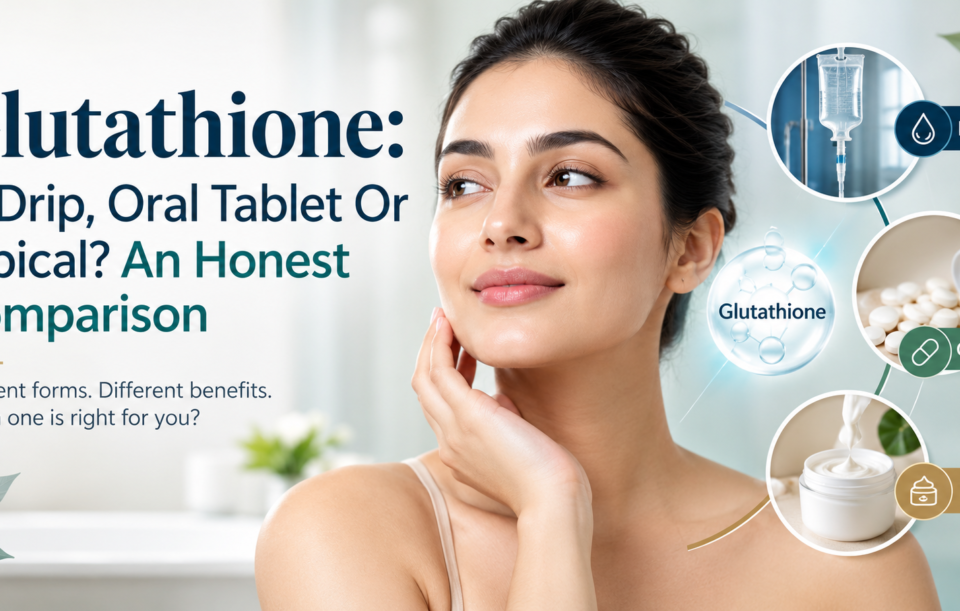
Glutathione is an antioxidant the body naturally makes. IV delivery reaches the bloodstream directly, while oral and topical routes have different absorption and evidence. Claims about skin lightening should be treated cautiously: any cosmetic change is variable, is not guaranteed to be permanent, and treatment should not be viewed as a cure for skin tone.
At Elegance Clinic, Dr. Ashutosh Shah recommends that glutathione treatment be considered only after understanding the intended goal, route of administration, available evidence, medical history and potential risks. The choice between glutathione injection vs oral or topical products should not be based on marketing claims alone.
What does glutathione actually do in the skin and the body?
Glutathione is an antioxidant produced naturally within the body. It participates in cellular antioxidant defence and helps protect cells against oxidative stress.
It is found throughout the body rather than being exclusively a skin-related substance. Its role in pigmentation has led to interest in glutathione products for cosmetic skin tone and glow.
However, the body’s natural biological role for glutathione should not be confused with proof that high-dose supplementation will reliably produce a particular cosmetic result.
Patients interested in skin-focused treatments can also explore the best treatment for smooth skin.
How do absorption and evidence differ between IV, oral and topical routes?
The three routes deliver glutathione differently.
Intravenous administration places glutathione directly into the bloodstream and therefore bypasses gastrointestinal absorption. Oral glutathione must pass through the digestive system, so its absorption and resulting biological effects differ from IV administration.
Topical glutathione is applied directly to the skin and is fundamentally different from a systemic infusion or oral supplement.
The fact that IV administration provides direct bloodstream delivery does not automatically mean it is the best option for cosmetic skin treatment. Effectiveness, safety, indication and quality of evidence all need to be considered.
Read more about intravenous therapy at Elegance Clinic.
Glutathione IV vs Oral vs Topical Comparison
| Route | Absorption | Strength of Evidence | Monitoring Needed | What Happens on Stopping |
|---|---|---|---|---|
| IV glutathione | Direct bloodstream delivery | Evidence for cosmetic skin lightening remains limited and should be interpreted cautiously | Medical assessment and monitoring are important | Any cosmetic effect should not be assumed to remain permanently |
| Oral glutathione | Absorption occurs through the gastrointestinal tract and can vary | Some studies have investigated oral use, but results are not sufficient to guarantee a specific cosmetic outcome | Depends on dose, duration, health and other supplements | Any benefit may diminish after discontinuation |
| Topical glutathione | Acts locally through application to the skin | Evidence varies by formulation and product | Usually less systemic monitoring, but skin reactions remain possible | Cosmetic effects generally require continued skin-care maintenance |
This comparison should not be interpreted as a recommendation for one route. The appropriate approach depends on the purpose of treatment and individual medical assessment.
What results are realistic, and what happens when sessions stop?
The question does glutathione lighten skin does not have a guaranteed yes-or-no answer for every person.
Some people pursue glutathione because they want brighter or more even-looking skin, but the degree of visible change can vary considerably. Results depend on factors including baseline pigmentation, route, formulation, treatment duration and individual biology.
A dramatic or permanent transformation in natural skin colour should not be promised.
If a cosmetic change occurs during a treatment course, it should not automatically be expected to remain indefinitely after treatment stops. Natural pigmentation processes continue, so maintenance may be required to sustain any treatment-related cosmetic effect.
Patients exploring other approaches can read about chehre ka glow treatment in Surat.
What are the documented safety concerns and monitoring requirements?
Glutathione side effects and risks depend partly on the route, formulation, dose and individual health status.
IV treatment deserves particular care because substances are administered directly into the bloodstream. The treatment should therefore be provided in an appropriate clinical environment after medical assessment.
Before treatment, the clinician should review medical conditions, medications, supplements, allergies and previous reactions. Depending on the planned formulation and the patient’s health, relevant blood investigations may also be considered.
During a course, unexpected symptoms or adverse reactions should be reported rather than simply continuing the next scheduled session.
Patients can meet the clinical team to understand how treatment suitability and monitoring are assessed.
Who should not have glutathione at all?
There is no single suitability rule that can safely be applied to everyone considering glutathione.
People with significant medical conditions, previous reactions to infusion ingredients, abnormal laboratory findings or other contraindications may not be suitable for a particular treatment formulation.
Pregnancy, breastfeeding, kidney or liver problems and concurrent medicines or supplements should be discussed with the treating clinician before treatment is considered.
The safest decision is based on an individual medical assessment rather than assuming that an antioxidant is automatically suitable because it occurs naturally in the body.
Conclusion
When comparing glutathione injection vs oral and topical products, direct bloodstream delivery should not be confused with guaranteed cosmetic superiority. Each route differs in delivery, evidence, monitoring and potential risks, while any skin-tone change can vary and should not be promised as permanent.
At Elegance Clinic, Dr. Ashutosh Shah can assess the treatment goal, medical history and suitability before recommending whether glutathione or another skin treatment should be considered.
Frequently Asked Questions
Permanent skin lightening should not be promised. If glutathione produces a visible cosmetic change, the result can vary between individuals and may diminish after treatment stops. Natural pigmentation continues, so glutathione should not be presented as a permanent cure or guaranteed method for changing natural skin colour.
There is no reliable timeline that applies to everyone. Any visible change depends on the treatment route, formulation, baseline skin tone, individual response and treatment duration. If improvement occurs, it may develop gradually rather than immediately, and a specific result by a fixed number of sessions cannot be guaranteed.
Any cosmetic effect should not be assumed to remain permanently after treatment is discontinued. Skin pigmentation is influenced by ongoing biological and environmental factors. If a treatment-related change has occurred, it may gradually reduce after stopping, which is why cosmetic treatment is better understood as maintenance rather than a cure.
Long-term IV glutathione should not automatically be considered risk-free. Safety depends on dose, formulation, treatment frequency, health status and the reason for therapy. Repeated IV treatment requires appropriate medical oversight, and continued sessions should be reconsidered if there is no clear indication or adverse effects develop.
Oral glutathione has been studied, but absorption and response can vary. Some research has reported biological or cosmetic effects, but this does not guarantee meaningful skin changes for every person. Oral treatment should therefore not be promoted as equivalent to IV administration or as a guaranteed skin-lightening method.
Monitoring depends on the route, dose, formulation, duration and individual health. Medical history, medicines and supplements should be reviewed before treatment. For IV courses, the clinician may recommend relevant blood tests and ongoing clinical assessment, particularly when repeated sessions or other infused ingredients are involved.


Category
Latest From Blog
Small Black Warts on Face and Neck: Removal and Recurrence
Can Facial Ageing Be Treated Without Surgery?
Red Veins On The Face: What Causes Them And Which Vascular Laser Fits