




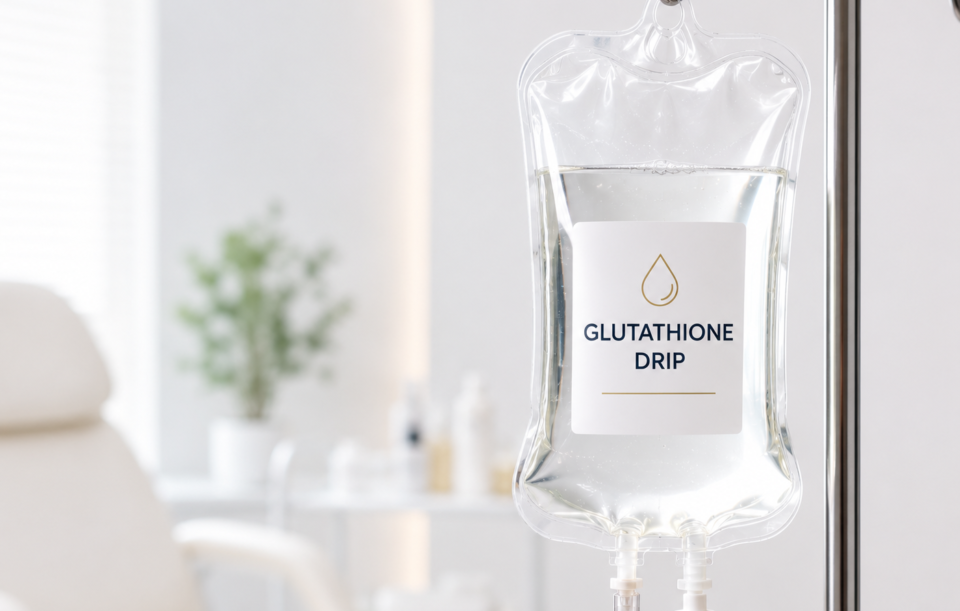
Glutathione Drip Therapy: What You Should Know
A glutathione drip therapy session delivers glutathione directly through an intravenous infusion. Glutathione is an antioxidant that the body naturally produces and uses in several biological processes.
It is also promoted in cosmetic settings, particularly for skin-tone changes. However, the evidence for intravenous glutathione as a cosmetic skin-lightening treatment remains limited. A 2025 systematic review found only limited evidence for IV glutathione and concluded that concerns about efficacy and adverse effects remain important.
Any cosmetic change should therefore not be presented as permanent. Available evidence suggests that effects are not reliably sustained after treatment is stopped.
A supervised clinical approach is important because an IV infusion is different from taking an oral supplement. It involves intravenous administration, product quality, monitoring during the infusion and assessment of whether treatment remains appropriate.
Intravenous Therapy at Elegance Clinic
What Does Glutathione Drip Therapy Actually Deliver?
Glutathione is a naturally occurring antioxidant. The body produces it and uses it in processes involved in protecting cells from oxidative stress.
When glutathione is administered intravenously, it enters the bloodstream directly. This does not automatically mean that a higher blood level will produce a predictable cosmetic result.
For skin-tone improvement specifically, the available research has important limitations. Studies have used different doses, treatment schedules and outcome measures, while follow-up has often been limited. A 2026 review also concluded that evidence for IV glutathione remains insufficient to support routine cosmetic skin-lightening use.
This is why a responsible consultation should focus on evidence, expectations and safety, rather than promising a particular change in skin colour.
What Does the Evidence Show?
The evidence for glutathione differs according to how it is administered.
Research on oral and topical glutathione has produced some findings suggesting possible effects on pigmentation, but these results are variable and not necessarily applicable to intravenous treatment.
For IV glutathione, the evidence is much less certain. Earlier reviews highlighted the lack of long-term safety data, while newer reviews continue to describe uncertainty around efficacy, dosing and long-term safety.
Therefore, glutathione drip therapy should not be described as a guaranteed skin-whitening treatment.
The more appropriate approach is to explain what is known, what remains uncertain and why medical supervision matters.
Why Monitoring Matters During an IV Course
An IV treatment should not be treated like an ordinary beauty appointment.
Before beginning a course, a clinician should review the person’s medical history, current medicines, allergies and other relevant health information. Where appropriate, baseline blood testing may also be requested.
During the infusion, the patient should be observed for any immediate reaction. The treatment record should document the infusion and relevant observations.
Review between sessions is also important. A clinician can determine whether treatment remains appropriate, whether any adverse effects have occurred and whether continuing the course is justified.
This supervised approach is different from an unsupervised or walk-in infusion service.
The importance of product quality has also been highlighted by recent safety reports. In August 2026, the U.S. FDA reported adverse events associated with IV glutathione products compounded using dietary-supplement-grade glutathione and warned that such ingredients are not appropriate for making injectable drugs.
What Baseline Tests Are Needed?
There is not one universal blood-test list that applies to every person receiving glutathione.
The appropriate assessment depends on the patient’s medical history and the clinician’s judgement.
A clinical consultation may include:
- Medical and medication history
- Allergy history
- Assessment of current health conditions
- Baseline blood testing when clinically indicated
- Review of previous reactions to medicines or infusions
- Assessment of whether IV treatment is appropriate
The important point is that baseline assessment should happen before starting a planned course, rather than treating the infusion as a routine procedure requiring no medical review.
Who Should Avoid Glutathione Infusions?
Glutathione infusions are not suitable for everyone.
Whether a person can safely receive an infusion should be decided after a clinical assessment. Relevant factors can include the person’s medical history, allergies, medicines and previous reactions to IV treatments.
A person should not start an IV glutathione course simply because it is advertised as a cosmetic treatment.
If there is uncertainty about whether treatment is appropriate, the correct step is a medical consultation before the first infusion.
The evidence also does not support presenting IV glutathione as a routine cosmetic treatment with established long-term safety.
What Side Effects Can Occur?
IV treatment carries risks that are different from oral treatment because the substance is administered directly into the bloodstream.
Reported concerns with IV glutathione include infusion reactions and other adverse effects. Published literature has raised concerns about hypersensitivity and other safety issues, while the FDA has recently reported adverse events linked to contaminated or inappropriate compounded glutathione products.
A patient should tell the clinical team immediately if they develop symptoms such as:
- Dizziness
- Difficulty breathing
- Chills or fever
- Unusual pain
- Feeling faint
- Any sudden or unexpected reaction
The infusion should be performed in an appropriate clinical setting where the patient can be assessed if a reaction occurs.
Glutathione Course Length: Is There One Standard Schedule?
There is no single universally established glutathione course length for cosmetic IV treatment.
A responsible treatment plan should be individualised rather than automatically promising a fixed number of sessions.
The course can be organised around several stages:
| Stage | Tests / assessment | What is monitored | Interval | What is documented |
|---|---|---|---|---|
| Baseline | Medical assessment and blood tests when indicated | Suitability for treatment | Before starting | History, assessment and baseline findings |
| Induction | As clinically required | Infusion tolerance and immediate reactions | According to clinical plan | Treatment and observations |
| Review | Repeat assessment when indicated | Response and adverse effects | Between sessions | Progress and safety review |
| Maintenance | Based on clinical assessment | Whether continued treatment remains appropriate | Individualised | Ongoing treatment record |
| Stopping | Review after stopping | Whether any effect is maintained | Follow-up as appropriate | Outcome and further plan |
The exact schedule should be determined by the treating clinician rather than copied from another person’s course.
What Happens When You Stop?
This is one of the most important points to understand before starting treatment.
A cosmetic effect from glutathione should not be presented as permanent.
Research has reported variable and often reversible effects, and the evidence does not establish a reliable long-term maintenance schedule for IV glutathione.
This means that stopping treatment may be followed by a loss of any cosmetic change that had occurred.
Patients should therefore ask:
- What result are we actually measuring?
- How long might the change last?
- What happens after the course ends?
- Is further treatment medically appropriate?
- Are there safer alternatives for the actual skin concern?
A good consultation should answer these questions before treatment begins.
Glutathione IV in Surat: What Should You Ask the Clinic?
If you are considering glutathione IV in Surat, do not choose a service only on the basis of the advertised number of sessions or a promised skin-tone result.
Ask whether:
- A clinician assesses you before treatment.
- Your medical history and medicines are reviewed.
- Baseline testing is required for your situation.
- The infusion is supervised.
- The product used for injection is appropriate for injectable use.
- Your response is reviewed between sessions.
- Adverse effects are documented.
- You are told clearly what is known and what remains uncertain.
- The expected effect is explained as potentially temporary.
- You have a clear plan for stopping treatment.
These questions help distinguish a clinically supervised course from a treatment marketed purely as a cosmetic drip.
Oral Glutathione: Is It an Alternative?
Oral glutathione is another form that has been studied for pigmentation. Some clinical studies have reported changes in melanin measurements, but results remain variable and do not establish that oral glutathione is an equivalent replacement for IV treatment.
The route of administration matters. Evidence from oral or topical glutathione should not simply be transferred to IV treatment.
If the goal is treatment of pigmentation, a dermatologist can assess the underlying cause and discuss options that are appropriate for that particular condition.
Best Treatment for Smooth Skin
Glutathione Drip Therapy: A Clinical Approach Rather Than a Quick Beauty Treatment
The main takeaway is simple: glutathione drip therapy should be approached as a medical IV treatment, not as a guaranteed skin-whitening procedure.
Glutathione is naturally produced by the body, but that does not establish that intravenous administration will produce a predictable cosmetic result.
The current evidence for IV glutathione and cosmetic skin lightening remains limited, while safety and product-quality concerns make appropriate clinical supervision important.
A sensible course should include appropriate assessment before treatment, monitoring during infusions, review between sessions and honest discussion about what may happen after treatment stops.
Most importantly, patients should not be promised permanent skin lightening. Any cosmetic effect should be considered potentially temporary, and treatment should only continue when the clinician considers it appropriate.
Frequently Asked Questions
How many glutathione sessions make a course?
There is no single evidence-based session number that applies to everyone. The schedule should be decided after clinical assessment.
Do the effects last after I stop?
Any cosmetic effect should not be assumed to be permanent. Published evidence describes effects as variable and potentially reversible.
What blood tests are needed first?
Baseline blood testing depends on the individual’s medical history and the clinician’s assessment. There is no universal test panel for every patient.
Are there side effects?
Yes. IV glutathione can cause adverse reactions, and product quality is an important safety consideration.
Can it be given at home?
An IV treatment should be administered under appropriate medical supervision rather than treated as an unsupervised home beauty service.
Is oral glutathione an alternative?
Oral glutathione has been studied separately, but evidence for oral treatment should not be assumed to prove that IV treatment is effective or equivalent.
About Dr. Ashutosh Shah and Elegance Clinic

Dr. Ashutosh Shah is a board certified plastic, reconstructive and cosmetic surgeon with more than 22 years of surgical experience. He is the founder and director of Elegance Clinic, with advanced centres in Adajan and Vesu, Surat. His team is known for safe, natural looking and personalised results using modern techniques and an ethical, patient first approach.


Category
Latest From Blog
Small Black Warts on Face and Neck: Removal and Recurrence
Can Facial Ageing Be Treated Without Surgery?
Red Veins On The Face: What Causes Them And Which Vascular Laser Fits