




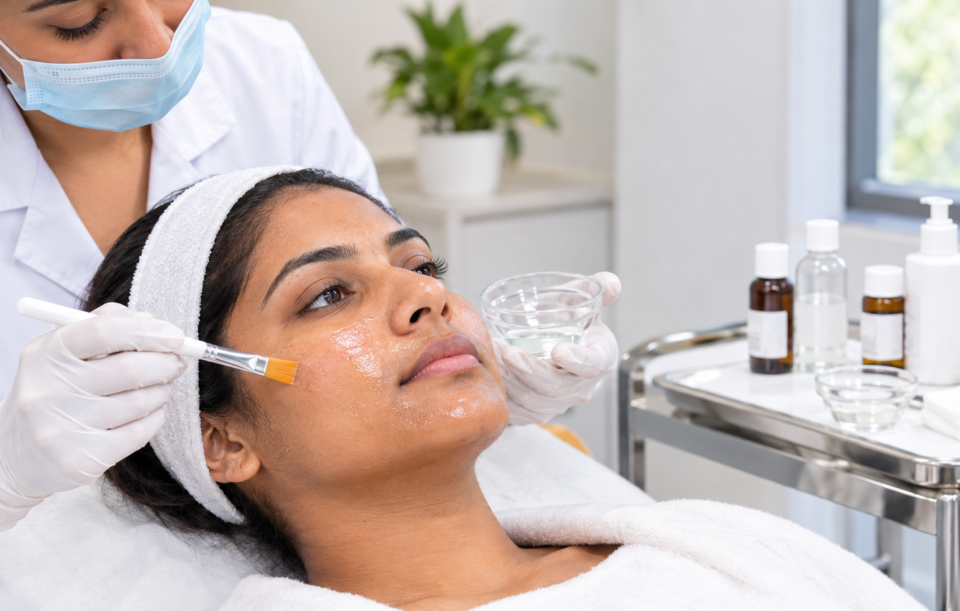
A tan can make the skin look darker, uneven, or dull, especially after repeated sun exposure. For some people, the colour gradually fades as the skin renews itself. For others, tanning can remain noticeable for weeks or longer.
A chemical peel can be used to improve superficial pigmentation and uneven skin tone by removing damaged outer layers of skin. But the right peel depends on the depth of pigmentation, the treatment area, your skin type, and your tendency to develop pigmentation after irritation.
This is particularly important for brown or melanin-rich skin. Superficial peels can be used safely in skin of colour when appropriately selected and performed, while stronger peels require more caution because irritation can sometimes trigger darker pigmentation.
What Is Tanning At The Skin Level?
Tanning happens when ultraviolet exposure stimulates melanocytes, the cells responsible for producing melanin. The increased melanin is the skin’s natural response to UV exposure.
The colour may gradually fade as pigmented skin cells are shed and replaced. However, repeated sun exposure can continue stimulating melanin production, making uneven pigmentation last longer.
This is why removing a tan is not only about exfoliating the surface. Continued sun exposure can work against the result.
Sun protection is therefore an important part of any de-tan plan.
Can A Chemical Peel Remove Tanning?
A superficial chemical peel can help improve the appearance of surface pigmentation and uneven skin tone.
The peel works by applying a controlled chemical solution to the skin. Depending on the formulation and strength, it causes controlled exfoliation of the outer skin layers.
For tanning, the aim is generally to improve the appearance of superficial pigmentation rather than aggressively remove several layers of skin.
Chemical peels have also been studied for pigmentary conditions in darker skin types. Recent reviews suggest that superficial peels such as glycolic and salicylic acid can have useful applications in skin of colour, although research remains limited and treatment protocols are not standardized.
Which Peel Is Suitable For Tan On Brown Skin?
There is no single chemical peel that is automatically best for every person with brown skin.
A dermatologist may consider superficial options such as glycolic acid, lactic acid, salicylic acid, or combination peels depending on the skin condition being treated.
The choice can depend on:
- Depth of the pigmentation
- Facial or body treatment area
- Skin sensitivity
- Previous reactions to peels
- History of post-inflammatory pigmentation
- Current skincare products
- Recent sun exposure
- Whether the pigmentation is actually tanning or another condition such as melasma
Superficial peels are generally preferred when the goal is mild exfoliation and pigment improvement. Stronger or deeper peels are not automatically better.
People with darker skin need particular care because inflammation from an aggressive treatment can itself lead to post-inflammatory hyperpigmentation.
Peel Selection For Tanning
| Tan depth and site | Possible peel approach | Typical course | Expected flaking | Approximate interval | Maintenance |
|---|---|---|---|---|---|
| Mild facial tan | Superficial peel | Around 3 to 6 sessions | Mild or minimal | Often 2 to 3 weeks | Sun protection and skincare |
| Moderate facial tan | Superficial or tailored combination peel | Around 3 to 6 sessions | Mild to moderate | Usually several weeks | Based on response |
| Tan on neck | Gentle superficial approach | Several sessions if needed | Mild | Determined by skin response | Regular sunscreen |
| Tan on arms or body | Superficial peel selected for the area | Multiple sessions may be required | Varies by peel | Determined by clinician | Sun protection |
| Persistent or uneven pigmentation | Diagnosis first | Depends on cause | Depends on treatment | Individualized | Long-term pigment control |
The session numbers are a general guide, not a fixed prescription. The American Academy of Dermatology notes that some people need about three to five mild peels to achieve the desired cosmetic result, while repeat treatment should be planned according to the type of peel and individual response.
How Many Peels Are Needed To Clear Tanning?
For a straightforward superficial tan, a course of around three to six sessions may be considered.
The sessions are commonly spaced apart rather than performed close together. Your dermatologist may allow approximately two to three weeks or longer between superficial treatments depending on the peel used and how your skin has recovered.
The exact number depends on how deep the pigmentation is and whether there is another pigment condition underneath the tan.
For example, someone with mild surface tanning may see improvement after a few sessions, while persistent uneven pigmentation may need a different treatment plan.
More treatment is not necessarily better. Increasing peel strength or shortening the interval can increase irritation and pigmentary risk.
What Does Downtime Look Like?
One reason superficial peels are commonly considered for tanning is that the recovery period can be relatively short.
After treatment, you may experience:
- Mild redness
- Tightness
- Dryness
- Mild burning or stinging
- Fine flaking
- Temporary sensitivity
Some superficial peels cause very little visible peeling. Others may produce more noticeable flaking for several days.
Do not judge the effectiveness of a peel by how dramatically the skin peels. Visible peeling is not the goal by itself.
Picking, scratching, or manually removing peeling skin can increase irritation and potentially contribute to pigmentation changes. The American Academy of Dermatology also warns that inadequate sun protection and poor aftercare can increase the risk of complications.
Will A Chemical Peel Lighten Your Natural Skin Colour?
A properly selected peel should not be viewed as a way to permanently change your natural skin colour.
The goal is to reduce excess pigmentation, surface dullness, or uneven tone so that the skin can appear more even.
If the skin has become darker because of sun exposure, reducing that excess pigmentation may make the skin look closer to its previous tone.
This is different from intentionally making naturally pigmented skin lighter.
A consultation is particularly important if the concern is not simple tanning but melasma, post-inflammatory pigmentation, or another pigment disorder.
Can Chemical Peels Be Done On Brown Skin?
Yes, chemical peels can be performed on skin of colour, but the peel needs to be selected and performed carefully.
A 2026 review found that superficial peels such as glycolic and salicylic acid show promise in skin of colour, while also noting that research is limited and that improper use can cause complications.
Brown skin can be more prone to post-inflammatory pigmentation. This means excessive irritation is something your dermatologist will want to avoid.
For this reason, a strong peel should not be chosen simply because the tan looks dark.
Why Deeper Peels Are Usually Not The First Choice For Tanning
A deeper peel reaches further into the skin and produces a more significant injury and recovery period.
For simple tanning, there is usually no reason to assume that a deeper peel will provide a better result.
In darker skin types, stronger procedures can carry greater risks of pigmentary and textural complications. A review of cosmetic procedures in dark skin recommends that superficial peels can be used safely when appropriate, while medium-depth treatments require considerable caution and deep peels should generally be avoided because of pigmentary and textural risks.
The appropriate peel strength should therefore be decided after examining the skin rather than choosing the strongest available option.
Does A Peel Help Tanning On The Arms And Neck?
It can, but treatment of body areas may require a different approach from facial skin.
The neck can be sensitive and may develop uneven pigmentation if it becomes irritated.
Arms and other exposed areas can also continue receiving UV exposure, which may make it harder to maintain improvement.
The dermatologist may therefore consider:
- The thickness and sensitivity of the skin
- The depth of tanning
- Existing pigmentation
- Previous treatment reactions
- Sun exposure
- The type and concentration of peel
Body tanning should not automatically be treated with the same peel protocol used on the face.
How To Hold The Result After A Peel
The most important part of maintaining a de-tan result is reducing continued UV exposure.
Daily broad-spectrum sunscreen should be part of the routine, especially on exposed areas. Physical sun protection such as hats, clothing, and shade can provide additional protection.
Your dermatologist may also recommend skincare ingredients depending on whether you have simple tanning or another pigmentation condition.
Chemical peels can improve pigmentation, but the underlying triggers can continue. Pigmentation treatments therefore often require ongoing maintenance rather than a one-time procedure. Photoprotection is particularly important in skin of colour.
Can You Have A Peel During Summer?
A peel may sometimes be performed during summer, but increased sun exposure makes planning and aftercare more important.
If you spend a lot of time outdoors, your dermatologist may recommend postponing treatment or adjusting the treatment plan.
The skin should be protected carefully from direct sunlight before and after treatment.
If the skin is already sunburned, irritated, or freshly tanned, a peel may not be appropriate at that time.
Do not schedule a peel simply because you want to remove a fresh tan immediately. The condition of the skin needs to be assessed first.
How Soon Can The Next Peel Be Done?
The next peel should be performed only after the skin has recovered from the previous treatment.
For many superficial peel protocols, treatments may be spaced approximately two to three weeks apart, but the correct interval depends on the peel, treatment area, skin response, and pigmentation risk.
If your skin is still red, irritated, unusually sensitive, or peeling significantly, another treatment may need to be delayed.
The aim is controlled treatment with enough recovery time, not the fastest possible schedule.
What If The Darkening Is Not Just A Tan?
Not every dark area is caused by tanning.
Pigmentation can also be related to:
- Melasma
- Post-inflammatory hyperpigmentation
- Acne marks
- Certain medications
- Hormonal changes
- Skin inflammation
- Other dermatological conditions
This matters because the treatment plan can be completely different.
For example, chemical peels can be used as an adjunct treatment for some pigmentary conditions, but they can also aggravate pigmentation if the skin becomes inflamed.
If the pigmentation is persistent, patchy, symmetrical, or repeatedly returns, getting the diagnosis first is more useful than simply increasing peel strength.
What To Expect From A De-Tan Peel Course
A realistic expectation is gradual improvement rather than an overnight colour change.
Before treatment
Your skin is assessed for pigmentation, sensitivity, active irritation, previous peel reactions, and sun exposure.
During the course
A superficial peel is applied according to the selected protocol. The number and strength of treatments can be adjusted according to your response.
After each session
You may experience temporary dryness, redness, tightness, or mild flaking.
Over several sessions
The overall skin tone may gradually look more even, with less visible surface pigmentation.
After the course
The focus changes to maintenance, skincare, and sun protection.
The result can fade if the skin continues to receive significant UV exposure.
The Bottom Line
Chemical peel for tanning can be useful when the pigmentation is superficial and the treatment is appropriately selected.
For many people, a course of three to six superficial peels, spaced roughly two to three weeks apart, may be considered. However, the number of sessions should be adjusted according to the skin’s response and the cause of the pigmentation.
For brown or melanin-rich skin, stronger treatment is not automatically better. Superficial approaches are generally more appropriate for simple tanning, while deeper peels carry greater pigmentary risks and are rarely necessary for straightforward de-tanning.
Most importantly, sunscreen is what helps protect the improvement after treatment. Without good UV protection, tanning and pigmentation can return.
If your skin has persistent or uneven darkening, the first step should be determining whether it is actually tanning or another pigmentation condition.
Frequently Asked Questions
A superficial de-tan course may involve around three to six sessions, depending on the depth of pigmentation and skin response.
No. The goal is to reduce excess pigmentation and improve uneven tone, not permanently change your natural skin colour.
Not always. Some superficial peels cause mild flaking, while others produce little visible peeling.
They may be possible in selected cases, but strong sun exposure can increase risk and make aftercare more difficult.
It can, but the treatment needs to be selected according to the skin and pigmentation of each area.
Many superficial protocols use intervals of about two to three weeks, but your skin should be fully recovered before another treatment.
Related Reading
You can also read our guide on Laser Treatment for a Tan That Will Not Fade for information about other approaches to persistent tanning.
For information about pigmentation and Daag Dhabba Treatment, see our guide on Daag Dhabba Door Karva Treatment.
If your goal is smoother and more even-looking skin, read our guide to Best Treatment for Smooth Skin.
You can also explore our Laser and Skin Treatments to understand the range of aesthetic skin treatments available.


Category
Latest From Blog
Small Black Warts on Face and Neck: Removal and Recurrence
Can Facial Ageing Be Treated Without Surgery?
Red Veins On The Face: What Causes Them And Which Vascular Laser Fits