



Written by Dr. Ashutosh A Shah, M.B.B.S., M.S., M.Ch., D.N.B., Board Certified Plastic and Cosmetic Surgeon, Elegance Cosmetic Clinic, Surat. Reg. no. [REG NO]. 22+ years in plastic, reconstructive and aesthetic practice.
Medically reviewed by Dr. Ashutosh A Shah · Published 29 September 2026 · Last reviewed 29 September 2026
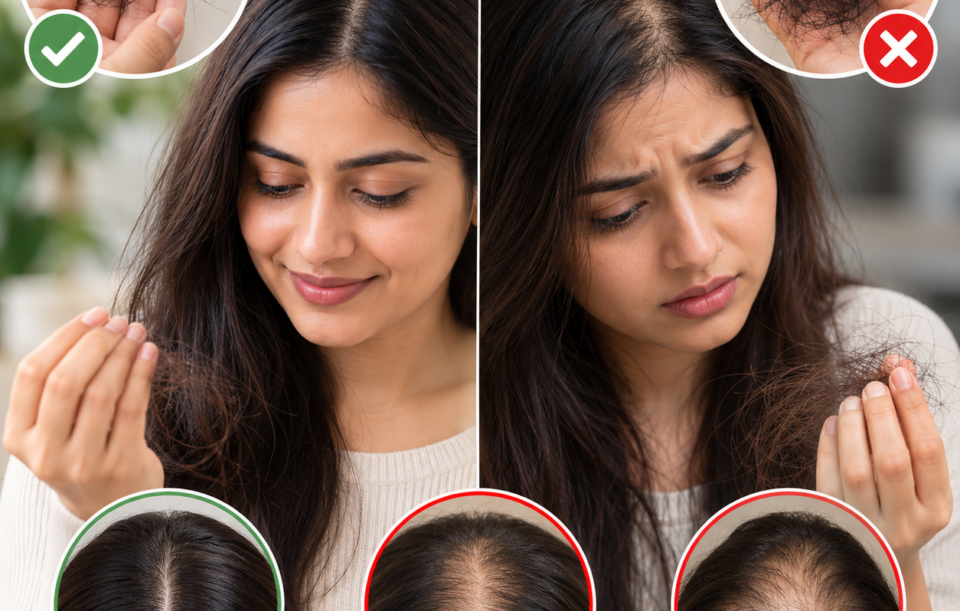
Some hair fall every day is normal, and the usual figure quoted is a range rather than a single number. It stops being normal when shedding is heavier than your own baseline, when density visibly reduces, or when the scalp becomes more visible. Those are assessment signs, not treatment signs.
Almost everyone who worries about this starts in the same place: the drain, the pillow, or the comb. What they are looking for is permission to stop worrying, or a reason to act.
This page gives you the means to tell which you need. It covers what is normal, what the commonly quoted number actually means, the signs that genuinely warrant attention, and what an assessment looks at. It does not recommend a treatment, and section nine explains why not.
Why is some hair fall normal every day?
Because hair grows in cycles rather than continuously, and at any moment a proportion of your hair is at the end of its cycle and due to be released.
Hair is not a single crop that grows and stays. Each follicle runs its own cycle independently: a long growing phase, a short transition, and a resting phase that ends when the hair is shed and a new one starts beneath it. Because the follicles are out of step with each other, the shedding is spread out, and you never notice all of it at once.
The NHS frames the whole subject in one sentence worth keeping in view while you read the rest of this page: “Losing your hair is not usually anything to be worried about, but it can be upsetting.”
Both halves of that matter. The upset is real even when the finding is normal, and being told it is normal does not always settle it. That is a reasonable thing to take to an appointment.
How much hair fall is normal, and what does that number not tell you?
The American Academy of Dermatology gives the figure most people have heard: “It’s normal to shed between 50 and 100 hairs a day.”
That is a real, sourced number and it is the honest answer to the question. It is also the least useful thing on this page, and it is worth understanding why before you go and count.
- Nobody counts accurately. Hair sheds into a pillow, a towel, a drain, clothing and a comb. What you see in any one of those is a fraction.
- It is a range, not a threshold. A range that wide is telling you the normal is broad, not giving you a line to cross.
- Frequency changes the picture. Somebody who washes their hair twice a week sees a bigger clump than somebody who washes daily, with identical shedding.
- Hair length changes the perception. Longer hairs look like more hair. The count has not changed.
So treat the figure as background rather than as a test. What actually tells you something is the next section, and it has nothing to do with counting.
What counts as a change, and why does your own baseline matter?
A change from your own normal is the only comparison that means anything. There is no population figure that tells you whether your hair is behaving differently from how it behaved.
The AAD makes the distinction that this whole page rests on. Excessive shedding is defined relative to the person: “When the body sheds significantly more hairs every day, a person has excessive hair shedding.” Note what that sentence is comparing against. Not a number, and not anybody else.
Useful ways to establish your own baseline, none of which involve counting:
- The same routine, compared over time. What the comb holds after the same wash routine, this month against a few months ago.
- The ponytail or the parting. Whether the band goes round an extra turn, or whether the parting reads wider than it did.
- Photographs in the same light. The same spot, the same lighting, months apart, taken for your own reference rather than to send anywhere.
- What other people notice. Uncomfortable, and often the earliest accurate signal.
If nothing has changed against your own baseline, the amount in the drain on any given day is not information.
What are the warning signs?
The signs worth acting on are about pattern, scalp and speed rather than quantity. Quantity is the thing people watch and the least informative of the three.
| What you notice | What it may point towards | How soon to act |
|---|---|---|
| The parting reads wider, or the scalp shows more in bright light | A reduction in density rather than increased shedding | Worth an assessment, not urgent |
| Heavier fall than your own usual, starting fairly suddenly | Shedding triggered by an event some months earlier | Worth an assessment, and worth dating the trigger |
| Loss in a defined patch, with skin that looks normal | A pattern that needs identifying rather than watching | See a doctor rather than wait |
| Redness, scaling, soreness or itch on the scalp | A scalp condition rather than a hair problem | See a doctor rather than wait |
| Hair coming away with pain, or with skin attached | Something other than ordinary shedding | Prompt assessment |
| Change alongside fatigue, weight change or a new illness | Hair as a symptom of something systemic | See a doctor, and mention both together |
Nothing in the middle column is a diagnosis. Each is a direction, and the point of the third column is that most of these are not emergencies. Two of them are worth not sitting on.
What is the difference between shedding and thinning?
Shedding is hair leaving. Thinning is hair not being replaced, or being replaced by something finer. They look similar in the mirror and they are different problems.
The AAD draws the line precisely: “Hair loss occurs when something stops the hair from growing.” Set that against its definition of shedding, where the body sheds significantly more hairs every day but the follicles carry on working.
What that means in practice:
- Shedding is usually about timing. More follicles than usual entered the resting phase together, so more hairs are released together. The clinical term for the commonest version of this is telogen effluvium.
- Thinning is usually about density. Fewer hairs occupying the same area, or hairs that come back finer each cycle.
- They feel opposite. Heavy shedding is alarming and often self-limiting. Thinning is quiet and progressive, and people notice it years in.
- The one that worries people less is usually the one that matters more.
This distinction is the single most useful thing to be able to describe at an appointment, and you do not need to name it correctly. Saying “it is coming out more” or “there is less of it” gets you to the same place.
What makes hair fall worse temporarily, and what does not?
A stress on the body months ago, rather than anything you did this week. The delay is the part almost nobody knows about, and it is why people look for the cause in the wrong month.
The AAD is specific about that lag: “Most people notice the excessive hair shedding a few months after the stressful event.” So by the time you notice, the cause is already in the past, which is why it so often seems to have no explanation.
The NHS lists what can bring on temporary hair loss: “an illness, stress, cancer treatment, weight loss, iron deficiency”. Add to that childbirth and surgery, both of which the AAD names as triggers.
Two further points that matter:
- If the trigger has passed, this type of shedding usually settles. The AAD describes hair tending to regain its normal fullness within six to nine months once the body readjusts. That is their observation about shedding after a trigger, not a promise about your hair.
- If the trigger has not passed, it does not settle. The AAD is direct: “If the stressor stays with you, however, hair shedding can be long lived.” Ongoing stress, an unresolved illness or a continuing deficiency keeps the mechanism running.
What does not cause it, despite what the internet says: washing your hair, washing it often, brushing it, tying it loosely, or the hair that comes out while you do any of those. Hair that was going to be shed is shed when it is disturbed, not because it was disturbed.
When is hair fall a symptom of something else?
More often than people expect, and that is the main argument for having it looked at rather than treated. Hair is sensitive to what is happening elsewhere in the body.
The NHS list in the previous section is the practical version of this: illness, stress, weight loss and iron deficiency all appear there, and none of them is a hair problem. It also notes the reassuring corollary: “Hair loss caused by a medical condition usually stops or grows back once you’ve recovered.”
Hormonal drivers belong in the same category. Where hair behaviour changes alongside cycle changes or unwanted hair growth elsewhere, the relevant assessment is of the hormonal picture rather than of the hair, which is set out on our post about PCOS and unwanted hair.
The practical consequence is simple. If hair fall has changed at the same time as anything else about how you feel, say both things in the same sentence at your appointment. The pairing is often the whole diagnosis.
What does an assessment look at before anything is recommended?
The scalp itself, the pattern of loss, what has changed and when, and what has been going on in your life over the preceding months. Not the amount in the drain.
The NHS describes the first step plainly: “The GP may be able to tell you what’s causing your hair loss by looking at your hair.” That is not a dismissal. A great deal is settled by an experienced look at the scalp, because pattern is visible in a way that quantity is not.
What is generally covered:
- The scalp. Whether the skin is normal, and whether the follicles are still there.
- The pattern. Diffuse, patchy, along the parting, at the temples, or general.
- The hair itself. Whether the hairs are the same calibre as each other, or whether some are finer.
- The timeline. When it changed, and what was happening roughly a few months before that.
- Family pattern. The NHS notes of one common type that “This type of hair loss usually runs in the family.”
- General health, including recent illness, weight change, diet and anything being taken.
- Blood tests where indicated, which are ordered because of what the history suggests rather than routinely.
Notice that none of those steps is a treatment, and that the assessment can end with no treatment at all.
Why is this page not recommending a treatment?
Because recommending one before anybody knows the cause is guessing with your money and your time. That is true whoever is doing the recommending, including us.
This is worth stating plainly because almost every other page you will find on this subject arrives at a product, a course or a procedure within a few paragraphs. The order is the wrong way round.
The reasoning, in four steps:
- Hair fall is a symptom, not a diagnosis. Several quite different things produce the same appearance in a mirror.
- The treatments for those things are different, and some of them are not hair treatments at all.
- Some causes resolve without treatment. Treating those is paying for something that was going to happen anyway, and then crediting the treatment.
- Some do not resolve, and starting the wrong thing delays finding out which you have.
The AAD’s closing advice on this is the right note to end on: “If you are concerned by the amount of hair falling out, you don’t need to suffer in silence.” Being seen is the step. What follows depends on what is found.
How are hair and scalp assessed at Elegance, Surat?
By looking at the scalp and the pattern before discussing anything that could be done about either.
In our practice in Surat, the most common thing we see is somebody who has already bought two or three things before anyone has looked at their scalp. They usually arrive expecting to be sold a fourth, and are surprised when the appointment is mostly questions about the last year of their life. The second most common is someone whose fall is genuinely within normal range and who needed that said clearly by a person rather than by a search result.
An assessment covers the scalp, the pattern, how the hair itself has changed, what was happening in the months before it started, family pattern, and whether anything in general health should be tested. Where the answer is that nothing needs doing, that is the answer you will get, and it is a complete one.
Where the finding points somewhere other than hair, you will be sent there rather than kept here.
Next step
If your hair has changed against its own usual and you want to know what is actually happening rather than what to buy, the useful step is having the scalp looked at. You can book a consultation to have the pattern assessed and be told plainly whether anything needs doing.
This page is for education and is not a substitute for professional assessment. Patchy loss, a sore or scaly scalp, or hair fall alongside any other change in health should be examined by a doctor. Discuss your own situation with Dr. Ashutosh A Shah or another qualified clinician.
The American Academy of Dermatology states that it is normal to shed between 50 and 100 hairs a day. That figure is a range rather than a threshold, and nobody counts accurately, because hair sheds into pillows, towels and drains. A change from your own usual is far more informative than any number.
Compare it with your own baseline rather than with a figure. The AAD defines excessive shedding as the body shedding significantly more hairs every day than it used to. A wider parting, more visible scalp, a thinner ponytail or a sudden increase are the signs worth acting on.
Shedding is hair leaving. Thinning is hair not being replaced, or replaced by something finer. The AAD notes that hair loss occurs when something stops the hair from growing, whereas in shedding the follicles keep working. Heavy shedding often settles. Quiet thinning usually matters more.
Yes, and often. The NHS lists illness, stress, cancer treatment, weight loss and iron deficiency among causes of temporary hair loss. It also notes that hair loss caused by a medical condition usually stops or grows back once you have recovered. Mention any other change at the same appointment.
No, not by itself. The NHS notes that losing your hair is not usually anything to be worried about. Heavy shedding after a trigger is usually temporary. What predicts a lasting change is a reduction in density over time, which is a different pattern and needs looking at.
When it has changed against your own usual, when the scalp is visibly showing more, when loss is patchy, or when the scalp is sore, red or scaly. The AAD puts it simply: if you are concerned by the amount of hair falling out, you do not need to suffer in silence.
Probably not yet, and nobody can answer that before your scalp has been examined. What comes first is finding out whether this is shedding or thinning, whether anything systemic is driving it, and whether the pattern is stable. A transplant answers only one specific kind of finding.

Category
Latest From Blog
Is There a Permanent Solution for Hair Fall? What Actually Works
How Much Hair Fall Is Normal, and Which Signs Mean It Is Not
NAD Drip Therapy: What The Evidence Supports And What It Does Not