




Surgical Insights By: Dr. Ashutosh Shah, M.Ch., DNB (Plastic Surgery)
Plastic, Reconstructive & Cosmetic Surgeon
Founder & Director, Elegance Clinic | 22+ Years of Experience
Article Updated: August 2026
A mouth corner lift can help elevate naturally downturned corners of the mouth and create a more balanced or pleasant resting expression. However, like any cosmetic surgery, it has potential risks.
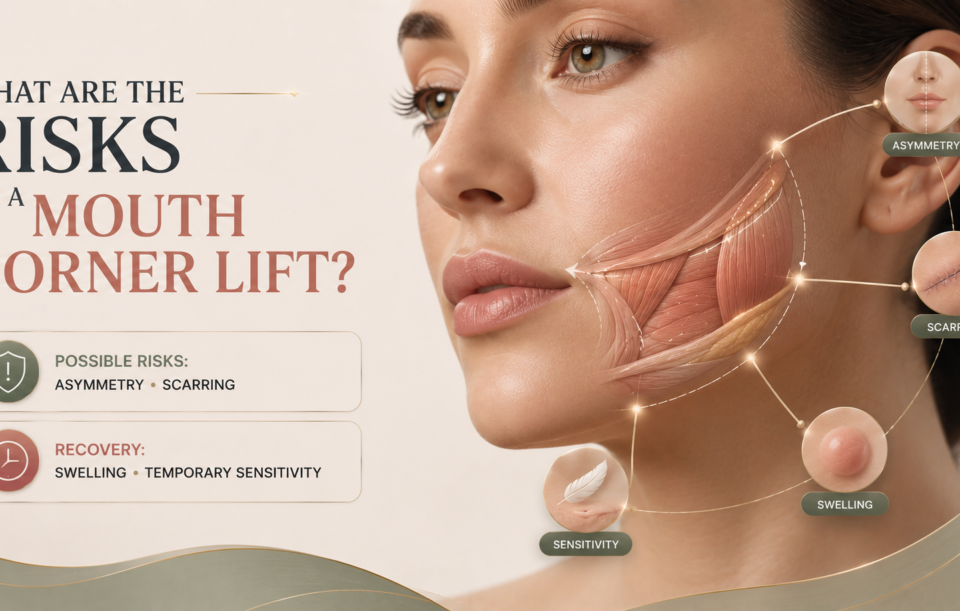
The main risks of a mouth corner lift include swelling, bruising, visible scarring, asymmetry, infection, overcorrection, undercorrection, altered sensation and an unnatural-looking smile. Many early changes improve during healing, but some complications or unsatisfactory results may require further treatment.
Understanding what is normal during recovery and what may represent a genuine complication is important before deciding on surgery.
Key Takeaways
- Temporary swelling and bruising are expected after surgery.
- Early asymmetry does not always mean the procedure has gone wrong.
- Scarring is an important consideration because incisions are made near the mouth.
- Too much elevation can create an unnatural expression.
- The two mouth corners may heal differently.
- Infection and wound-healing problems are possible.
- Final results should not be judged during early swelling.
- Some unsatisfactory outcomes can be revised, but revision depends on the cause.
- Surgeon experience, planning and realistic expectations are important for reducing avoidable risks.
What Is a Mouth Corner Lift?
A mouth corner lift is a cosmetic surgical procedure designed to elevate downturned outer corners of the mouth by removing and repositioning a carefully planned amount of tissue near the oral commissures.
The oral commissure is the point where the upper and lower lips meet at each side of the mouth.
A downward orientation can occur naturally or become more noticeable with ageing and changes in surrounding facial tissues.
Elegance Clinic offers mouth corner lift surgery for appropriately selected patients who want to address downturned mouth corners.
Why Do People Have a Mouth Corner Lift?
Some people naturally have downward-facing mouth corners even when their face is relaxed.
Others notice the change with ageing.
Factors influencing the appearance may include:
- natural lip anatomy,
- skin laxity,
- facial volume changes,
- muscle activity,
- previous procedures,
- and changes in surrounding facial tissues.
A mouth corner lift primarily addresses the position of the corners. It cannot correct every cause of an unhappy or aged facial appearance.
What Are the Risks of a Mouth Corner Lift?
Possible mouth corner lift risks include scarring, asymmetry, infection, bleeding, wound-healing problems, altered sensation, overcorrection, undercorrection and an unnatural appearance.
Some effects are temporary parts of recovery, while others can persist.
Understanding the difference helps patients avoid judging their surgical result too early.
Swelling and Bruising
Swelling and bruising around the lips and mouth are common after surgery.
One side may initially swell more than the other.
This can temporarily make the mouth appear uneven even when the underlying surgical correction is balanced.
Visible Scarring
Every surgical incision creates a scar.
Because mouth corner lift incisions are positioned close to a highly visible part of the face, scar placement and healing are important considerations.
Scars generally mature over time, but some people may develop more noticeable, raised, widened or differently pigmented scars.
No surgeon can promise an invisible scar.
Asymmetry
Perfect facial symmetry does not exist naturally.
Pre-existing differences between the two sides can remain after surgery, and differences in swelling or healing can temporarily exaggerate them.
Persistent asymmetry may occasionally require further assessment or treatment.
Infection
As with other surgical procedures, infection is possible.
Increasing redness, warmth, swelling, worsening pain, discharge, fever or an unpleasant smell should be reported to the treating surgeon.
Bleeding or Hematoma
Minor bleeding can occur after surgery.
More significant bleeding or a collection of blood beneath the tissues is less common but may require medical attention.
Altered Sensation
Temporary numbness, tingling or unusual sensation can occur around an incision.
Sensation often improves as tissues heal, but persistent sensory changes are possible.
Wound-Healing Problems
The mouth is a mobile area.
Speaking, eating and facial expressions continually move the surrounding tissues. This can place tension on healing incisions.
Delayed healing or wound separation can occur, particularly when additional risk factors are present.
Can a Mouth Corner Lift Make the Smile Look Unnatural?
Yes. Excessive elevation or an unsuitable surgical design can potentially make the mouth corners appear overly raised, sharp or unnatural, particularly when the face is at rest or during expression.
The objective should not be to create a permanently smiling face.
A natural result should remain compatible with the patient’s facial proportions and expressions.
This is why conservative planning matters.
Why Can the Mouth Look Uneven After Surgery?
Unevenness immediately after surgery is not necessarily a complication.
The two sides of the face may develop different amounts of:
- swelling,
- bruising,
- tissue stiffness,
- scar formation,
- and healing.
Pre-existing asymmetry can also become more noticeable when a patient starts closely examining the mouth after surgery.
Persistent asymmetry after adequate healing is different and should be evaluated by the surgeon.
Can a Mouth Corner Lift Be Overcorrected?
Yes.
Overcorrection means the mouth corner has been elevated more than intended.
This may produce a pulled, exaggerated or unnatural appearance.
Overcorrection can be more difficult to manage than temporary postoperative swelling, which is another reason surgeons should avoid unnecessarily aggressive tissue removal.
What Is Undercorrection?
Undercorrection means the mouth corners remain more downturned than the patient expected.
This can occur because of conservative correction, tissue characteristics, healing or differences between the desired and realistically achievable result.
More surgery should not automatically be performed immediately.
The tissues need adequate time to heal before deciding whether revision is appropriate.
Is Scarring a Major Risk?
Scarring deserves particular consideration in mouth corner surgery because the procedure involves incisions on the face.
Scar visibility depends on several factors, including:
- incision placement,
- skin characteristics,
- wound tension,
- individual healing,
- infection,
- sun exposure,
- and postoperative care.
Scars typically change as they mature.
A scar that looks red or noticeable early in recovery may become less prominent with time.
How Long Should You Wait Before Judging the Result?
A mouth corner lift should not be judged solely by its appearance during the first days or weeks after surgery.
Early swelling, stiffness and scar changes can distort the appearance.
Healing continues progressively, and scars themselves undergo maturation.
Your surgeon should provide a realistic timeline based on the exact technique used and your healing progress.
How Do You Know If a Mouth Corner Lift Has Gone Wrong?
A result should not be labelled unsuccessful simply because the area looks swollen or asymmetric soon after surgery.
More concerning findings can include:
- worsening rather than improving pain,
- increasing redness or warmth,
- pus or abnormal discharge,
- wound separation,
- significant bleeding,
- severe persistent asymmetry,
- obvious persistent overcorrection,
- or an unusual functional problem.
Contact the operating surgeon if you are concerned rather than waiting for a routine follow-up.
Can a Bad Mouth Corner Lift Be Corrected?
Some unsatisfactory mouth corner lift results can be improved, but the appropriate correction depends on whether the problem involves scarring, asymmetry, overcorrection, undercorrection or another anatomical issue.
Revision may not always mean another full operation.
Depending on the problem, management could involve observation during healing, scar management or a later surgical revision.
Revision surgery itself carries additional risks and should therefore be considered carefully.
Is a Mouth Corner Lift the Same as a Lip Lift?
No.
Both involve the lips, but they address different anatomical concerns.
A conventional upper lip lift generally reduces the distance between the nose and upper lip to alter upper-lip show and proportion.
A mouth corner lift specifically targets downturned outer corners.
Elegance Clinic provides different lip enhancement and lip surgery options according to the patient’s anatomy and concern.
Choosing the correct procedure is important because a patient asking for a “lip lift” may actually be concerned about a different part of the lips.
Can Botox or Fillers Replace Mouth Corner Lift Surgery?
Not in every case.
Selected nonsurgical treatments can alter particular aspects of lip shape, surrounding volume or muscle activity, but they do not reproduce the same anatomical change as surgery.
Elegance Clinic also provides Botox and filler treatments for appropriately selected facial concerns.
The correct option depends on whether the downturned appearance comes primarily from anatomy, ageing, volume changes, muscle activity or a combination.
Who May Have a Higher Risk of Healing Problems?
Individual risk varies.
Factors that may influence surgical healing include smoking, certain medical conditions, medications, previous surgery or scarring, active infection and individual scar tendency.
Medical history should therefore be discussed openly before surgery.
How Can Mouth Corner Lift Risks Be Reduced?
Complications cannot be eliminated completely, but careful planning can reduce avoidable risks.
Important steps include choosing an appropriately qualified surgeon, assessing baseline facial asymmetry, planning conservative elevation, understanding scar placement, reviewing medical history and following postoperative instructions.
Patients should also have realistic expectations.
The aim is usually a subtle improvement in mouth-corner position, not a permanently exaggerated smile.
When Should You Contact Your Surgeon?
Contact the treating surgeon if you develop unexpected or worsening symptoms, particularly:
- increasing pain,
- rapidly increasing swelling,
- significant bleeding,
- fever,
- spreading redness,
- discharge,
- wound opening,
- or another sudden change that concerns you.
Prompt assessment can help distinguish a normal recovery issue from a complication requiring treatment.
Making a Safe Decision About Mouth Corner Lift Surgery
Mouth corner lift surgery can create a subtle change in the resting position of downturned mouth corners, but the procedure should not be considered risk-free.
Scarring, asymmetry and overcorrection are especially important to discuss because the treatment area is central to facial appearance and expression.
Dr. Ashutosh Shah holds M.Ch. and DNB qualifications in Plastic Surgery and has more than 22 years of surgical experience. Patients considering facial cosmetic surgery can learn more about Dr. Ashutosh Shah and the treatment philosophy at Elegance Clinic before making a decision.
If your mouth corners naturally turn downward, or you are concerned about the result of a previous procedure, speak with Elegance Clinic about your anatomy, expected outcome and available treatment options.
Frequently Asked Questions
It has potential risks, including scarring, asymmetry, infection and unwanted changes in appearance.
Temporary unevenness can occur from swelling. Persistent asymmetry may require assessment.
Scars are unavoidable, although careful placement and normal scar maturation may make them less noticeable.
Sometimes, but correction depends on the cause and should usually be considered after adequate healing.
Surgery creates a structural change, but ageing and ongoing changes in facial tissues can influence the appearance over time.


Category
Latest From Blog
What Is Laser Bleach? What It Can and Cannot Change
Small Black Warts on Face and Neck: Removal and Recurrence
Can Facial Ageing Be Treated Without Surgery?