




Written by Dr. Ashutosh A Shah, M.B.B.S., M.S., M.Ch., D.N.B., Board Certified Plastic and Cosmetic Surgeon, Elegance Cosmetic Clinic, Surat. Reg. no. [REG NO]. 22+ years in aesthetic practice.
Medically reviewed by Dr. Ashutosh A Shah · Published [DD Month 2026] · Last reviewed [DD Month 2026]
Permanent lip makeup is cosmetic tattooing that implants pigment into the lip. It is better described as semi-permanent, because it fades and needs touching up rather than lasting forever. The colour looks darker and sharper for the first week before settling. Removal is considerably harder than application.
Most of the regret around this procedure comes from three things nobody mentioned beforehand: the colour on day three is not the colour you keep, it does not actually last forever, and getting rid of it is much harder than getting it.
None of that means it is a bad procedure. It means it is a tattoo, and tattoos are decisions you make with full information rather than on a Saturday because a reel looked good. This page is what to check before you book.
What is permanent lip makeup, and why is “permanent” misleading?
Permanent lip makeup is a cosmetic tattoo. Pigment is implanted into the upper layers of the lip with a needle, to add colour, define the border or correct unevenness. It is called permanent because the pigment is placed under the skin surface rather than sitting on top of it, but it does not stay unchanged for life.
What actually happens over time is that it fades and shifts. Pigment particles are gradually broken down and cleared by the body, and the colour softens and changes tone as that happens. How fast varies considerably between people, and depends on the pigment used, how deeply it was placed, your skin, sun exposure and how much you smoke.
So the honest description is semi-permanent, with two consequences:
- It needs maintenance. Touch-ups are part of the arrangement, not an upsell, and the cost of the procedure is really the cost of the first session plus the touch-ups over the years that follow.
- It does not conveniently disappear if you dislike it. Fading is slow and partial. It is not a get-out.
One regulatory fact worth knowing before you decide, and it is an international reference point rather than a statement of Indian law. The United States Food and Drug Administration states plainly that no colour additives are approved for tattoos, including those used in permanent makeup. The FDA regulates the United States, not India, so this does not describe the legal position here. It does tell you something about how well characterised these pigments are anywhere.
What does healing actually look like, day by day?
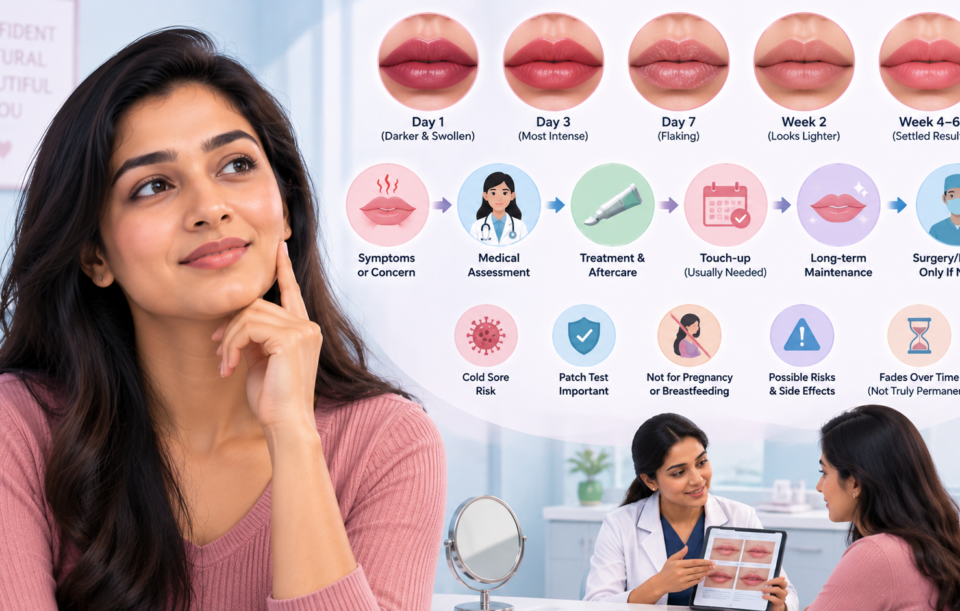
The pattern is fairly consistent: swollen and very dark for the first two or three days, flaking through the first week, then looking faded and patchy for a week or two before the colour re-emerges softer than it started. Most people see something close to the final result at around four to six weeks.
A typical course, and this is a general pattern rather than a promise, because it varies by person and technique:
- Day 1. Swollen and tender. The colour is far darker and sharper than what you chose. This is expected and it is when people panic.
- Days 2 to 3. Usually the most intense colour of the whole process, and often the most swelling. Lips may feel tight and dry.
- Days 3 to 7. Flaking begins. The surface layer comes away carrying some pigment with it. Do not pick it, because picking pulls pigment out unevenly and that is how patches happen.
- Week 2. The colour often looks far too light, sometimes almost gone. This stage alarms people more than the dark stage did. It is normal and it is not the result.
- Weeks 3 to 4. Colour gradually re-emerges as the deeper pigment becomes visible through healed skin.
- Weeks 4 to 6. Close to the settled result. This is the earliest point at which it should be judged, and the point at which a touch-up is usually assessed.
Two things worth planning around. Do not book this in the week before an event. The period when you would want to look your best is the period when the colour is at its most intense and your lips are flaking. And a touch-up session is normal, not a sign that the first attempt failed. Pigment does not take evenly everywhere and most people need a second pass.
Why is the colour on day one not the colour you keep?
Because you are looking at pigment sitting in freshly traumatised, swollen tissue, seen through a surface layer that is about to come away. Three things change between day one and week six, and all three lighten and soften what you see.
- The surface layer sheds. Some pigment sits in skin that will flake off in the first week, and it goes with it.
- Swelling settles. Swollen tissue concentrates colour and sharpens edges. As the swelling goes, the colour spreads across more tissue and softens.
- Healed skin covers it. You end up viewing the pigment through a layer of healed skin, which mutes it. This is also why the same pigment looks different on different people.
The practical consequence is the single most useful rule on this page: do not judge it, and do not ask anyone to correct it, before six weeks. Corrections made at week two are made on a result that does not exist yet, and adding more pigment to something still settling is how lips end up too dark.
It also explains why nobody can promise you a specific shade. A practitioner can choose pigment carefully for your skin and your undertone, and a good one will. What comes out the other side of your healing is not fully predictable, which is why any promise of an exact colour should make you cautious rather than reassured.
Who should not have permanent lip makeup?
Several groups, and a good practitioner will turn you away rather than work around any of these. Being declined is a sign of a practitioner worth returning to later, not a problem to shop around for.
- Anyone with an active cold sore, or an outbreak currently healing. See the next section, this is the important one.
- Anyone with a known allergy to tattoo pigments, hair dye or cosmetic pigments, or who has reacted to a previous tattoo.
- People who form keloid or thickened scars.
- Anyone with active skin disease, infection, eczema or cracking on or around the lips.
- People taking isotretinoin for acne, or who have recently finished it, because skin healing is altered. Ask your prescriber how long to wait.
- Anyone on blood-thinning medication, which needs discussing with the prescribing doctor first, not stopping on your own.
- People with uncontrolled diabetes or a condition affecting healing or immunity.
- During pregnancy and breastfeeding, which is the conventional position given that pigments are not well characterised.
- Anyone who has had filler in the lips recently. Sequencing matters and the two should be spaced, so tell the practitioner either way.
- Anyone who cannot commit to the aftercare, which is mostly about not picking and keeping the area clean for a week.
One more, which is not medical. If you are considering this because you are unhappy with your lips in a way that changes week to week, a tattoo is a poor answer to a moving question. Wait.
Can permanent lip makeup trigger cold sores?
Yes, and this is the risk most people are never warned about. Tattooing the lip breaks the skin in exactly the area where herpes simplex lies dormant in people who carry the virus, and that can set off an outbreak. The critical point is that it is prevented before the appointment, not treated after it.
A published guideline on the management of herpes simplex 1 and cosmetic interventions identifies procedures that breach skin integrity as carrying reactivation risk, and notes that reactivation tends to occur in the treated area, with the perioral area among the commonest sites. The same guideline recommends antiviral prophylaxis for people who have had a herpetic outbreak following a previous aesthetic procedure, for procedures that breach skin integrity, and with particular caution in anyone immunocompromised, starting before the procedure and continuing afterwards.
What this means for you, practically:
- If you have ever had a cold sore, say so at the consultation. Not on the day. At the consultation, so there is time to arrange cover.
- Antiviral tablets can be prescribed in advance, started before the appointment and continued afterwards. This is a prescription from a doctor, not something to buy and take on your own judgement.
- If you have an active cold sore, the appointment is postponed. Not worked around, not covered up. Postponed.
- An outbreak on healing pigment is not only uncomfortable, it disrupts the area while the colour is settling, and that can affect how evenly the pigment takes.
- Most outbreaks settle within about five to seven days, and one persisting beyond a week should be reviewed.
If a practitioner does not ask you about cold sores before tattooing your lip, that tells you something useful about how thorough the rest of their assessment is.
Why is patch testing not optional?
Because the pigments are not standardised and reactions to them are a recognised problem, and because a reaction to pigment already implanted in your lip is a genuinely difficult situation to resolve. A patch test is standard practice before this procedure, not an extra.
The FDA notes that some people have had bad reactions to tattoo and permanent makeup inks, that some have suffered permanent disfigurement, and that contaminated inks have caused infections even when the artist followed hygienic procedures.
What a patch test involves is small and undramatic: a tiny amount of the actual pigment to be used is placed in an inconspicuous area, usually behind the ear or on the inner arm, and left for a period while you watch for redness, itching, swelling or a raised reaction.
Three things to insist on:
- It must be the same pigment that will be used on you, from the same batch if possible, not a generic test.
- Leave adequate time. Reactions are not always immediate. Ask how long your practitioner waits and why.
- A record of the pigment used should be kept and given to you. If you ever react later, or need removal, knowing exactly what is in your lip matters enormously.
A delayed reaction months or years after a tattoo is uncommon but it happens, and it is one of the situations where having that record turns a difficult problem into a manageable one.
What can go wrong, and how hard is each problem to fix?
Most complications are manageable. The ones that are not tend to be about colour rather than about safety, which is the opposite of what people expect. The table below is roughly ordered by how hard each is to resolve.
| What can happen | How it presents | How hard it is to fix |
|---|---|---|
| Swelling and tenderness | First two to three days, expected | Not a complication. Settles on its own |
| Patchy uptake | Uneven colour once healed, common | Usually corrected at the touch-up session. Expected rather than a failure |
| Cold sore outbreak | Within days of the procedure | Treatable, largely preventable in advance, but can affect how the colour settles |
| Infection | Increasing pain, redness, swelling or discharge after the first days | Needs medical treatment promptly. Can affect the final result |
| Colour too dark or too intense | Apparent at six weeks, once settled | Difficult. Fading is slow and removal has its own problems. See the next section |
| Colour shifted to an unwanted tone | Over months as pigment ages, sometimes cooler or greyer | Difficult. Sometimes improved by a corrective pass, sometimes not |
| Shape or border not as intended | Asymmetry, or a border set outside the natural lip line | Hard. Adding is easier than subtracting, and a border placed too wide is a removal problem |
| Allergic reaction to pigment | Itching, swelling or raised areas, sometimes delayed by months | The hardest. The pigment is already in the tissue, and removal in an inflamed area is complicated |
Read the bottom half of that table again before you book. The genuinely difficult problems are all versions of “the pigment is in there and you want it out”, which is the subject of the next section.
How hard is permanent lip makeup to remove?
Considerably harder than applying it, and there is a specific technical reason that applies to cosmetic tattoos more than to ordinary ones. Laser removal of light-coloured pigments can make them darker rather than lighter, and lip pigments are light-coloured pigments.
A review of laser tattoo removal states that paradoxical darkening can occur as the titanium dioxide or iron oxide pigment is reduced by the laser treatment, and warns specifically about treating pink, tan, white, yellow or other light-coloured tattoos, noting that these are often used in permanent makeup applications.
In plain terms: a lip tattoo you dislike can be turned a darker colour by the first attempt to remove it.
The rest of the removal picture is equally worth knowing before rather than after:
- Complete removal is difficult. The same review reports a study in which only 1.26 percent achieved complete pigment removal, and suggests that around 75 percent of pigment can be diminished. Expect improvement rather than erasure.
- It takes multiple sessions. Amateur tattoos generally need four to six treatments and professional tattoos eight or more, spaced over months.
- A test spot should be done first. The review advises a test spot before treating the whole tattoo, precisely because of the darkening risk. Ask for one. A practitioner who declines to do a test spot on a lip tattoo is not the right practitioner.
- It can cost more than the original procedure. Several sessions of laser, spread over a year, on a result you did not want.
- The FDA puts it simply: tattoos and permanent makeup are not easily removed and in some cases may cause permanent discoloration.
This is the section to reread if you are wavering. The procedure itself is usually straightforward. The exit is not. Laser treatments offered here are described on our laser treatment page.
How should you choose a practitioner?
On hygiene, on records, and on what they refuse to do, rather than on their Instagram grid. A portfolio shows you their best work on other people’s lips. It does not tell you how they handle the case that goes wrong.
What to check, and you are entitled to ask all of it:
- Do they patch test as standard? If the answer is that it is available on request, that is a no.
- Do they ask about cold sores, allergies, medication, skin conditions and pregnancy before you book? A consultation that goes straight to colour selection has skipped the assessment.
- Single-use needles, opened in front of you. Watch this happen. Do not take it on trust.
- Will they give you a written record of the pigment used, including batch details.
- What is their touch-up policy, is it included, and within what timeframe.
- What happens if you react or get an infection. Who sees you, how quickly, and is there a doctor involved.
- Who do they refer to for removal, and have they ever needed to. A practitioner who says nobody has ever wanted removal is either inexperienced or not telling you the truth.
- Will they say no? Ask what would make them decline to treat someone. A practitioner with no answer has never declined anyone.
The last one is the most revealing question in the list. In our clinic in Surat, a meaningful share of the people we see about lips are seeking correction of work done somewhere that did not assess them first, and the consultation that would have prevented it would have taken twenty minutes.
What do touch-ups and fading really cost over time?
The real cost is not the first session, it is the first session plus a touch-up plus repeat sessions over the years, and possibly removal if you change your mind. Price the pathway rather than the appointment.
What actually drives the total:
- The initial session, which varies widely by practitioner and by technique.
- The first touch-up, usually at around six to eight weeks and often needed. Ask whether it is included before you pay for the first session, not after.
- Colour refresh sessions at intervals, for as long as you want to maintain it.
- The patch test consultation, if charged separately.
- Antiviral cover, if you need it.
- Correction or removal, which is the line nobody budgets for and the one that can exceed everything above combined.
Ask for the whole pathway in writing before the first session. A quote that covers only the first appointment is not a cost for the decision you are actually making. And treat a price noticeably below everyone else’s as information about something, because on this procedure the two things being economised on are usually assessment time and pigment quality.
What does Elegance Cosmetic Clinic, Surat offer around this?
Assessment before, management if something goes wrong, and honest advice about removal if you already have work you are unhappy with.
Dr. Ashutosh A Shah is a board certified plastic and cosmetic surgeon with over 22 years of aesthetic practice in Surat, Gujarat. The role of a medical clinic in this subject is threefold: assessing suitability properly before anything is tattooed, including the cold sore and allergy questions that get skipped; managing complications such as infection, reaction or a healing problem; and giving a realistic account of what removal can and cannot achieve for someone who already has a result they dislike.
That third one is worth saying plainly. If you have permanent lip makeup you regret, the useful first appointment is one where somebody looks at it, tells you honestly what is achievable, and does a test spot before committing to a course. Related treatments are described under face makeover, and our approach to non-surgical skin treatments is set out in our guide to the carbon laser peel.
Next step
If you are considering permanent lip makeup, the most useful thing you can do before booking anything is a proper assessment rather than a colour consultation.
- Mention any history of cold sores, even years ago, and even if it was mild
- Mention allergies, skin conditions, current medication and whether you are pregnant or breastfeeding
- Ask about patch testing, and ask to see the needle opened
- Ask what the touch-up policy is and get the whole pathway priced in writing
- If you already have work you are unhappy with, ask for a test spot before agreeing to a course of removal
Book a consultation at Elegance, Surat
Medical disclaimer. This article is general information and is not a substitute for assessment by a qualified practitioner. Permanent lip makeup is a cosmetic tattoo and carries real risks including allergic reaction, infection, reactivation of herpes simplex, and colour outcomes that cannot be guaranteed in advance. Seek medical advice promptly if you develop increasing pain, spreading redness, swelling or discharge after any cosmetic tattooing procedure. Do not take prescription antiviral medication without a doctor’s advice.
No. It is better described as semi-permanent. The pigment is placed under the skin surface, but the body gradually breaks it down, so the colour fades and shifts and needs touching up. How quickly varies with the pigment used, how deeply it was placed, your skin, sun exposure and smoking.
The lips are sensitive, so some discomfort is expected, and topical numbing is normally used. Most people describe it as tolerable rather than severe. Swelling and tenderness for two to three days afterwards is usual. Anyone promising a completely painless procedure is overselling it.
The surface heals over about a week, with the most intense colour at days two to three and flaking through the first week. The colour then looks too light for a week or two before re-emerging. Judge the result at four to six weeks, not before.
Partially, with difficulty. Complete removal is hard to achieve, it takes multiple laser sessions over months, and light-coloured pigments used in permanent makeup can paradoxically darken when lasered. A test spot before treating the whole area is advised. Removal can cost more than the original procedure.
Yes. Tattooing breaks the skin where herpes simplex lies dormant, and the perioral area is a common site of reactivation. If you have ever had a cold sore, say so at the consultation rather than on the day, so antiviral cover can be prescribed in advance. Active outbreaks mean postponing.
Anyone with an active cold sore, a known pigment or dye allergy, a tendency to keloid scarring, active skin disease on the lips, uncontrolled diabetes, or who is pregnant or breastfeeding. People on isotretinoin or blood thinners need to discuss timing with their prescriber first. A good practitioner declines rather than works around these.
It varies widely by practitioner and technique, and the useful figure is the whole pathway rather than the first session. Budget for the initial appointment, a touch-up at six to eight weeks, refresh sessions over the years, and possibly correction or removal. Ask for the full pathway in writing.


Category
Latest From Blog
Is There a Permanent Solution for Hair Fall? What Actually Works
How Much Hair Fall Is Normal, and Which Signs Mean It Is Not
NAD Drip Therapy: What The Evidence Supports And What It Does Not