



Written by Dr. Ashutosh Shah, M.Ch., DNB (Plastic Surgery)
Director, Elegance Clinic, Surat
Dr. Ashutosh Shah is a Board-Certified Plastic, Cosmetic & Reconstructive Surgeon with more than 22 years of surgical experience. His practice includes facial aesthetics, cosmetic surgery, reconstructive procedures, and advanced non-surgical aesthetic treatments.
A non-surgical facelift is not one specific procedure. It is a broad term used for treatments that aim to improve facial firmness, wrinkles, volume loss, or mild sagging without traditional facelift surgery. Depending on the technique, this may include radiofrequency or ultrasound-based skin tightening, dermal fillers, injectable treatments, or thread lifts. Each option has a different safety profile.
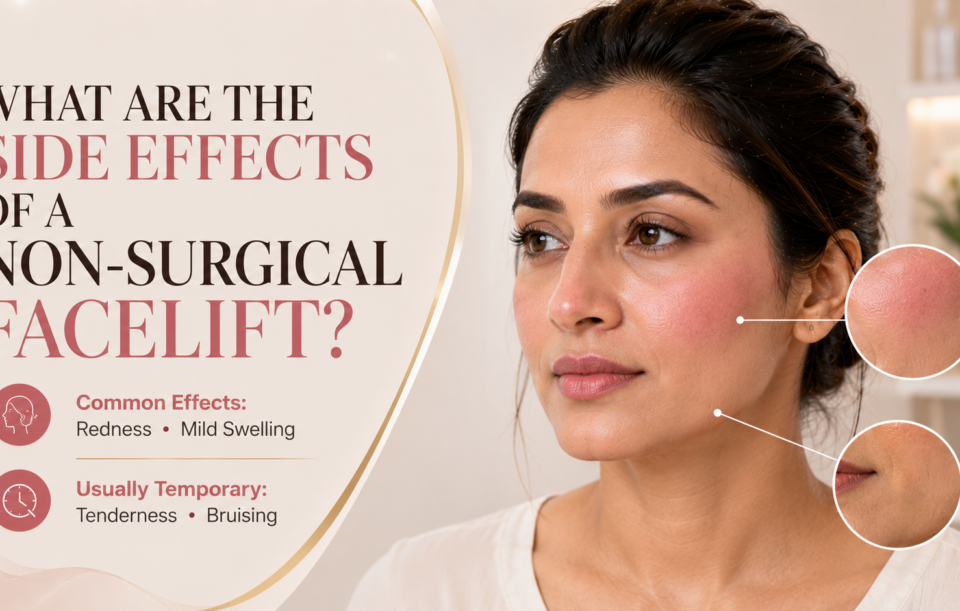
The side effects of a non-surgical facelift are often temporary, such as redness, swelling, bruising, tenderness, or mild discomfort. However, more significant complications can occur with some treatments. For example, excessive heat from energy-based devices can cause burns, while fillers carry rare but serious risks if injected into a blood vessel. Thread lifts can also cause infection, persistent pain, visible or extruding threads, or an unfavourable result.
This is why the phrase “non-surgical” should not be interpreted as “risk-free.” The appropriate treatment depends on the degree of skin laxity, facial anatomy, treatment goals, medical history, and the specific technology or injectable being considered.
Key Takeaways
- Non-surgical facelift is a broad term covering several different aesthetic treatments.
- Common temporary effects include redness, swelling, bruising, tenderness, and mild discomfort.
- Energy-based treatments can rarely cause burns, skin injury, or nerve-related problems.
- Fillers can cause swelling and bruising, while rare vascular complications can be serious.
- Thread lifts are minimally invasive rather than completely non-surgical and have their own complications.
- Choosing an appropriately trained medical professional and having an individual assessment can reduce avoidable risks.
What Is a Non-Surgical Facelift?
A non-surgical facelift refers to a group of minimally invasive or non-invasive aesthetic treatments designed to improve selected signs of facial ageing without traditional facelift surgery. Depending on the method, treatment may target loose skin, fine lines, wrinkles, volume loss, or early jowling. The effects are generally more limited than those of surgical facelift procedures.
The term can refer to several different approaches rather than one standard treatment.
Common options include:
- Radiofrequency skin tightening
- Ultrasound-based skin tightening
- Dermal fillers
- Botox and other neuromodulators
- Thread lifts
- Selected laser or energy-based treatments
The risks therefore depend heavily on the treatment used.
Non-surgical facelift: A general term for aesthetic treatments intended to improve facial ageing concerns without traditional facelift surgery.
For example, radiofrequency skin tightening uses controlled energy to heat deeper skin layers and stimulate collagen production. Cleveland Clinic describes redness and swelling as possible short-term effects, while burns are a rare complication when excessive heat is delivered.
A thread lift is different. It uses absorbable sutures placed under the skin and is considered a minimally invasive procedure rather than a completely non-invasive treatment.
Why the Term Can Be Misleading
The phrase “non-surgical facelift” can make a treatment sound similar to a surgical facelift without the risks of surgery. However, these procedures do not all produce the same degree of lifting or correction.
Some primarily improve skin firmness. Others restore lost facial volume or temporarily relax selected muscles. Thread lifts mechanically reposition tissue to a limited degree.
Therefore, the treatment should be selected according to the actual facial concern rather than the label “facelift.”
What Are the Common Side Effects of a Non-Surgical Facelift?
Most common side effects are temporary and depend on the technique. Redness, swelling, bruising, tenderness, sensitivity, tingling, and mild discomfort can occur after different non-surgical facial treatments. The intensity and duration vary according to the device, injection technique, treatment area, and individual response.
Common temporary effects may include:
- Redness
- Mild swelling
- Bruising
- Tenderness
- Warmth
- Tightness
- Temporary sensitivity
- Mild pain or discomfort
- Small areas of irritation
- Temporary numbness or tingling
With radiofrequency skin tightening, the treatment area may feel warm, and some patients experience tingling or mild discomfort. Mild redness and swelling can occur and usually settle relatively quickly.
After a thread lift, swelling, bruising, irritation, and discomfort can occur during the initial healing period.
After dermal fillers, swelling, bruising, redness, pain, tenderness, itching, and rash are among the reported effects. Many short-term reactions settle within days to weeks, although some complications can appear later.
Definition: Edema
Edema: Medical term for swelling caused by an accumulation of fluid in body tissues.
Swelling is not automatically a sign of a complication. What matters is its severity, duration, progression, and whether it occurs with other concerning symptoms.
What Are the Risks of Different Non-Surgical Facelift Treatments?
The potential side effects vary considerably between energy-based treatments, fillers, injectables, and threads. A treatment that uses heat has different risks from one involving a needle or absorbable threads. Understanding the specific technique is therefore more useful than considering all non-surgical facelifts as one category.
| Treatment | Common Effects | Important Potential Risks | Typical Purpose |
|---|---|---|---|
| Radiofrequency | Redness, warmth, swelling, tenderness | Burns or skin injury | Skin tightening |
| Ultrasound | Discomfort, redness, swelling | Burns or nerve injury in certain circumstances | Skin tightening |
| Dermal fillers | Swelling, bruising, tenderness | Infection, nodules, vascular complications | Volume and contour |
| Thread lift | Swelling, bruising, discomfort | Infection, thread extrusion, persistent pain | Mild tissue lifting |
| Botox | Injection-site redness, bruising, headache | Temporary muscle weakness or asymmetry | Dynamic wrinkles |
This comparison is important because there is no single list of “non-surgical facelift side effects” that applies equally to every treatment.
Radiofrequency Skin Tightening
Radiofrequency devices use electromagnetic energy to generate heat within targeted tissue. This can stimulate collagen production and improve skin firmness.
Temporary redness, swelling, warmth, and mild discomfort can occur. Excessive heat can rarely result in burns. Cleveland Clinic recommends notifying the provider if the treatment produces an uncomfortable burning sensation.
Ultrasound-Based Treatments
Ultrasound devices deliver sound-wave energy into tissue. Depending on the device and indication, ultrasound can be used for different aesthetic purposes.
The FDA notes that therapeutic ultrasound can cause pain or discomfort, redness, swelling, blisters, burns, and nerve damage in certain applications. The exact risk depends on the device, treatment area, and intended use.
Dermal Fillers
Dermal fillers add volume or modify facial contours. They are commonly used for areas such as the cheeks, lips, jawline, and selected facial folds.
Common reactions include bruising, swelling, redness, pain, and tenderness. Less common complications include infection, nodules, allergic reactions, and tissue injury.
One particularly important but uncommon complication occurs when filler unintentionally enters a blood vessel. This can interfere with blood flow and may cause tissue death, visual problems, or stroke.
Vascular occlusion: A blockage of a blood vessel that can restrict blood flow to tissue.
Thread Lifts
Thread lifts use absorbable sutures to provide a degree of mechanical lifting and may also stimulate collagen formation.
Potential complications include infection, swelling, bruising, pain, difficulty opening the mouth temporarily, thread extrusion, sensitivity, and an unfavourable aesthetic result.
Because threads are inserted under the skin, this treatment should not be considered completely non-invasive.
Botox
Botulinum toxin injections work differently from fillers and skin-tightening devices. They temporarily reduce muscle activity and are primarily used to soften selected expression lines.
Possible effects include temporary redness, swelling, bruising, headache, or unwanted weakness in nearby muscles. The risks depend on the injection site, dose, anatomy, and technique.
Can Non-Surgical Facelift Treatments Cause Serious Complications?
Yes. Serious complications are uncommon with appropriately selected and performed treatments, but they are possible. The risk depends strongly on the technology and technique. Patients should understand both the common temporary effects and the less frequent complications before treatment.
For example, the FDA issued a safety communication in 2025 regarding certain uses of radiofrequency microneedling. Reported complications included burns, scarring, fat loss, disfigurement, and nerve damage, with some cases requiring medical or surgical treatment.
This does not mean that every RF treatment carries the same risk. RF microneedling differs from other radiofrequency skin-tightening technologies, so the specific device and treatment method matter.
Similarly, dermal fillers have rare but potentially serious vascular complications, while thread lifts have potential risks such as infection and thread extrusion.
The key point is that non-surgical does not mean risk-free.
How Does the Treatment Process Work Step by Step?
The exact process varies according to the selected treatment, but safe cosmetic treatment generally begins with assessment rather than immediately choosing a procedure.
Step 1: Consultation
The clinician discusses your concerns, previous treatments, medical history, allergies, medications, and aesthetic goals.
For thread lifts, ASPS recommends discussing previous surgeries, medical conditions, medications, allergies, and treatment expectations during consultation.
Step 2: Facial Assessment
The face is assessed for:
- Skin quality
- Skin laxity
- Facial volume
- Wrinkles
- Jowling
- Facial proportions
- Muscle activity
- Previous cosmetic treatments
This helps determine whether the concern is primarily related to skin, volume, muscle activity, or tissue laxity.
Step 3: Treatment Selection
The provider explains which treatment may address the concern and what it cannot realistically achieve.
For mild skin laxity, an energy-based treatment may be considered. Volume loss may be addressed with fillers, while selected expression lines may respond to neuromodulators.
Step 4: Treatment
The treatment is performed according to the selected technique.
Energy-based treatments deliver controlled energy to the target area. Injectables use carefully placed injections. Thread lifts involve placement of absorbable threads beneath the skin.
Step 5: Recovery and Follow-Up
Aftercare depends on the procedure. Some treatments have minimal downtime, while others require more precautions.
Following the provider’s instructions helps identify unexpected swelling, pain, skin changes, or other complications early.
Who May Be Suitable for a Non-Surgical Facelift?
People with early or moderate signs of facial ageing may be candidates for selected non-surgical treatments, particularly when they want improvement without traditional facelift surgery. However, suitability depends on the specific problem and the treatment being considered.
A consultation may be useful when a person has:
- Mild skin laxity
- Fine lines or wrinkles
- Early jowling
- Loss of facial volume
- Reduced skin firmness
- Concerns about facial contour
- Realistic expectations about non-surgical improvement
Non-surgical treatments may be less suitable when there is substantial loose skin or advanced tissue descent. In such situations, a surgical facelift may provide a more significant structural correction.
The aim should be to match the treatment to the degree and cause of ageing rather than selecting a procedure simply because it has less downtime.
How Long Do Side Effects Last?
The duration of side effects depends on the procedure, treatment intensity, injection sites, and individual healing. Mild redness may settle quickly, while bruising or swelling can take longer to disappear. Thread lifts generally involve a longer early healing period than many purely non-invasive treatments.
For radiofrequency skin tightening, Cleveland Clinic reports that mild redness and swelling may resolve within about 24 hours.
For thread lifts, initial swelling, bruising, irritation, and discomfort are expected during healing, while ASPS notes that many patients become presentable within several days even though final healing takes longer.
For fillers, many common injection-related effects resolve over days to weeks, although some complications can occur later.
When Normal Healing May Need Review
A patient should not assume that every symptom is normal.
Contact the treating clinician if symptoms are:
- Getting worse rather than better
- Persistent beyond the expected period
- Associated with significant pain
- Accompanied by skin colour changes
- Associated with increasing swelling
- Accompanied by fever or signs of infection
How Can You Reduce the Risk of Complications?
Risk cannot be eliminated, but appropriate treatment planning can help reduce avoidable problems.
Important considerations include:
Choose an Appropriately Qualified Practitioner
The person performing the treatment should have appropriate medical training and experience with the specific procedure or device.
ASPS recommends choosing a qualified, board-certified plastic surgeon for thread lift procedures and discussing potential complications before treatment.
Disclose Your Medical History
Tell the clinician about:
- Previous cosmetic procedures
- Allergies
- Medical conditions
- Current medications
- Previous complications
- Pregnancy or breastfeeding when relevant
- Active skin conditions
This information can affect whether a treatment is appropriate.
Ask Which Device or Product Is Being Used
Patients should understand whether they are receiving radiofrequency, ultrasound, filler, Botox, threads, or another treatment.
Different devices and products have different indications and risks.
Understand the Limits of Treatment
A non-surgical treatment may improve a selected concern without reproducing the results of a surgical facelift.
Clear expectations can reduce dissatisfaction and help patients choose a treatment that matches their goals.
Are Non-Surgical Facelifts Safer Than Surgical Facelifts?
Non-surgical treatments generally avoid some of the risks associated with major surgery and often involve less downtime. However, “safer” cannot be applied universally because different procedures have different risks.
A radiofrequency treatment, dermal filler injection, and thread lift should not be considered equivalent simply because they are marketed as alternatives to surgery.
For example, fillers have rare vascular risks, energy-based treatments can cause thermal injury, and thread lifts can cause infection or thread-related complications.
The most appropriate option depends on the patient’s anatomy, degree of ageing, expectations, and tolerance for downtime and potential risks.
If you are considering a non-surgical facial rejuvenation treatment, an individual assessment can help determine whether the expected benefits justify the potential risks for your particular concerns.
What Results Can You Expect?
Results vary according to the treatment.
Energy-based skin tightening generally aims for gradual improvement in firmness rather than a dramatic surgical lift. Cleveland Clinic notes that changes after radiofrequency treatment may develop over several months as collagen and skin remodelling occur.
Fillers can produce more immediate changes in facial volume, although swelling may temporarily affect the appearance.
Thread lifts can create an early lifting effect, but the final result develops as swelling settles and healing progresses. ASPS notes that thread lift results become apparent over the following weeks and that outcomes are not guaranteed.
Ageing continues after any aesthetic treatment, so results may change over time.
Non-Surgical Facelift vs Surgical Facelift
A non-surgical approach may be appropriate for someone seeking a modest improvement with limited downtime. A surgical facelift is more extensive and is designed to address significant tissue laxity and reposition deeper facial structures.
| Feature | Non-Surgical Approach | Surgical Facelift |
|---|---|---|
| Incisions | Usually none or very small, depending on treatment | Yes |
| Anaesthesia | Usually minimal or local depending on procedure | Usually more extensive |
| Downtime | Often limited | Longer recovery |
| Degree of lifting | Usually modest | More significant structural lifting |
| Skin tightening | Depends on technique | More extensive |
| Volume correction | Possible with fillers | May be combined with fat grafting |
| Longevity | Depends on treatment | Generally longer-lasting, but ageing continues |
There is no universal winner. The right option depends on how much correction is needed and what the patient is willing to accept in terms of recovery, invasiveness, and risks.
When Should You Contact a Doctor?
Most mild post-treatment effects improve as the area heals. However, certain symptoms should be assessed promptly rather than being assumed to be routine recovery.
After filler treatment, the FDA advises immediate medical attention for unusual pain, changes in vision, or skin near the injection site becoming white, gray, or blue. Sudden neurological symptoms such as weakness, facial drooping, difficulty speaking, severe headache, or confusion also require urgent medical attention.
After energy-based treatment, persistent or worsening redness, swelling, rash, or unexpected skin changes should be discussed with the treating clinician.
After a thread lift, persistent pain, infection, thread extrusion, or an unexpected aesthetic change should be evaluated by the treating surgeon.
Dr. Ashutosh Shah, M.Ch., DNB (Plastic Surgery) is a Board-Certified Plastic, Cosmetic & Reconstructive Surgeon and Director of Elegance Clinic, Surat. He has more than 22 years of surgical experience and has trained in plastic surgery, microvascular surgery, and cosmetic surgery. His clinical work includes cosmetic and reconstructive surgery, facial aesthetics, hair restoration, and related aesthetic procedures.
Elegance Clinic was established in Surat in 2014 and provides cosmetic surgery, plastic surgery, dermatology, hair restoration, laser treatments, and reconstructive procedures. The clinic has centres in Adajan and Vesu and focuses on individualised treatment planning, patient safety, and natural-looking outcomes.
The side effects of a non-surgical facelift depend on the specific treatment being performed. Mild redness, swelling, bruising, tenderness, or discomfort are common with several cosmetic procedures and often improve as the treated area heals. However, more significant complications are possible. Energy-based treatments can cause burns or other tissue injury, fillers carry rare but serious vascular risks, and thread lifts can cause infection, persistent pain, or thread-related complications.
The term “non-surgical facelift” covers several different procedures, so treatment should not be selected solely because it sounds less invasive. A qualified practitioner should evaluate the degree of skin laxity, facial anatomy, medical history, desired outcome, and potential risks before recommending an approach.
For patients considering facial rejuvenation, Dr. Ashutosh Shah and the team at Elegance Clinic can discuss appropriate options based on individual needs rather than using a one-treatment-fits-all approach.
Book a personalised consultation with Dr. Ashutosh Shah at Elegance Clinic, Surat, to discuss your facial rejuvenation goals and suitable treatment options.
Book a Consultation at Elegance Clinic Surat
Frequently Asked Questions
A: Temporary redness, swelling, tenderness, bruising, or sensitivity may occur depending on the treatment used.
A: They are generally considered safe when performed by a qualified medical professional, but risks vary by procedure and individual factors.
A: Minor effects often improve within a few days, although recovery varies depending on the treatment and the patient.
A: Permanent complications are uncommon but possible. Proper treatment selection and professional assessment can help reduce risks.
A: Seek medical advice if you develop severe pain, worsening swelling, significant skin changes, infection symptoms, or other unexpected problems.

Category
Latest From Blog
What Are the Risks of an Eyebrow Lift?
Is Botox Safe for Forehead Lines?
How Can You Treat Horizontal Neck Lines?