




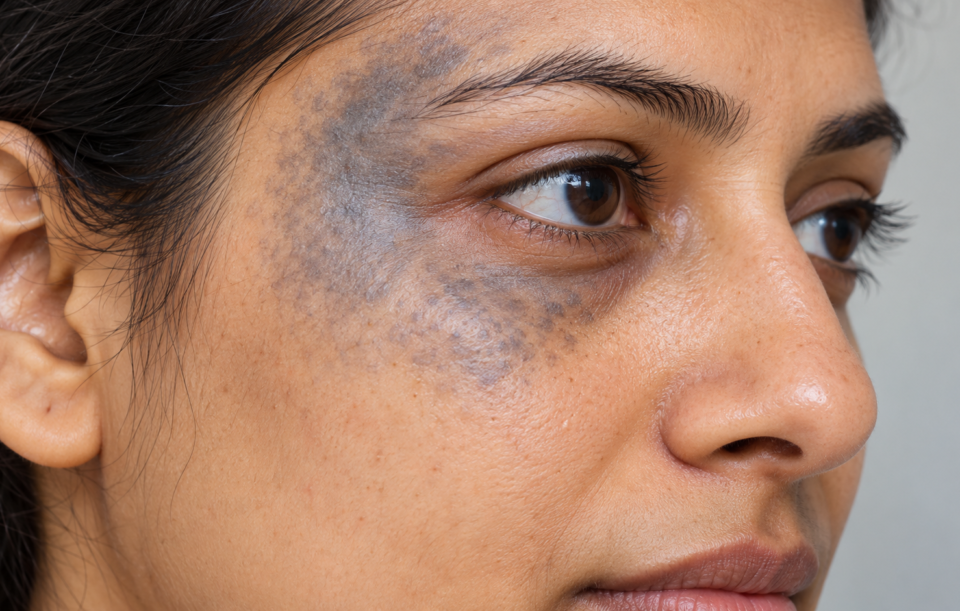
Nevus of Ota causes a blue-grey or brown patch around the eye, temple or cheek. Pigment cells sit deep in the skin and create this colour.
Laser for nevus of Ota can lighten the patch. However, treatment usually requires several sessions. Many patients need four to eight sessions or more.
Doctors often leave eight to twelve weeks between sessions. Starting treatment younger may help some patients achieve improvement with fewer visits.
Most importantly, an eye examination may be necessary because nevus of Ota can affect eye tissues and increase glaucoma risk.
What Is Nevus of Ota?
Nevus of Ota is a form of dermal melanocytosis. It usually causes flat blue, grey or brown pigmentation on one side of the face.
The patch may cover the eyelids, temple, forehead or upper cheek.
Why Does the Patch Look Blue-Grey?
Melanocytes produce melanin, the pigment that gives skin its colour.
In nevus of Ota, these cells sit deeper in the skin. As a result, the pigment may look blue or grey.
Unlike surface pigmentation, this deeper colour often responds poorly to ordinary creams.
When Does It First Appear?
Some children have the patch from birth. Others develop it during childhood or adolescence.
Over time, the colour may become more noticeable.
However, a dermatologist should examine new or changing pigmentation to confirm the diagnosis.
How Can You Recognise Nevus of Ota?
Nevus of Ota usually appears as a flat patch with uneven blue-grey or brown colour.
It often affects the skin around one eye. Sometimes, pigment also appears in the white part of the eye.
Is Every Blue-Grey Patch Nevus of Ota?
No. Other pigmented conditions may look similar.
For example, certain birthmarks and acquired dermal pigmentation can resemble nevus of Ota.
Therefore, do not rely on photographs alone.
A dermatologist can examine the pattern and decide whether you need additional tests.
Which Laser Is Used for Nevus of Ota?
Dermatologists commonly use pigment-targeting lasers for nevus of ota treatment.
These lasers deliver short pulses of energy into the skin. The energy targets pigment, and the body gradually clears some of it.
Q-Switched Nd Laser at 1064 nm
The 1064 nm Q-switched Nd laser can target deeper pigment.
Doctors often consider this wavelength for darker skin types because it generally interacts less with surface melanin than some shorter wavelengths.
However, the clinician must still select suitable settings to reduce side effects.
Read more about Q-switched Nd laser.
Q-Switched Alexandrite Laser at 755 nm
The 755 nm alexandrite laser is another established treatment option.
Studies have reported improvement in nevus of Ota with this technology.
However, skin type, pigment depth and treatment experience influence the choice.
Can Picosecond Lasers Help?
Picosecond lasers deliver very short energy pulses.
They may improve pigment clearance in selected patients. However, results vary, and not every clinic uses this technology.
No laser guarantees complete removal.
Explore the clinic’s Laser nevus removal service.
How Many Laser Sessions Are Usually Needed?
Many patients need approximately four to eight sessions or more.
However, the exact number depends on the patch and the treatment response.
What Affects the Session Count?
Pigment depth is important. A large or deeply pigmented patch may need additional treatment.
Skin type also matters. Moreover, different laser technologies may produce different results.
Therefore, a dermatologist should assess progress before recommending further sessions.
Why Are Sessions Spaced Months Apart?
Laser treatment produces gradual pigment clearance.
Meanwhile, the skin needs time to recover between sessions.
Therefore, doctors commonly leave at least eight to twelve weeks between appointments.
Some patients may need longer intervals.
Can One Session Remove the Patch?
Complete clearance after one session is uncommon.
Some patients notice early lightening. Others see only a small change.
As a result, doctors usually judge progress over several sessions.
Nevus of Ota Laser Treatment Plan
The following table shows an example treatment schedule. Your dermatologist may recommend a different plan.
| Session number | Typical interval | Expected lightening stage | Eye check timing | Sun protection rule |
|---|---|---|---|---|
| Before session 1 | Initial consultation | Baseline assessment and photographs | Baseline eye assessment when indicated | Begin daily sun protection |
| Session 1 | Start of treatment | Early pigment response; temporary darkening possible | Confirm ophthalmology plan | Protect treated skin from sunlight |
| Session 2 | About 8-12 weeks later | Gradual lightening may appear | Follow eye specialist’s advice | Continue daily protection |
| Session 3 | Another 8-12 weeks | Further improvement may become visible | Repeat eye review if advised | Avoid tanning and sunburn |
| Session 4 | Another 8-12 weeks | Assess remaining pigmentation | Continue recommended monitoring | Maintain consistent protection |
| Sessions 5-8 or more | Usually 8-12 weeks or longer apart | Further improvement; some pigment may remain | Follow ophthalmology schedule | Continue long-term protection |
How Should You Track Results?
Your dermatologist may take photographs before treatment.
Next, the clinician compares the patch after healing.
This approach helps determine whether the current laser plan is working.
Why Can Earlier Treatment Help?
Some studies suggest that younger patients may respond well to laser treatment.
In certain cases, they may need fewer sessions.
However, this does not mean every child will respond faster.
Does Age Affect Laser Results?
Age may influence the response. However, pigment depth, skin type and laser settings also matter.
Therefore, doctors should assess each patient individually.
Can Children Receive Laser Treatment?
Yes. Selected children can receive treatment after specialist assessment.
However, the doctor must consider the child’s age, comfort and ability to cooperate.
Parents should also discuss pain control and eye protection.
Why Is an Eye Examination Important?
Nevus of Ota can affect both facial skin and eye tissues.
For example, pigment may appear in the sclera, which is the white part of the eye.
What Is the Glaucoma Risk?
Some patients with ocular involvement have a higher risk of glaucoma.
Glaucoma can damage the optic nerve. Moreover, early disease may not cause noticeable symptoms.
Therefore, an ophthalmologist may check eye pressure and examine the optic nerve.
When Should You Schedule an Eye Check?
A baseline examination is especially important when the patch affects the eyelids or visible eye tissues.
Next, the ophthalmologist can recommend follow-up visits.
Importantly, facial laser treatment does not replace eye monitoring.
Is Nevus of Ota Cancerous?
Nevus of Ota is usually benign.
However, rare melanoma cases have occurred in people with this condition.
Therefore, seek medical advice for unusual changes, new lumps or visual symptoms.
Nevus of Ota Doctor Near Palsana: What to Ask
If you are searching for a nevus of ota doctor near palsana, start with a qualified dermatologist.
The clinician should confirm the diagnosis and explain the treatment options.
Questions About Laser Treatment
First, ask which laser suits your skin type.
Next, discuss the expected number of sessions.
Also, ask how the doctor will monitor improvement.
Questions About Eye Safety
Ask whether you need an ophthalmology referral.
In addition, discuss eye protection during laser treatment.
Finally, ask about side effects and recovery.
You can read more about Laser for pigmentation and review the clinic’s Our doctors page.
What Are the Side Effects of Laser Treatment?
Laser treatment may cause temporary skin reactions.
However, more serious complications can occur.
Common Short-Term Effects
Some patients experience redness, swelling or mild discomfort.
Also, the patch may look darker soon after treatment.
This change does not always mean treatment has failed.
Pigmentation Changes
Laser can sometimes cause post-inflammatory hyperpigmentation.
As a result, the treated skin may become darker.
Alternatively, hypopigmentation can create lighter patches.
Less Common Complications
Blistering, infection and scarring are possible.
Moreover, inadequate eye protection can cause serious eye injury.
Therefore, choose a qualified clinician who follows appropriate laser safety procedures.
Can Nevus of Ota Return After Laser?
Laser can produce significant lightening. However, complete clearance is not guaranteed.
Some patients retain pigment. Others notice renewed darkening later.
Therefore, follow-up may be useful.
How Should You Care for Treated Skin?
First, follow your dermatologist’s aftercare instructions.
Next, avoid rubbing or picking the treated area.
Also, use appropriate sun protection as advised.
When Should You Contact a Doctor?
Contact the treating clinician if you notice severe pain, blistering or unusual skin changes.
Most importantly, seek urgent medical assessment for sudden vision changes.
Frequently Asked Questions
Many patients need four to eight sessions or more. However, the number depends on pigment depth, skin type, laser choice and treatment response. Sessions are often spaced eight to twelve weeks apart.
Usually, no. Nevus of Ota is generally benign. However, rare melanoma cases have been reported. Therefore, new or changing lesions and eye symptoms need medical evaluation.
Yes. Selected children can receive laser treatment after specialist assessment. The doctor should consider age, comfort, cooperation and eye safety before deciding when to begin.
It can. Many patients achieve lasting improvement, but some pigment may remain or return. Therefore, follow-up is useful when colour changes again.
Temporary darkening can happen as treated pigment and inflammation change the skin’s appearance. However, persistent or worsening pigmentation needs assessment to rule out post-inflammatory hyperpigmentation.
Patients may feel snapping, warmth or stinging during treatment. However, discomfort varies. The clinician may recommend suitable pain-control measures.
Usually, makeup can be resumed after the skin has healed and the clinician approves it. However, avoid applying cosmetics to irritated, blistered or broken skin.
Q-switched Nd 1064 nm is often considered for darker skin types. However, burns and pigment changes remain possible. Therefore, correct diagnosis, suitable settings and an experienced clinician are important.
Yes, an eye examination is especially important when pigmentation affects the eyelids or eye tissues. An ophthalmologist can assess eye pressure and recommend monitoring for glaucoma.
If you are searching for a nevus of ota doctor near palsana, arrange an assessment with a qualified dermatologist. Ask about laser experience, realistic session counts and whether an ophthalmology referral is needed.
Conclusion
Laser for nevus of Ota can significantly lighten blue-grey facial pigmentation.
Q-switched Nd 1064 nm and alexandrite 755 nm are established treatment options. Picosecond lasers may also be considered.
However, treatment takes patience. Many patients need several sessions spaced at least eight to twelve weeks apart.
Earlier treatment may help selected patients, but results vary.
Most importantly, do not overlook the eyes. A suitable ophthalmology examination and follow-up plan can help identify complications that facial laser treatment cannot address.


Category
Latest From Blog
How much does laser hair removal cost in Surat?
HydraFacial in Katargam, Surat: Procedure, Recovery and Cost Guide
Nevus Of Ota: How Many Laser Sessions It Takes And Why Earlier Treatment Helps