




Laser Mole Removal: Why Every Mole Should Be Checked First
Laser mole removal can be appropriate for selected small, flat or slightly raised moles that a dermatologist has examined and judged to be harmless.
The important safety issue is that laser can destroy the tissue. When a mole is vaporised, there may be no specimen left for a laboratory to examine under a microscope.
That is why a changing, bleeding, itchy, irregular or otherwise suspicious mole should not simply be treated with laser for cosmetic reasons. Suspicious lesions may need surgical removal and histopathological examination.
The American Academy of Dermatology recommends checking suspicious spots using the ABCDE warning signs, while suspicious pigmented lesions may require biopsy or excision for diagnosis.
Which moles are suitable for laser removal?
Laser may be considered for a mole that has been examined by a qualified dermatologist and assessed as benign.
Potentially suitable characteristics include:
- Small size
- Stable appearance
- No recent unexplained change
- No persistent bleeding
- No concerning colour variation
- No significant asymmetry or irregular border
- A clinical examination that supports a benign diagnosis
The exact laser used depends on the lesion. More importantly, the diagnosis comes before the device.
A mole should not be selected for laser simply because it looks small or cosmetically bothersome.
What happens during a mole assessment?
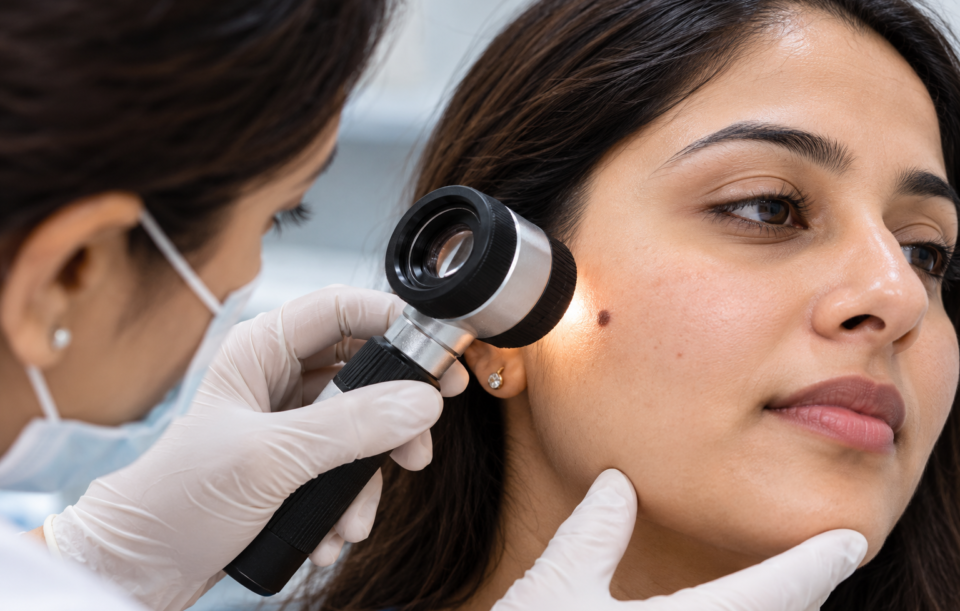
A dermatologist may inspect the lesion clinically and use a dermatoscope, which provides magnified and illuminated views of structures that may not be visible to the naked eye.
In the clinic’s planned approach, each mole is examined and photographed before deciding whether laser treatment is appropriate.
If the diagnosis is uncertain, the safer route may be biopsy or surgical excision rather than cosmetic destruction.
What are the ABCDE warning signs that rule out laser?
The ABCDE method is a useful screening guide for suspicious pigmented lesions:
| ABCDE sign | What it looks like | Laser allowed? | Next step |
|---|---|---|---|
| A – Asymmetry | One half does not resemble the other | ❌ Not for cosmetic laser without assessment | Dermatologist assessment |
| B – Border | Uneven, ragged or poorly defined edge | ❌ | Dermatoscopic assessment and possible biopsy/excision |
| C – Colour | Multiple colours or uneven pigmentation | ❌ | Dermatologist assessment |
| D – Diameter | Traditionally, greater than 6 mm is a warning sign | ❌ Without assessment | Clinical/dermatoscopic assessment |
| E – Evolving | Changing size, shape, colour or symptoms | ❌ | Prompt medical assessment |
Important: ABCDE is a warning system, not a diagnosis. A melanoma can be smaller than 6 mm, and a benign mole can be larger than 6 mm.
Other warning signs include persistent bleeding, crusting, itching, pain or a lesion that looks distinctly different from a person’s other moles.
If a mole is suspicious, the priority is diagnosis—not cosmetic removal.
Laser, radiofrequency or surgical excision: how is the method chosen?
The method depends on the lesion’s diagnosis, depth, location, size and cosmetic considerations.
Laser
Laser may be considered for selected benign lesions after appropriate assessment. Its major limitation for a suspicious pigmented lesion is that destruction can eliminate tissue that might otherwise have been submitted for histopathology.
Radiofrequency
Radiofrequency or electrosurgical techniques may be used for selected benign skin lesions. They also require appropriate diagnosis before treatment.
Surgical excision
Surgical removal is generally preferred when a lesion is suspicious, diagnostically uncertain or requires complete tissue assessment.
The removed specimen can be sent for histopathology, allowing a pathologist to examine the tissue microscopically.
Therefore, choosing between laser and surgery is not simply a matter of which treatment leaves the smallest mark. The first question is whether the mole is safe to destroy without obtaining tissue for diagnosis.
Is laser mole removal safe?
For an appropriately assessed benign lesion, laser treatment may be a reasonable cosmetic option in selected cases.
However, is laser mole removal safe cannot be answered by the device alone. Safety depends on the diagnosis, the type of lesion, the treatment method and appropriate aftercare.
A laser should not be used to destroy a mole that has warning signs or has not been adequately assessed.
The same principle applies to online or handheld “mole removal pens.” A device marketed for home use cannot determine whether a pigmented lesion is benign.
Will a mole come back or leave a mark?
A treated mole can sometimes recur or leave a visible mark.
Possible outcomes include:
- Temporary redness
- Darkening or lightening of the treated area
- Crusting during healing
- Persistent pigmentation changes
- A depressed or raised scar
- Partial or complete recurrence
The risk depends on the lesion, treatment depth, skin type, location and healing response.
A treatment marketed as a mole scar fix should not be confused with mole removal itself. If a scar remains after a mole has been treated, that scar requires separate assessment.
Does laser mole removal leave a scar?
It can, although the degree of scarring varies.
Small superficial treatments may heal with little visible marking, while deeper treatment can cause textural or pigmentary changes.
The face can be particularly noticeable because even a small change in skin texture may be visible.
A dermatologist should explain the expected healing pattern and possible pigmentation or scarring before treatment.
Can a mole grow back after laser?
Yes, recurrence or residual pigmentation can occur after some treatments.
If pigmentation or a new lesion appears in the treated area, do not automatically assume that it is simply “regrowth.”
A recurrent or changing lesion should be examined again, particularly if its appearance is different from the original mole.
This is another reason why suspicious moles should not be casually destroyed without obtaining appropriate tissue when indicated.
Is it safe to remove a mole at a salon?
No. A salon cannot substitute for medical assessment of a pigmented lesion.
The major concern is not simply infection or scarring. A mole that requires diagnosis could be cosmetically destroyed without appropriate examination or histopathology.
If you want a mole removed, the first step should be assessment by a qualified medical professional who can determine whether the lesion is appropriate for cosmetic treatment.
How many sessions does a mole need?
The number of treatments depends on the lesion and the method used.
Some selected benign lesions may require only one treatment, while others may need additional treatment because pigment or tissue remains.
However, repeated laser sessions should not be used as a substitute for reassessing a lesion that is changing or behaving unusually.
Can I remove a mole before my wedding?
A benign mole may sometimes be treated before a wedding, but timing matters.
Healing can involve redness, crusting or temporary pigmentation changes. These may be more noticeable for several days or weeks depending on the treatment and individual healing.
Do not schedule a cosmetic mole procedure immediately before an important event without allowing adequate recovery time.
If the mole has recently changed, started bleeding or developed other warning signs, cosmetic timing should not take priority over medical assessment.
Should a birthmark mole be removed in childhood?
Not every congenital or birthmark-type mole needs to be removed.
The decision depends on the type of lesion, its size, location, appearance, symptoms and whether there are features that require medical evaluation.
A dermatologist or paediatric specialist should assess a concerning lesion rather than removing it simply because it is present from birth.
When is surgical removal safer?
Surgical excision becomes particularly important when a mole:
- Is changing
- Has irregular pigmentation
- Has an irregular border
- Is significantly asymmetrical
- Bleeds without a clear reason
- Develops persistent crusting
- Becomes persistently itchy or painful
- Has an uncertain diagnosis
- Requires tissue diagnosis
In these situations, preserving a specimen for histopathology can be more important than minimizing the immediate cosmetic procedure.
For patients comparing different options, Laser mole removal explains the cosmetic treatment route, while Scar, cyst and mole removal covers broader removal options.
What should you do before mole removal?
Before treatment, ask:
- Has the mole been examined with a dermatoscope?
- Does it have any ABCDE warning signs?
- Has it changed recently?
- Is laser appropriate for this specific lesion?
- If there is any uncertainty, should it be biopsied or excised?
- Will the removed tissue be sent for histopathology?
- What scar or pigmentation changes are possible?
- How long will the area take to heal?
The most important question is not “Which laser?” but “Has this mole been safely diagnosed?”
Mole Removal in Vesu: What Should You Expect?
If you are considering mole removal in vesu, start with a proper skin examination rather than choosing a removal method based only on photographs or online descriptions.
A dermatologist can assess the mole with appropriate magnification and decide whether cosmetic treatment is reasonable or whether the lesion should be removed surgically for histopathology.
This approach helps separate harmless cosmetic moles from lesions that require further investigation.
Is laser mole removal suitable for every mole?
No.
A small, stable, clinically benign mole may be suitable for laser in selected cases. A changing, suspicious or diagnostically uncertain mole should not be treated as a routine cosmetic lesion.
The fundamental rule is:
Check first. Treat second.
If there is a reason to suspect melanoma or another skin cancer, diagnosis must take priority over cosmetic removal.
FAQs
Laser treatment can leave temporary redness, pigmentation changes or, less commonly, a visible scar. The risk depends on the lesion, treatment depth, skin type and healing response. Your dermatologist should discuss expected healing and possible pigment or texture changes before treatment.
Yes. Residual pigment or tissue can sometimes remain or recur after treatment. If a treated mole changes again, develops new symptoms or looks different from before, it should be reassessed rather than repeatedly treated cosmetically.
A salon should not be used to diagnose or remove a suspicious mole. A medical professional should first assess the lesion because a suspicious mole may require biopsy or surgical excision and histopathology rather than cosmetic destruction.
Some appropriately selected benign lesions may need only one treatment, while others may require additional treatment. The number depends on the lesion and technique. A changing or suspicious lesion should be reassessed rather than repeatedly treated.
A benign mole may sometimes be removed before a wedding, but allow sufficient time for redness, crusting or pigmentation changes to settle. If the mole has recently changed or started bleeding, medical assessment should come before cosmetic scheduling.
Not every congenital mole requires removal. The decision depends on its type, size, location, appearance and symptoms. A concerning birthmark mole should be assessed by an appropriate medical professional rather than removed simply because it has been present since birth.
Featured Questions
Is laser mole removal safe?
Laser can be appropriate for selected benign moles after medical assessment. It should not be used to destroy a lesion that is suspicious or diagnostically uncertain because tissue may be unavailable for histopathological examination.
Which moles should not be removed with laser?
Moles that are changing, asymmetrical, irregularly bordered, unevenly coloured, bleeding, persistently itchy or otherwise suspicious should be medically assessed. Surgical removal and histopathology may be safer when diagnosis is uncertain.
Laser or surgery for mole removal on the face?
The choice depends on the diagnosis, depth, size, location and cosmetic considerations. Laser may be considered for selected benign lesions, while suspicious or uncertain lesions may require surgical excision so tissue can be examined under a microscope.
Final Takeaway
Laser can be useful for selected harmless moles, but not every mole should be treated with laser.
The key safety issue is that laser can destroy the tissue, leaving nothing available for histopathological examination. A changing, bleeding, irregular or otherwise suspicious mole needs medical assessment and may require surgical excision.
Check the mole first. Choose the removal method second.


Category
Latest From Blog
Can Facial Ageing Be Treated Without Surgery?
Red Veins On The Face: What Causes Them And Which Vascular Laser Fits
CO2 Laser Or MNRF For Acne Scars: Which Suits Your Scar Type And Skin Tone