




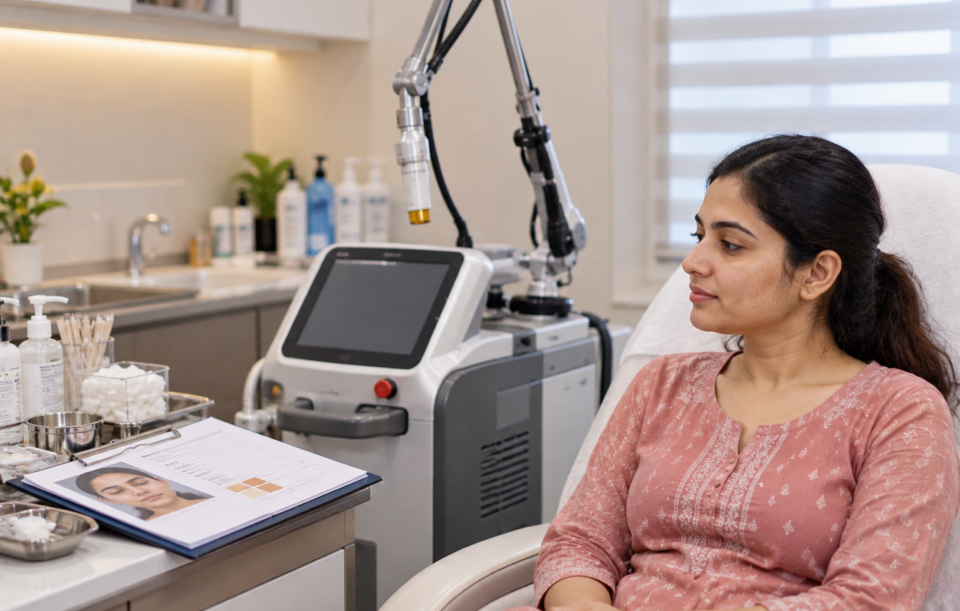
A doctor-led laser facial starts before the laser is switched on. The clinician should assess your skin type, recent tanning, active skin conditions, medicines and previous reactions, then choose an appropriate device and treatment plan. A test spot may be recommended when risk is higher, and the laser settings should be recorded so future sessions can be adjusted safely.
What should happen before the laser is switched on?
A proper consultation should come before treatment. A provider should first establish why you want the procedure and whether a laser is appropriate for your concern.
The pre-treatment assessment should include:
- Your skin type and tendency to pigment
- Your main concern, such as pigmentation, uneven tone or texture
- Recent sun exposure or tanning
- Active acne, dermatitis, infection or irritation
- Previous laser or energy-based treatments
- Previous problems with burns or pigmentation
- Current skincare products
- Prescription and non-prescription medicines
- Previous history of abnormal scarring
- Any medical or skin condition that could affect healing
The exact device matters too. “Laser facial” is a broad marketing term rather than one specific procedure. Different lasers use different wavelengths, pulse durations and energy settings, and they may target different skin concerns.
A provider should therefore be able to tell you the device name, wavelength or treatment technology, intended purpose and who will operate the device.
A treatment should not begin simply because a machine is available and the appointment has been booked.
Which medicines and skin conditions change the plan?
Medicines and recent skin treatments can affect how a procedure should be planned.
Tell the provider if you use:
- Isotretinoin or recently completed a course
- Prescription retinoids
- Photosensitising medicines
- Acne treatments
- Products containing exfoliating acids
- Other medicines that your doctor has advised you to disclose before procedures
Also mention recent chemical peels, microneedling, waxing or other energy-based treatments.
Active skin problems matter as well. Significant irritation, infection, open wounds, severe sunburn or an active inflammatory flare may mean that treatment should be postponed.
What about isotretinoin?
This requires individual medical judgment rather than a blanket internet rule. Older product information and traditional protocols commonly advised waiting six months after isotretinoin before cosmetic procedures. However, dermatology literature has subsequently found insufficient evidence to support a mandatory delay for every procedure, particularly for several non-ablative and fractional laser treatments.
For this clinic’s safety protocol, laser treatment is deferred if isotretinoin has been taken within the previous six months, unless the supervising physician specifically determines otherwise after reviewing the individual case. This conservative rule should not be confused with a universal evidence-based prohibition applying to every type of laser.
Patients should never stop prescribed isotretinoin or another medicine on their own just to receive a cosmetic treatment.
Why does a test spot matter on darker skin?
A test spot allows the clinician to observe how a particular area responds before treating a larger region.
This can be particularly useful when there is greater concern about pigmentary changes, previous reactions or a higher-risk skin type. The test area can help the provider evaluate the response and decide whether the planned settings need adjustment.
A test spot is not a guarantee that complications cannot occur. It is one part of a risk-reduction strategy.
For higher-risk skin, the clinic protocol may read the test response after 48 to 72 hours before proceeding with a larger treatment area.
This matters because excessive inflammation from an energy-based procedure can sometimes trigger unwanted pigmentation changes. Dermatology guidance on skin of colour also emphasises careful settings and prevention of post-inflammatory pigmentation.
Patients should be cautious of any provider who treats every person with exactly the same energy, pulse settings and treatment pattern without assessing individual skin characteristics.
What records should the clinic keep after each session?
A professional treatment record makes it easier to understand what was actually performed and to modify future sessions safely.
The record should ideally include:
| Record | Why it matters |
|---|---|
| Skin type | Helps guide treatment planning |
| Device name | Identifies the technology used |
| Wavelength | Helps identify the treatment parameters |
| Treatment area | Documents exactly what was treated |
| Energy/fluence | Allows settings to be reviewed |
| Pulse duration or relevant setting | Helps reproduce or adjust treatment |
| Number of passes/shots, where applicable | Documents treatment intensity |
| Test spot result | Records the initial response |
| Immediate skin response | Helps identify excessive reactions |
| Post-care instructions | Documents aftercare advice |
| Adverse reaction | Helps guide future treatment |
Keeping settings recorded also prevents a patient’s treatment history from becoming dependent only on memory.
If you experience unusual redness, blistering, severe pain, crusting or significant colour change after a session, contact the treating provider promptly rather than waiting for the next appointment.
Doctor-led versus salon laser sessions
The important difference is not simply whether the treatment takes place in a clinic or salon. The key issue is who assesses the patient, who operates the device, what device is being used and what safety process is followed.
A provider should be able to answer these questions before treatment:
| Question | What you should expect |
|---|---|
| Who operates the device? | A clearly identified trained operator |
| What device is being used? | Exact device/technology explained |
| What is the wavelength? | Stated when relevant to the device |
| What is my skin type? | Assessed and documented |
| What medicines do I take? | Medication history reviewed |
| Do I need a test spot? | Risk assessed individually |
| Are settings recorded? | Treatment parameters documented |
| What happens if I burn? | Clear emergency/complication plan |
| Who supervises the treatment? | Named responsible clinician where applicable |
This does not mean every salon treatment is automatically unsafe or every clinic treatment is automatically safe. A consumer should judge the actual provider, device, training, assessment and safety process.
Is a laser facial safe for sensitive skin?
A laser facial may be possible for some people with sensitive skin, but sensitivity alone does not tell a provider which treatment or setting is appropriate.
The skin should be examined for:
- Active redness
- Irritation
- Eczema or dermatitis
- Broken skin
- Recent sun exposure
- Acne inflammation
- Previous treatment reactions
The treatment plan may need to be modified or postponed if the skin barrier is significantly irritated.
People with sensitive skin should also ask what symptoms are expected immediately after treatment and which symptoms would be considered abnormal.
A safe laser facial is not defined by using the lowest setting on everyone. It means selecting an appropriate treatment for the patient’s skin and concern, using suitable parameters and monitoring the response.
How often can I repeat a laser facial?
There is no universal interval that applies to every laser facial.
The appropriate interval depends on:
- The laser or energy device
- Treatment intensity
- The condition being treated
- Skin type
- Previous response
- Presence of redness or irritation
- Whether pigmentation developed after the previous session
Repeating a procedure too soon can expose irritated skin to another treatment before it has adequately recovered.
Your previous treatment record should therefore be reviewed before another session rather than simply booking the next available appointment.
Is a laser facial the same as laser toning?
No. “Laser facial” and “laser toning” are not interchangeable names for one standardized treatment.
Laser toning commonly refers to a particular approach using laser energy for pigment-related concerns, while “laser facial” can be used more broadly by providers to describe different cosmetic laser or light-based procedures.
Ask the provider:
- Which device is being used?
- What wavelength is being used?
- What condition is being treated?
- What skin response is expected?
- What side effects are possible?
- What alternatives are available?
This helps you compare treatments based on the actual technology rather than the marketing name.
What should you ask any laser facial provider in Vesu?
Before booking a laser facial in vesu surat, use this checklist:
Provider checklist
- Who operates the laser?
- What is the exact device name?
- What wavelength or technology does it use?
- Has my skin type been recorded?
- Has recent tanning been checked?
- Have my medicines been reviewed?
- Have I been asked about isotretinoin?
- Do I need a test spot?
- Will the settings be recorded?
- What side effects should I expect?
- What should I do if I develop a burn?
- Who will review me if a complication occurs?
A provider who answers these questions clearly gives you more information to make an informed decision.
What are common laser facial side effects?
Temporary effects can include redness, warmth, mild swelling or sensitivity depending on the treatment used.
More concerning reactions can include:
- Blistering
- Significant pain
- Crusting
- Persistent swelling
- Infection
- Burns
- Darkening or lightening of the treated skin
- Prolonged irritation
Pigmentary changes deserve particular attention in darker skin because inflammation or injury can result in unwanted dark or light areas. The American Academy of Dermatology notes that cosmetic procedures, including laser treatments, can contribute to pigment changes in brown or black skin.
The possibility of a side effect does not mean laser treatment is inherently unsafe. It means treatment parameters and patient selection matter.
Can I go straight to work after a laser facial?
That depends on the device and treatment intensity.
Some procedures cause only mild temporary redness, while stronger treatments can produce swelling, sensitivity or visible skin changes that last longer.
Before treatment, ask:
- How long will redness normally last?
- Will swelling occur?
- Should I avoid heat or direct sunlight?
- Can I apply makeup immediately?
- Do I need special sunscreen or aftercare?
- When can I return to normal skincare?
If your work involves significant heat, dust, outdoor exposure or sweating, discuss this before scheduling the procedure.
How to choose a laser facial clinic near me
When searching for a laser facial clinic near me, do not compare providers only by price.
Compare:
- Who performs or supervises the treatment.
- Whether your skin is assessed before treatment.
- Whether the device and wavelength are disclosed.
- Whether medicines are reviewed.
- Whether test spots are used when appropriate.
- Whether treatment settings are recorded.
- Whether complications are explained beforehand.
- Whether there is a clear plan for managing burns or pigment changes.
A lower price does not necessarily mean a better treatment, just as a higher price does not guarantee safety.
The most useful question is not simply, “How much is the laser facial?” It is, “What safety checks will you perform before treating my skin?”
Frequently Asked Questions
Safety depends on the device, operator training, patient selection, treatment settings and availability of appropriate medical assessment and complication management. A salon should not be assumed unsafe solely because it is a salon, but patients should verify who operates the device and what safety process is followed.
Ask who will operate the device, the exact device and wavelength, whether your skin type and medicines will be assessed, whether recent tanning is checked, whether a test spot is appropriate, whether settings are recorded and what plan is available if you develop a burn or pigment change.
Do not make this decision without discussing the exact laser and your isotretinoin history with the supervising clinician. Current evidence does not support a mandatory six-month delay for every laser procedure, but some procedures remain unsuitable and individual risk assessment is important. This clinic protocol defers laser treatment within six months of isotretinoin use.
It may be suitable for selected patients, but sensitive or irritated skin needs individual assessment. The provider should check for active inflammation, recent tanning, skin-barrier problems and previous reactions before choosing the device and settings. Treatment may need to be postponed when the skin is significantly irritated.
The interval depends on the specific device, treatment intensity, skin concern and your response to the previous session. There is no single schedule that applies to every laser facial. The provider should review your previous treatment settings and skin response before recommending another session.
It depends on the treatment intensity and your skin’s response. Some procedures cause temporary redness or warmth, while stronger treatments may cause swelling or sensitivity. Ask about expected downtime, sun exposure, heat, makeup and aftercare before scheduling the session.
Provider checklist before booking
Use this checklist before agreeing to treatment:
- Who operates the laser?
- Device name and wavelength stated?
- Skin type recorded?
- Recent tanning checked?
- Medicine history taken?
- Isotretinoin history specifically asked?
- Test spot offered when appropriate?
- Treatment settings logged?
- Expected side effects explained?
- Emergency plan for burns or significant reactions available?
If these basic questions cannot be answered clearly, consider getting a proper consultation before proceeding.
Citable medical evidence
Traditional cosmetic-procedure guidance commonly recommended a six-month waiting period after isotretinoin. However, subsequent expert consensus and systematic reviews have found insufficient evidence to justify automatically delaying every superficial or non-ablative laser procedure for six months. Fully ablative procedures and individual high-risk situations still require greater caution.
A 2026 review also concluded that evidence supporting a mandatory six-month discontinuation period is limited for many dermatologic procedures, while noting that more prospective evidence is needed, particularly for darker skin types and people prone to abnormal scarring.
For this article, the clinic’s more conservative protocol is retained: isotretinoin within the previous six months, active tanning or photosensitising medicines should lead to laser treatment being deferred unless the supervising physician determines an appropriate alternative plan.
For patients researching the treatment itself, see Laser facial for an overview of the procedure. Those considering a more advanced treatment can review Advanced laser facial and learn more about the treating team through Our doctors. For appointment or clinic information, use Vesu and Adajan clinic contact.


Category
Latest From Blog
Can Facial Ageing Be Treated Without Surgery?
Red Veins On The Face: What Causes Them And Which Vascular Laser Fits
CO2 Laser Or MNRF For Acne Scars: Which Suits Your Scar Type And Skin Tone