




Written by Dr. Ashutosh Shah, M.Ch., DNB (Plastic Surgery)
Director, Elegance Clinic, Surat
Dr. Ashutosh Shah is a Board-Certified Plastic, Cosmetic & Reconstructive Surgeon with more than 22 years of surgical experience, including expertise in facial aesthetics and cosmetic procedures.
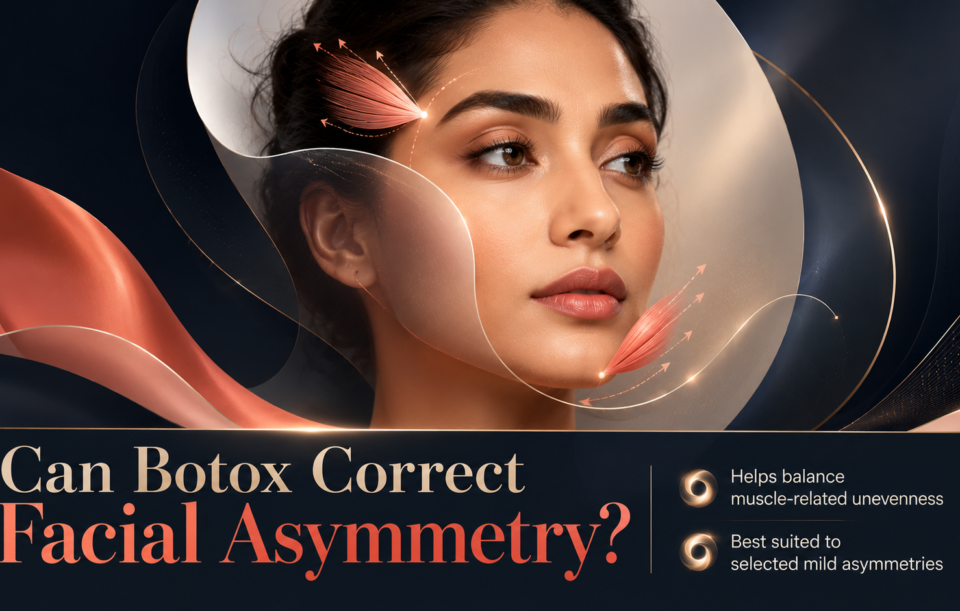
Botox face asymmetry correction can help improve certain types of mild facial asymmetry when differences are caused by uneven muscle activity. By temporarily relaxing specific muscles on one side of the face, Botox may create a more balanced appearance. However, Botox cannot correct every type of facial asymmetry, particularly when the difference is caused by bone structure, significant volume loss, nerve problems, or skeletal development.
Facial asymmetry is common, and small differences between the two sides of the face are normal. The goal of treatment is usually not to make both sides perfectly identical, but to create a more harmonious and balanced appearance.
Botox for facial asymmetry may be considered for concerns involving the eyebrows, jawline, chin, smile, or other areas where muscle activity contributes to an uneven appearance. Treatment requires careful assessment because excessive relaxation of a muscle can sometimes create new asymmetry or affect facial expression.
This guide explains when Botox may help an asymmetrical face, how treatment works, what results to expect, possible risks, recovery, and when other facial asymmetry treatments may be more appropriate.
Key Takeaways
- Botox may improve mild facial asymmetry caused by unequal muscle activity.
- It does not correct asymmetry caused by bone or skeletal differences.
- Treatment is customised according to facial movement and muscle strength.
- Results are temporary and vary between individuals.
- Careful injection technique is important because facial muscles work together.
- A professional assessment is recommended before choosing Botox for facial balancing.
What Is Facial Asymmetry?
Facial asymmetry refers to differences between the left and right sides of the face. Minor asymmetry is normal, but more noticeable differences may involve the eyebrows, eyes, cheeks, nose, lips, chin, or jaw. The cause can be muscular, structural, developmental, related to ageing, or associated with previous injury or medical conditions.
Common types include:
- Uneven eyebrows
- Uneven smile
- One side of the mouth pulling higher
- Unequal jaw muscle size
- Chin asymmetry
- Differences in facial muscle movement
- Uneven facial volume
Facial asymmetry: A difference in the shape, size, position, or movement of one side of the face compared with the other.
Not every form of asymmetry requires treatment. If the difference is new, sudden, or associated with weakness, numbness, difficulty speaking, or other neurological symptoms, medical evaluation should be prioritised rather than cosmetic treatment.
Can Botox Correct Facial Asymmetry?
Yes, Botox face asymmetry correction can improve selected cases where excessive or uneven muscle activity contributes to the difference between the two sides of the face. Botox works by temporarily reducing muscle contraction, allowing the treated side to move less strongly and potentially creating a more balanced appearance.
The treatment is most useful for dynamic asymmetry, meaning asymmetry that becomes more noticeable when the facial muscles move.
For example, one side of the mouth may pull more strongly during smiling, or one masseter muscle may be larger than the other.
However, Botox cannot reposition facial bones, replace missing volume, or correct major structural differences. The cause of asymmetry must therefore be identified before treatment.
How Does Botox Work for Facial Asymmetry?
Botox works by temporarily blocking nerve signals that tell targeted muscles to contract. When a selected muscle becomes less active, its movement or size can decrease, depending on the treatment area.
For facial balancing, a practitioner may deliberately treat one side differently from the other rather than using equal amounts of Botox on both sides.
Dynamic asymmetry: Facial unevenness that becomes more noticeable during movement because the muscles on one side behave differently from the other.
The goal is controlled muscle relaxation, not complete paralysis. Over-treatment can affect facial expression and potentially make the face look less balanced.
Who Is a Good Candidate for Botox Asymmetrical Face Treatment?
A suitable candidate is generally someone with mild facial asymmetry caused primarily by uneven muscle activity and realistic expectations about what Botox can achieve. The practitioner should first determine whether the asymmetry is muscular or structural.
An assessment may include:
- Facial appearance at rest
- Facial movement during smiling
- Eyebrow movement
- Jaw muscle activity
- Chin movement
- Muscle strength
- Previous facial procedures
- Facial volume
- Underlying structural differences
People with asymmetry caused mainly by bone structure, significant tissue loss, or major skeletal differences may require other treatment options.
If you are considering Botox for facial asymmetry, a personalised assessment can help determine whether muscle activity is contributing to the uneven appearance and whether Botox is appropriate.
What Areas Can Botox Help Balance?
Botox may be used for certain types of muscular imbalance involving different parts of the face. The exact treatment depends on the cause of the asymmetry rather than simply the location of the concern.
Eyebrow Asymmetry
Differences in forehead and eyebrow muscle activity can sometimes make one eyebrow appear higher than the other. Carefully selected Botox treatment may help create greater balance.
Smile Asymmetry
If one side of the mouth moves more strongly than the other, carefully targeted muscle relaxation may sometimes improve the balance of the smile.
Jaw Asymmetry
Differences in masseter muscle size can contribute to an uneven lower face. Botox may reduce the activity and size of an overactive masseter muscle in appropriate patients.
Chin Asymmetry
Uneven mentalis muscle activity can sometimes contribute to an uneven or dimpled chin. Botox may help when muscle contraction is a significant factor.
The injection points and treatment amount should be individually planned because the same approach is not appropriate for every patient.
What Are the Benefits of Facial Balancing With Botox?
The main advantage of facial balancing with Botox is that it can address certain muscular imbalances without surgery. The treatment is minimally invasive and usually involves small injections rather than incisions.
Potential benefits include:
- Improved facial balance
- More even muscle movement
- Subtle correction of dynamic asymmetry
- No surgical incision
- Minimal downtime
- Temporary and adjustable results
- Ability to target specific muscles
The results are generally designed to look subtle rather than dramatically change facial identity.
Botulinum toxin is widely used in aesthetic medicine to temporarily reduce specific muscle activity, but outcomes depend strongly on treatment technique and individual anatomy.
What Results Can You Expect?
The results of Botox for facial asymmetry are usually gradual and subtle. Depending on the area treated, patients may begin noticing changes within several days, with the effect becoming more apparent over approximately one to two weeks.
The goal is to reduce the difference between the two sides rather than create perfect symmetry.
Results can vary because of:
- Muscle strength
- Facial anatomy
- Degree of asymmetry
- Injection technique
- Individual response
- Underlying structural differences
A follow-up assessment may be useful once the Botox has taken effect. If additional correction is considered, it should be based on the observed result rather than automatically repeating treatment.
How Long Does Botox Facial Asymmetry Correction Last?
Botox correction is temporary. In many cosmetic applications, the effects commonly last around three to four months, although the duration varies depending on the treatment area, muscle activity, dose, and individual response.
As nerve-to-muscle activity gradually returns, the treated muscle becomes more active again and the original asymmetry may become noticeable.
Some patients choose repeat treatment to maintain the effect. The timing should be individually determined by the treating medical professional.
What Are the Risks of Botox for Facial Asymmetry?
Botox is generally well tolerated when appropriately administered, but it carries potential side effects. These can include temporary bruising, redness, swelling, tenderness, headache, or unwanted weakness of nearby muscles.
When treating facial asymmetry, an additional concern is that excessive or incorrectly placed Botox can temporarily create a different imbalance.
Potential risks include:
- Temporary asymmetry
- Facial weakness
- Drooping of nearby structures
- Changes in facial expression
- Difficulty controlling certain facial movements
- Bruising or swelling
- Headache
- Injection-site discomfort
Rare but serious botulinum toxin complications can occur. Symptoms such as difficulty swallowing, breathing problems, widespread muscle weakness, or significant vision changes require prompt medical attention.
Choosing an appropriately qualified practitioner with detailed knowledge of facial anatomy can help reduce avoidable risks.
How Is Botox Facial Asymmetry Treatment Performed?
Botox face asymmetry correction generally involves consultation, facial assessment, customised treatment planning, precise injections, and follow-up.
Step 1: Consultation
Your concerns, medical history, previous treatments, medications, and expectations are discussed.
Step 2: Facial Movement Assessment
The practitioner evaluates the face at rest and during expressions such as smiling, frowning, raising the eyebrows, or clenching the jaw.
Step 3: Identify the Cause
The practitioner determines whether muscle activity is contributing to the asymmetry and whether Botox can reasonably improve it.
Step 4: Customised Injection
Small amounts of Botox are injected into selected muscles. The amount may differ between the two sides depending on the degree of imbalance.
Step 5: Follow-Up
The result is assessed after the Botox takes effect. Further treatment should only be considered when clinically appropriate.
When Is Botox Not Enough to Correct Facial Asymmetry?
Botox is not a universal solution for facial asymmetry. When the underlying problem involves bone, cartilage, significant volume loss, skin excess, or major structural differences, another treatment may be required.
Possible alternatives may include:
- Dermal fillers for selected volume differences
- Fat grafting for certain volume deficiencies
- Rhinoplasty for structural nasal asymmetry
- Orthognathic or jaw surgery for significant skeletal problems
- Facial implants in selected cases
- Skin or soft-tissue procedures
- Reconstructive surgery when appropriate
Some patients may benefit from a combination of treatments.
The correct approach depends on the cause, severity, location, and patient’s goals.
Botox vs Other Facial Asymmetry Treatments
The best facial asymmetry treatment depends on what is causing the uneven appearance. Botox may be suitable when one side of the face has stronger or more active muscles. Dermal fillers or fat grafting may be considered when differences are related to volume, while surgical procedures may be more appropriate when the asymmetry involves the nose, jawbone, or other underlying structures.
Botox is mainly used for muscle-related asymmetry. By temporarily reducing the activity of an overactive muscle, it may help create better balance in areas such as the eyebrows, smile, chin, or jaw.
Dermal fillers may be considered when one side of the face has less volume than the other. Depending on the area treated, filler can restore selected areas of soft-tissue volume and improve facial proportions.
Fat grafting uses the patient’s own fat to add volume to areas with certain deficiencies. It may be considered when a longer-lasting volume correction is desired, although results can vary as some of the transferred fat may be naturally reabsorbed.
Rhinoplasty may be appropriate when asymmetry is caused by the structure of the nose, such as a crooked nasal framework or uneven nasal tip. Unlike Botox, rhinoplasty can modify the underlying cartilage and bone.
Jaw surgery may be considered for significant skeletal asymmetry involving the position or development of the jaw. This is a much more involved treatment than cosmetic Botox and requires specialist assessment.
Facial surgery or reconstructive procedures may be appropriate for selected structural or soft-tissue differences, particularly when asymmetry is significant or related to previous injury or surgery.
Ultimately, there is no single treatment that is best for every asymmetrical face. The underlying cause should be assessed first, because treating muscle activity when the real problem is structural may not produce the desired result. A personalised evaluation can help determine whether Botox, fillers, fat grafting, rhinoplasty, or another approach is most appropriate.
Why Choose an Experienced Practitioner?
Facial muscles interact closely with one another. Changing the activity of one muscle can influence the movement and appearance of nearby areas. This makes detailed facial assessment particularly important when Botox is being used for balancing rather than simply treating wrinkles.
At Elegance Clinic, treatment planning is based on individual facial anatomy, muscle movement, aesthetic goals, and safety considerations.
You can learn more about Elegance Clinic Surat and its cosmetic and aesthetic services.
For information about Dr. Ashutosh Shah’s qualifications and experience, visit Dr. Ashutosh Shah, Plastic Surgeon in Surat.
Botox face asymmetry correction can be useful for selected patients when uneven muscle activity contributes to a difference between the two sides of the face. By temporarily reducing the activity of carefully selected muscles, Botox may improve the balance of areas such as the eyebrows, smile, chin, or jaw.
However, Botox cannot correct every type of facial asymmetry. Differences caused by bone structure, significant volume loss, cartilage, or other structural factors may require fillers, fat grafting, surgery, or another treatment approach.
The most important step is identifying the underlying cause before treatment. An experienced medical professional can assess your facial movements and structure and explain whether Botox is likely to provide meaningful improvement.
If you are considering Botox for facial asymmetry in Surat, Dr. Ashutosh Shah at Elegance Clinic can assess your concerns and discuss suitable treatment options.
Book a personalised consultation at Elegance Clinic Surat to understand whether Botox or another facial asymmetry treatment is appropriate for you.
Frequently Asked Questions
A: Botox can improve some mild asymmetry caused by uneven muscle activity, but it cannot correct major structural or skeletal differences.
A: It may help when uneven muscle activity causes one side of the smile to pull differently.
A: Botox may create better balance by reducing excessive activity in selected muscles, but perfect symmetry is not a realistic goal.
A: Results are temporary and commonly last around three to four months, although individual results vary.
A: It may help when asymmetry is related to differences in masseter muscle size, but it cannot correct an underlying jawbone difference.
Category
Latest From Blog
What Are the Risks of an Eyebrow Lift?
Is Botox Safe for Forehead Lines?
How Can You Treat Horizontal Neck Lines?