




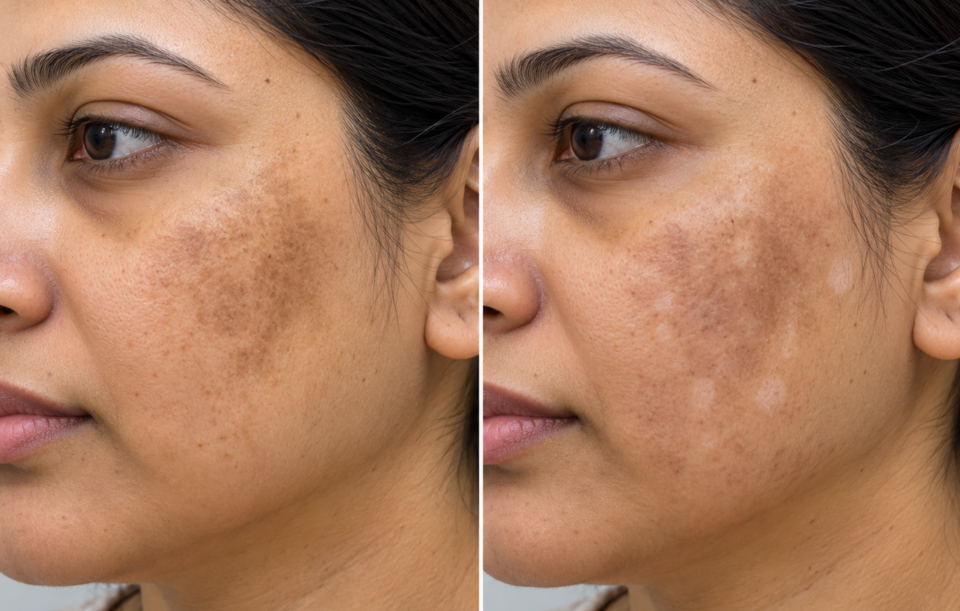
Laser toning is commonly used to improve selected pigmentation concerns, but it is not simply a matter of making the laser stronger or repeating sessions more frequently. In darker skin, inappropriate treatment can sometimes lead to more visible pigmentation or uneven lighter areas.
Laser toning commonly refers to low-fluence Q-switched Nd:YAG treatment, often using the 1064-nm wavelength, to target pigment gradually. Important potential complications include recurrent or rebound darkening and, after repeated treatment, mottled hypopigmentation or patchy lighter areas. Published reviews emphasize careful patient selection, conservative treatment parameters and adequate intervals between sessions.
The key is to identify what type of pigmentation is actually being treated, use an appropriate treatment plan and monitor the skin rather than continuing automatically.
What Does Laser Toning Actually Do To Pigment?
Laser toning uses short laser pulses to target melanin or pigment within the skin. The commonly discussed approach uses a low-fluence Q-switched Nd:YAG laser, particularly the 1064-nm wavelength, which can reach deeper pigment.
The objective is gradual reduction of excess pigmentation rather than changing a person’s natural skin colour.
Laser toning may be considered for selected pigmentary conditions, but the diagnosis matters. Melasma, post-inflammatory hyperpigmentation, freckles and acquired dermal melanoses do not behave identically and should not automatically receive the same laser protocol.
For melasma specifically, the Indian Pigmentary Expert Group concluded that lasers should not be considered first-line treatment. They may be used as an adjunct in selected resistant cases after appropriate patient selection and counselling, and low-fluence Q-switched Nd:YAG may be considered in refractory cases.
Why Can Pigment Come Back Darker After Toning?
Pigment can become darker after treatment for several reasons.
One possibility is post-inflammatory hyperpigmentation, where inflammation or irritation stimulates additional melanin production. Another is recurrence of the underlying pigmentation, particularly with melasma, which is a chronic and relapsing condition.
Treatment parameters can also matter. If the skin receives excessive energy or insufficient recovery time, irritation may increase the risk of unwanted pigment changes.
This is why darker pigmentation after laser toning should not automatically be treated with a stronger laser session. The diagnosis, settings, treatment interval, skin response and skincare plan should be reassessed first.
Published literature also reports that recurrence can occur after discontinuing laser therapy for melasma and that treatment protocols are not standardized.
What Are The White Spots Some People Get After Many Sessions?
One of the complications discussed in the literature is mottled hypopigmentation.
Instead of the skin becoming darker, small irregular areas can become lighter than the surrounding skin. These may look like scattered white or pale spots.
Mottled hypopigmentation has been reported following laser toning. A review of Q-switched laser treatment notes that the risk may be reduced with appropriate treatment parameters, larger spot sizes and longer intervals between sessions.
This does not mean that every person having laser toning will develop white spots. It does mean that repeated treatment should be monitored carefully rather than performed indefinitely.
Who Should Not Start Laser Toning?
Laser treatment should generally be reconsidered or postponed when the diagnosis is uncertain or when the skin is not suitable for treatment.
A clinician may defer treatment when there is:
- An undiagnosed pigmentation problem
- Active skin irritation, infection or significant inflammation
- Recent sunburn or substantial tanning
- A history suggesting unusually high sensitivity to light-based treatment
- Significant irritation from current skincare products
- Pigment that is already becoming progressively darker
- An unrealistic expectation that laser will permanently change overall skin colour
The exact decision depends on the individual. A proper examination is particularly important because different pigmentation disorders can look similar but require different treatment approaches.
For melasma, topical treatment and photoprotection remain important parts of management. The Indian consensus review describes topical therapies and sun protection as mainstays of treatment.
How Many Sessions And What Spacing Are Considered Safe?
There is no universally established maximum number of laser-toning sessions that can be considered safe for everyone.
The appropriate number depends on the diagnosis, skin type, treatment parameters, response and interval between sessions. A published review specifically notes that there is no consensus regarding the ideal protocol or number of sessions for melasma.
One prospective study involving 60 Indian patients with melasma used five treatment sessions at three-week intervals. That was a specific research protocol, not a universal prescription. The study reported no persistent or rebound pigmentation in its participants and emphasized low fluences, adequate recovery time and a maintenance plan.
Therefore, the question should not simply be, “How many sessions can I have?” It should be, “Is my skin improving safely, and is another session still appropriate?”
Laser Toning Safety Checklist
Before another treatment, the following points should be reviewed:
| Safety check | What should be reviewed? |
|---|---|
| Diagnosis confirmed | Melasma, tan, freckles, Hori’s nevus or another pigment disorder |
| Topical treatment | Whether appropriate medical treatment has been tried |
| Session count | How many laser-toning sessions have already been performed |
| Interval | Time between previous sessions |
| Pigment trend | Standardized photographs at each review |
| Stop rule | What happens if pigmentation visibly worsens |
For this treatment protocol, visible darkening on a review photograph is treated as a stop signal pending reassessment. This is a practical monitoring rule, not a universal international guideline.
Laser Toning For Face: Is It Good Or Bad?
People often ask whether pigmentation laser treatment is good or bad.
There is no single answer. Laser treatment can be useful for selected pigmentation problems, but the benefit depends on correct diagnosis, appropriate settings and careful follow-up.
Similarly, there is no single safe skin tone laser that is suitable for every person or every pigment condition. The treatment should target a diagnosed pigmentation problem rather than promise generalized skin lightening.
For people considering laser toning for face treatment, the consultation should establish what is being treated, whether non-laser treatment has been tried and whether laser is actually appropriate.
You can learn more about the treatment approach through the clinic’s information on Laser for pigmentation and Melasma treatment.
Laser Toning Before And After: What Should You Compare?
Laser toning before and after photographs should be compared under similar lighting, camera position, facial angle and exposure.
A photograph taken under brighter light can make pigmentation appear lighter even when the skin has not actually improved. Likewise, shadows or different camera settings can make pigmentation look worse.
Useful comparisons include:
- Overall pigment intensity
- New dark patches
- Areas of rebound pigmentation
- Patchy lighter areas
- Redness or irritation
- Whether improvement remains stable between visits
Consistent photography makes it easier to identify gradual improvement or early unwanted changes.
Laser Toning Near Piplod: What Should Be Checked Before Treatment?
Before choosing a treatment, ask whether the pigmentation diagnosis has been established and whether the treatment plan includes appropriate topical care and photoprotection.
It is also useful to ask how many sessions are planned initially, how long the intervals will be and what would happen if the pigment becomes darker.
A responsible treatment plan should include reassessment rather than automatically scheduling an unlimited series of sessions.
Is Laser Toning Safe For Indian Skin?
Laser toning can be used in selected people with Indian skin, but darker skin requires particular attention to treatment parameters because unwanted pigmentary changes can occur.
The Indian Pigmentary Expert Group recommends careful patient selection and counselling and does not recommend low-fluence Q-switched Nd:YAG as monotherapy for melasma.
The important point is that “Indian skin” is not a single uniform skin type. Individual pigmentation, skin response, diagnosis and treatment history all matter.
What Should I Do If My Pigment Gets Darker After Toning?
Do not assume that another laser session will correct the problem.
If pigmentation becomes darker, treatment should be paused while the skin is assessed. Possible explanations include irritation-related pigmentation, recurrence of the underlying condition, an incorrect diagnosis or an unsuitable treatment protocol.
If you are receiving laser toning near piplod, visible worsening should be reported before another session so that the treatment plan can be reassessed.
Is There Any Downtime After Laser Toning?
Downtime can be limited with conservative treatment, but this does not mean there is no possible skin reaction.
Temporary redness, sensitivity or mild irritation may occur. The amount of recovery time depends on the laser parameters and the individual’s skin response.
The absence of significant downtime should not be used as a reason to repeat treatment too frequently.
Can I Do Laser Toning Before A Festival?
A new laser treatment immediately before an important event is generally something to discuss carefully with the treating clinician.
Even when the expected downtime is short, temporary redness, sensitivity or unexpected pigmentation can occur. There should be enough time to observe the response before an important event.
If the skin has previously become darker after treatment, repeating the procedure immediately before a festival is particularly inappropriate without reassessment.
Featured Questions
It can be appropriate for selected patients, but treatment should use suitable parameters and careful monitoring. Laser is not considered first-line monotherapy for melasma.
Darkening may result from post-inflammatory pigmentation, recurrence of the underlying condition or another treatment-related problem. Worsening pigmentation should be assessed before another session.
There is no universal number. Published literature states that there is no consensus on the ideal number or protocol for melasma treatment with Q-switched Nd:YAG laser.
Common Questions About Laser Toning Side Effects
Is laser toning safe for melasma?
Laser toning may be considered for selected resistant melasma, but it is not recommended as first-line monotherapy. Topical treatment, photoprotection and appropriate maintenance remain important.
How many laser toning sessions are too many?
There is no universal session number that defines “too many.” Repeated sessions should be based on the diagnosis, response, treatment settings and adequate recovery intervals rather than a predetermined number.
Can laser toning lighten my overall skin colour?
Laser toning is intended to target excess pigment, not permanently change a person’s natural skin colour. The goal should be improvement in uneven pigmentation rather than generalized skin bleaching.
What should I do if my pigment gets darker after toning?
Pause further treatment and have the skin reassessed. New or worsening pigmentation should not automatically be treated with a stronger laser setting.
Is there any downtime after laser toning?
Downtime can be limited, but redness, sensitivity or temporary irritation can occur. Recovery depends on the treatment parameters and individual skin response.
Can I do laser toning before a festival?
Allow sufficient time before an important event to observe the skin’s response. Starting a new treatment immediately before a festival can make unexpected redness or pigment changes difficult to manage.
The Safer Way To Approach Laser Toning
Laser toning can have a role in selected pigmentation cases, but repeated treatment should never become automatic.
The safest approach is to confirm the diagnosis, use appropriate medical treatment and photoprotection, choose conservative laser parameters when laser is indicated, allow adequate recovery time and document the skin’s response with consistent photographs.
For melasma in particular, current evidence supports individualized treatment rather than assuming that more laser sessions will produce more improvement. The Indian expert literature places laser treatment after appropriate patient selection and counselling, particularly for resistant disease.
If pigment becomes visibly darker or patchy lighter areas develop, the next step should be reassessment rather than simply increasing treatment intensity.
For additional information about the available laser approach, see Nd:YAG laser skin treatment and Daag dhabba door karva.
Medical Review Note
This article should be reviewed by Dr. Ashutosh Shah, Physician, before publication. It provides general educational information and does not replace an individual dermatological assessment.


Category
Latest From Blog
Small Black Warts on Face and Neck: Removal and Recurrence
Can Facial Ageing Be Treated Without Surgery?
Red Veins On The Face: What Causes Them And Which Vascular Laser Fits