




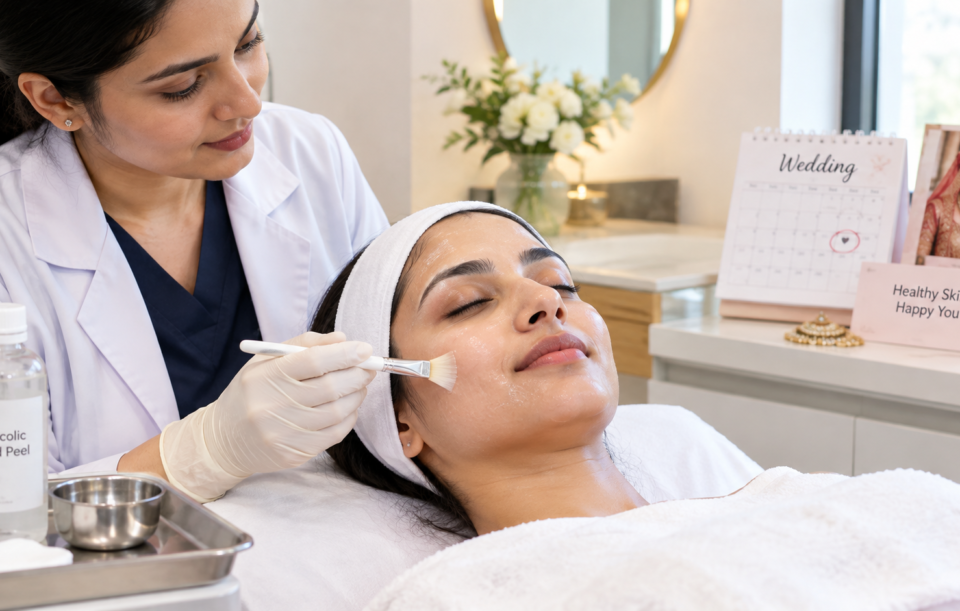
A light chemical peel such as glycolic, mandelic or salicylic should be done at least 7 to 14 days before a wedding or festival so any flaking settles. A medium peel like TCA needs 4 to 6 weeks. If you have never had a peel, do a trial 6 weeks ahead, because Indian skin can darken after irritation.
How long does each type of peel take to settle?
Chemical peel timing depends on the type and depth of the peel. When treatment is planned around a wedding or festival, the event date should be considered before choosing the treatment date. A chemical peel before wedding functions should not be scheduled simply because an appointment is available.
A light peel such as glycolic, mandelic or salicylic should be done at least 7 to 14 days before the event so any visible flaking can settle.
A medium peel such as TCA requires a longer gap of 4 to 6 weeks.
The first treatment needs additional planning. If you have never had a peel, the supplied decision rule is to do a trial 6 weeks ahead. This allows the skin response to be assessed before the important event.
The treatment timing should also account for photographs, makeup and other wedding or festival functions. A person may have several events rather than one single date, so the earliest important function should be considered when planning.
For people preparing their skin for an event, information about chemical peels can be reviewed before deciding when to schedule the treatment.
Chemical peel timing table
| Peel type | Depth | Visible peeling days | Minimum gap before event | Last safe date for Diwali 8 Nov |
|---|---|---|---|---|
| Glycolic | Superficial | Depends on individual response | 7-14 days | 25 Oct-1 Nov |
| Mandelic | Superficial | Depends on individual response | 7-14 days | 25 Oct-1 Nov |
| Salicylic | Superficial | Depends on individual response | 7-14 days | 25 Oct-1 Nov |
| Lactic | Superficial | Depends on individual response | 7-14 days | 25 Oct-1 Nov |
| TCA | Medium-depth | Longer recovery period | 4-6 weeks | 27 Sep-11 Oct |
The Diwali dates above are calculated by counting backwards from the 8 Nov event date using the minimum-gap rules supplied in the sheet.
Why should a first peel never be done just before an event?
A first chemical peel should not be treated as a last-minute treatment before a wedding or festival. The sheet specifically recommends a trial 6 weeks ahead for someone who has never had a peel.
The reason for this planning window is that individual skin responses can differ. The supplied brief specifically highlights that Indian skin can darken after irritation, making it important to avoid experimenting immediately before an important event.
A trial gives time to understand how the skin responds before the final treatment schedule is fixed.
This is especially relevant when considering a glycolic peel before wedding functions. Even though a light peel has a shorter minimum gap, a first-time treatment still needs the longer trial window specified in the brief.
The same planning principle applies to mandelic and salicylic peels.
If the event is important enough to require close-up photographs, makeup and multiple functions, the first treatment should not be placed immediately before the event.
The six-week trial also provides a more practical way to plan the final treatment because the patient has already experienced the selected peel.
The aim is to avoid discovering an unexpected skin response only a few days before the wedding or festival.
What is the last safe date for a peel before Diwali and wedding functions?
For the supplied 8 Nov Diwali date, the last safe timing depends on the peel type.
A superficial peel such as glycolic, mandelic or salicylic requires a minimum gap of 7 to 14 days. Counting backwards from 8 Nov gives a planning range of approximately 25 Oct to 1 Nov.
A medium-depth TCA peel requires 4 to 6 weeks. Counting backwards from 8 Nov gives an approximate planning range of 27 Sep to 11 Oct.
A first-ever peel should be trialled 6 weeks ahead, according to the supplied decision rule.
These dates should be considered alongside wedding functions and photography. If there is an earlier function before the main event, that earlier date should become the practical deadline.
The same principle applies to wedding season. The treatment should be planned around the event schedule rather than treated as a last-minute skin appointment.
For someone considering a chemical peel before diwali, counting backwards from the event date provides a simple starting point for treatment planning.
The important distinction is between a superficial peel with a shorter minimum gap and a medium-depth peel that needs substantially more time.
Which skin types and medicines need extra caution?
Skin type and medicines should be considered before scheduling a peel close to an important event. The sheet specifically identifies sensitive skin chemical peel as a secondary keyword and requires extra caution for certain skin types and medicines.
Sensitive skin may have a greater need for careful treatment planning when the event date is fixed.
The supplied brief also highlights the possibility of skin darkening after irritation in Indian skin. This makes the timing of a first peel particularly important.
If the patient has never had a peel, the sheet’s rule is to perform a trial 6 weeks ahead rather than trying the treatment immediately before the event.
Medicines should also be discussed during the consultation. The sheet requires caution around medicines but does not provide a specific medication list, so this article does not add one.
Patients should provide relevant medication information during consultation so the treatment plan can be considered appropriately.
The event schedule should also be disclosed because the amount of recovery time available affects how close the treatment can be planned to the wedding or festival.
What should you avoid in the week after a peel?
The week following a chemical peel should be planned as part of the overall treatment timeline rather than ignored when choosing the appointment date.
The supplied sheet specifically requires consideration of what should be avoided in the week after a peel, but it does not provide a detailed list of products or activities. Therefore, specific avoidance instructions should come from the treatment provider rather than being added without support from the sheet.
The important planning point is that visible flaking or irritation may occur, which is why the peel should not be scheduled immediately before a wedding or festival.
For a light peel, the supplied minimum gap is 7 to 14 days.
For a medium TCA peel, the minimum gap is 4 to 6 weeks.
For a first-ever peel, the supplied rule is a 6-week trial.
Patients should follow the individual aftercare instructions given for their selected peel.
Planning the treatment earlier gives more time for the skin to settle if the response lasts longer than expected.
For patients also considering other approaches to uneven or unwanted tanning, the related guide on clearing a tan that will not fade can be reviewed.
Chemical peel near city light: how should the timing be planned?
When looking for a chemical peel near city light, the event date should be discussed before the appointment is scheduled.
A superficial peel such as glycolic, mandelic or salicylic should have 7 to 14 days before the wedding or festival.
A medium-depth TCA peel should have 4 to 6 weeks.
If it is the first chemical peel, the supplied rule is to perform a trial 6 weeks ahead.
The important issue is not simply where the treatment is performed. The treatment date needs to fit the event calendar and leave enough time for visible flaking and irritation to settle.
If several wedding functions are planned, the earliest important function should be used as the deadline.
The same applies to Diwali. The supplied event date is 8 Nov, so the peel should be scheduled by counting backwards according to the type and depth of treatment.
The consultation should also cover sensitive skin, medicines and the possibility of darkening after irritation, particularly because the supplied brief highlights this concern for Indian skin.
How should you plan a chemical peel before a wedding?
Start by identifying the wedding date and any earlier functions or photography dates.
Then identify the planned peel:
- Glycolic: 7-14 days before the event.
- Mandelic: 7-14 days before the event.
- Salicylic: 7-14 days before the event.
- Lactic: 7-14 days before the event.
- TCA: 4-6 weeks before the event.
If it is your first peel, plan a trial 6 weeks ahead.
The decision should also consider sensitive skin, medicines and the possibility of darkening after irritation.
For people looking for smoother event-ready skin, information about treatments for smoother skin can be reviewed as part of the planning process.
The key is to give the skin enough time to settle rather than choosing a treatment date immediately before the event.
Final decision rule
The supplied decision rule can be summarised simply:
Superficial peel: 7 to 14 days before the event.
Medium-depth peel: 4 to 6 weeks before the event.
First-ever peel: trial at 6 weeks.
Topical retinoids: stop 5 to 7 days before the peel, according to the supplied decision rule.
For Diwali on 8 Nov, count backwards from the event date.
A light peel should be planned within the supplied 25 Oct-1 Nov window, while a medium-depth TCA peel should be planned within the supplied 27 Sep-11 Oct window.
The exact response can vary, so the treatment should be planned with enough time before wedding or festival functions.
FAQs
A chemical peel should not normally be planned only 3 days before a wedding. The supplied timing rule gives 7 to 14 days for a superficial peel and 4 to 6 weeks for a medium-depth TCA peel, allowing visible flaking and irritation time to settle before the event.
Visible flaking can occur after a chemical peel, which is why treatment timing matters before a wedding. A light peel should be planned at least 7 to 14 days ahead, while a medium TCA peel needs 4 to 6 weeks according to the supplied event-planning rule.
The supplied decision rule says to stop topical retinoids 5 to 7 days before a chemical peel. Because individual skin responses and treatment plans can differ, retinoid use should be discussed during the consultation, especially when the peel is being planned close to a wedding or festival.
The supplied sheet does not provide a specific waiting period for waxing or threading after a chemical peel. Rather than adding an unsupported number, follow the treatment provider’s instructions for your specific peel and skin response, particularly if the treatment has been scheduled close to an important wedding or festival.
Extra caution is important when a person has pigmentation concerns. The supplied brief specifically highlights the risk that Indian skin can darken after irritation. A chemical peel should therefore be discussed carefully before treatment, especially when the event is close and there is limited time for the skin to settle.
The supplied sheet does not identify one specific peel as the safest option for sensitive skin. It requires extra caution for sensitive skin and medicines. The appropriate peel and timing should therefore be decided during consultation, with the wedding or festival date considered before treatment is scheduled.


Category
Latest From Blog
Small Black Warts on Face and Neck: Removal and Recurrence
Can Facial Ageing Be Treated Without Surgery?
Red Veins On The Face: What Causes Them And Which Vascular Laser Fits