




Written by Dr. Ashutosh A Shah, M.B.B.S., M.S., M.Ch., D.N.B., Board Certified Plastic and Cosmetic Surgeon, Elegance Cosmetic Clinic, Surat. Reg. no. [REG NO]. 22+ years in plastic, reconstructive and aesthetic practice.
Medically reviewed by Dr. Ashutosh A Shah · Published 28 September 2026 · Last reviewed 28 September 2026
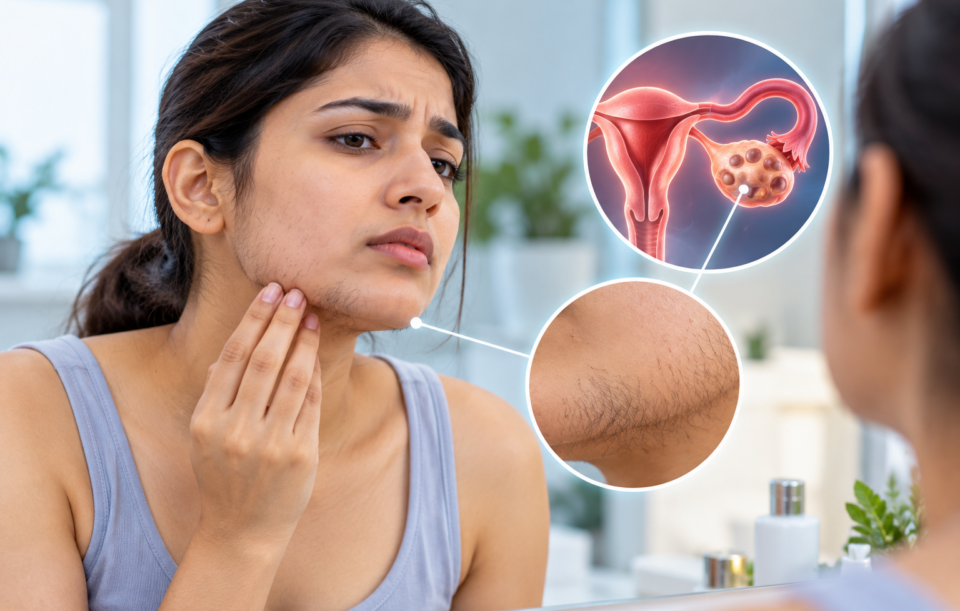
PCOS unwanted hair growth is hormonally driven, which is why removing it does not stop it returning. Treating the hair without addressing the underlying condition manages the symptom only. Laser reduction generally needs a longer course and ongoing maintenance in PCOS than in hormonally normal hair growth.
If you have been removing the same hair for years and it keeps arriving, nothing has gone wrong with your technique. The removal was never the thing that would stop it.
This page explains what is actually driving it, what that changes about treatment, and one thing that matters more than any of it and is routinely left out of the conversation at a cosmetic clinic.
Why does PCOS unwanted hair behave differently from other hair growth?
Because something is actively producing it. Most unwanted hair is simply hair that grew and is there. In PCOS a hormonal signal keeps prompting follicles to produce coarse hair in places they otherwise would not.
That distinction decides everything else on this page. If hair is just present, removing it deals with it. If hair is being produced, removing it deals with what has already been produced and nothing that follows.
This is why the frustration is so specific. Women describe it as the hair “coming back faster”, and the more accurate description is that it never stopped arriving in the first place.
What is actually driving the growth?
Hormones, and the NHS is careful to say the underlying cause of the condition itself is not fully known. Its page states that the cause “is unknown, but it may be to do with hormones such as insulin and testosterone not working properly.”
Excess hair growth is listed as one of the condition’s main features, alongside irregular periods, difficulty getting pregnant, weight changes, acne and low mood. The NHS describes it as “a hormone condition that can affect hair growth, periods, fertility and mood.”
One note on naming, because you may see both terms. The NHS has renamed the condition and now calls it polyendocrine metabolic ovarian syndrome, stating that “PMOS used to be called polycystic ovary syndrome (PCOS).” The international guideline and most clinicians in India still say PCOS, which is the term used throughout this page.
Why do waxing and shaving change nothing about recurrence?
Because they remove hair that already exists and do nothing to the follicle or to the signal reaching it. Every method that removes the visible hair is working downstream of the cause.
This is not a criticism of them. They do what they claim. The problem is that the claim has been quietly translated in most people’s minds into something more permanent than it was.
- Shaving cuts hair at the surface. Nothing below the surface is affected.
- Waxing and threading remove hair from the follicle. The follicle remains, and the signal prompting it remains.
- Creams dissolve hair at or near the surface. Same position.
- None of them changes the rate at which new hair is produced, which is the actual complaint.
So the cycle most women describe, removing it and watching it return, is not a failure of the method. It is the method working exactly as designed on a problem that is being renewed from elsewhere.
What can laser reduction do here, and what can it not?
It reduces hair. It does not affect the condition producing it. Those two facts sit at opposite ends of the same sentence and confusing them is how people end up disappointed after spending a great deal.
The international guideline does support its use. It states that “Mechanical laser and light therapies should be considered for reducing facial hirsutism and for related depression, anxiety and quality of life in women with PCOS.” Note that the guideline names quality of life and mood explicitly. The distress is treated as a legitimate reason, not a vanity.
| What you are asking about | In PCOS | In hair growth with no hormonal driver |
|---|---|---|
| Reducing the hair currently present | Yes, this is what it does | Yes |
| Sessions needed to reach that reduction | The guideline states more may be required | Fewer, comparatively |
| Whether maintenance is likely afterwards | Usually, because production continues | Less often, and less frequently |
| New hair appearing in previously unaffected areas | Possible, because the driver is systemic | Not expected |
| Effect on the underlying condition | None. Laser does not treat PCOS | Not applicable |
| Effect on other features such as periods or fertility | None whatsoever | Not applicable |
Read the fifth row as the most important one. Nothing done to hair changes the condition, and any clinic suggesting otherwise is describing something that does not happen.
How laser reduction works, why it is called reduction rather than removal, and what the growth cycle has to do with the number of visits are covered separately in our guide to how many laser hair reduction sessions it takes.
Why is the course longer, and why is maintenance the norm?
Because the production does not stop when the treatment does. The guideline puts the practical consequence directly: “A greater number of laser treatment sessions may be required in women with PCOS, compared to women with idiopathic hirsutism, to achieve hair reduction.”
That is a comparison rather than a count, and this page is not going to give you a number. How many sessions any individual needs is set at assessment and depends on far more than the diagnosis.
What is worth understanding is why the shape of the course differs.
- More hair is in active production at any given time, so more of it becomes treatable across a longer window.
- The driver continues after the course ends, which is what makes periodic maintenance the expectation rather than a sign something went wrong.
- Hair can appear in areas that were previously clear, because a systemic signal is not confined to the area being treated.
- If the underlying condition is managed, the picture can change, which is a conversation for the doctor managing it rather than for this page.
What should be assessed before starting any hair treatment?
Whether PCOS has actually been diagnosed, and whether the condition itself is being managed by anyone. Both questions are frequently unanswered in women who have been having hair treatments for years.
Worth establishing before you spend anything on hair.
- Has the diagnosis been made properly, by a doctor, rather than assumed from the hair growth itself.
- Is anyone managing the condition, as opposed to managing its most visible feature.
- Has the hair growth changed recently, particularly if it has appeared or worsened quickly, which is a reason for assessment rather than treatment.
- Are the other features being looked at, including periods, and fertility if that is relevant to you now or later.
- Has your metabolic risk been assessed, which is the subject of the next section and the one most often skipped entirely.
Why is PCOS not only a hair condition?
Because it carries risks that have nothing to do with how you look, and those risks are what the guidelines are most concerned with. This is the section that matters more than everything above it.
The 2023 international guideline is unambiguous about what should be happening. It states that “Glycaemic status should be assessed at diagnosis in all adults and adolescents with PCOS” and that “All women with PCOS should be assessed for cardiovascular disease risk factors.”
The NHS lists the conditions the risk of which can be raised: “type 2 diabetes; high blood pressure; cardiovascular disease (CVD); non-alcoholic fatty liver disease; womb (uterus) cancer.”
Put plainly. If you have PCOS and have had hair treatments for years without anyone checking your glycaemic status or your cardiovascular risk factors, you have been receiving the least important part of your care, attentively, while the most important part has not started.
That is not a reason to feel foolish. It is a reason to book a different appointment, with a doctor who manages the condition rather than its appearance.
Why is treating the hair alone incomplete care?
Because it addresses what you can see and leaves what you cannot. A hair treatment plan with no corresponding plan for the condition is half a plan, and it is the visible half.
There is a second reason, and it is more practical. Managing the condition is the only thing that can change what the hair does over time. Everything a cosmetic clinic can offer works on hair that has already been produced. Only the doctor managing the condition is working on the production itself.
Which is why the sequence matters more than people expect. Getting the condition assessed and managed does not mean delaying hair treatment, and the two frequently run alongside each other. It means not treating the hair instead of the condition, which is what happens by default when the only door a woman walks through is a cosmetic one.
What that management consists of is genuinely not this page’s business, and specifically not this clinic’s to prescribe. Ask the doctor managing your PCOS.
What are realistic expectations?
Meaningful reduction in what is there, over a longer course than average, with maintenance continuing afterwards, and no effect at all on the condition. That is the honest version and it is worth having before you start rather than after.
- Expect reduction, not removal. That is true of laser generally and is not specific to PCOS.
- Expect a longer course than a friend without PCOS describes, per the guideline.
- Expect maintenance, and treat it as part of the plan rather than as evidence of failure.
- Expect no change in periods, fertility, weight or anything else. Nothing done to hair affects those.
- Do not expect a number of sessions from a website, including this one. Anyone quoting one before assessing you is guessing.
How is this assessed at Elegance, Surat?
By establishing what is driving the growth before discussing anything that removes it, and by asking who is managing the condition. If the answer is nobody, that conversation comes before the treatment plan.
In our practice in Surat the most common history on this is a woman in her twenties who has been waxing or threading the same areas for six or seven years, has been told at some point that she probably has PCOS, and has never been assessed for anything other than the hair. She is usually apologetic about raising it, which is its own comment on how this subject gets handled. The second most common is a woman who has had a course of laser elsewhere, was not told maintenance would be needed, and has concluded the treatment failed when it did what it was always going to do.
An assessment covers what the growth pattern actually is and when it changed, whether the diagnosis has been properly made, who is managing the condition, your skin and hair type, what you have already tried, and a realistic description of the course and the maintenance afterwards. Where the condition is not being managed, we will say so and say why that matters more than the hair does.
Next step
If nobody is currently managing your PCOS, that appointment matters more than this one. If it is being managed and the hair is what you want addressed, book an assessment through the Elegance Clinic contact page in Surat.
This article is for education and is not a substitute for professional assessment. It describes what the NHS and the 2023 international guideline state about this condition and about laser for excess hair. No treatment described here treats PCOS itself, and nothing on this page replaces assessment and management of the condition by a qualified doctor. Please discuss your own situation with a clinician.
A hormonal signal prompts follicles to produce coarse hair in areas they otherwise would not. The NHS says the cause of the condition is unknown but may relate to hormones such as insulin and testosterone not working properly. Because the signal continues, so does the production.
Yes, for reducing hair that is present. The international guideline says laser and light therapies should be considered for reducing facial hirsutism and for the related effects on mood and quality of life. It reduces hair. It does not affect the condition producing it.
Because the hormonal driver continues after the course ends, so new hair keeps being produced. This is not a failure of the treatment or a sign it was done badly. It is the predictable consequence of treating hair while the thing generating it carries on.
There is no number this page can honestly give you. The guideline says more sessions may be required in PCOS than in hirsutism without a hormonal driver, which is a comparison rather than a count. The number is set at assessment, and anyone quoting one beforehand is guessing.
You should have the condition assessed and managed regardless, and the two usually run alongside each other. The guideline says glycaemic status should be assessed at diagnosis and all women with PCOS should be assessed for cardiovascular risk factors. Hair treatment does not replace either.
It does not increase the hormonal drive, so it does not make the underlying growth worse. What it does is remove hair that already exists without affecting production, which is why the pattern repeats. Waxing before a laser course is a separate issue worth asking about first.
Expect it to continue while the hormonal driver does. That is the honest answer, and it is the reason maintenance should be discussed before a course rather than presented afterwards. If the condition is being managed, what happens to the hair may change, which is a question for that doctor.


Category
Latest From Blog
Small Black Warts on Face and Neck: Removal and Recurrence
Can Facial Ageing Be Treated Without Surgery?
Red Veins On The Face: What Causes Them And Which Vascular Laser Fits