




Written by Dr. Ashutosh A Shah, M.B.B.S., M.S., M.Ch., D.N.B., Board Certified Plastic and Cosmetic Surgeon, Elegance Cosmetic Clinic, Surat. Reg. no. [REG NO]. 22+ years in plastic, reconstructive and aesthetic practice.
Medically reviewed by Dr. Ashutosh A Shah · Published 28 September 2026 · Last reviewed 28 September 2026
Skin booster treatment is an injectable that improves skin hydration and quality rather than adding volume or changing shape. It is given as a course of sessions and the effect is gradual. It does not lift, it does not fill lines caused by volume loss, and it does not replace sun protection.
This is one of the harder aesthetic treatments to research honestly, because it sits in the same sentence as fillers in most marketing and does something completely different.
So this page separates the two properly, says what a course actually involves, and is specific about who should not have it. If you are deciding whether to book, the two sections worth reading first are what it cannot change, and who it is not for.
What is a skin booster, actually?
An injectable placed into the upper layers of the skin to improve hydration and skin quality, rather than to change the shape of anything.
A review in the Indian dermatology journal Cosmoderma describes the category as a method of delivering “either hyaluronic acid (HA) infused with other vitamins, amino acids, and antioxidants or HA per se to stimulate the body’s natural response that is to make more collagen and elastin”.
Two things in that definition do a lot of work:
- It is delivered by injection into the skin itself, described as the papillary dermis or the superficial subcutaneous layer. Not onto the surface, and not deep enough to support a contour.
- The intended effect is the skin’s own response, not the material sitting there filling something. That is what separates it from a filler, and it is also why the effect takes time.
There are several products in this category and they are not interchangeable. This page describes the category, because the specifics of any one product are a consultation matter rather than a website matter.
How is it different from a dermal filler?
A filler works mechanically. A skin booster does not. That is the entire distinction and everything else follows from it.
The same dermatology review states it directly: “Skin boosters do not exert any mechanical effects, they only stimulate further collagen and elastin production through their biochemical properties.” A filler, by contrast, functions as a sculpting tool by adding volume.
| Skin booster | Dermal filler | |
|---|---|---|
| What it targets | Skin quality and hydration | Shape, volume and contour |
| How it works | Biochemically, by stimulating the skin’s own collagen and elastin | Mechanically, by occupying space |
| Where it is placed | Upper skin layers | Deeper, according to the contour being supported |
| How soon you see it | Gradually, over a course | Largely at the time of treatment |
| Given as | A course of sessions | Commonly a single treatment, then review |
| Does it change your face shape | No | That is the point of it |
The practical consequence: if what bothers you is a change in shape, a booster is the wrong treatment and no number of sessions will make it the right one. If what bothers you is the quality of the skin itself, a filler is the wrong treatment.
What does dull, dry skin usually mean underneath?
It is worth separating, because the same two words describe two unrelated problems with two different treatments, and choosing wrongly wastes a course.
Broadly there are two versions:
- A surface problem. Accumulated dead cells, oil and debris sitting on top of the skin, often alongside open pores and an oily texture. This is a surface-level issue and it responds to surface-level treatment.
- A skin quality problem. Skin that is dehydrated within its upper layers, feels tight, and looks textured rather than congested. This is what a booster addresses.
They can coexist, which is why this is a consultation question rather than a mirror question. If yours is mainly the first kind, the treatment you want is described in the post on what a carbon laser peel does for oily skin and open pores, and a booster would be an expensive way to address the wrong layer.
What can a skin booster realistically change?
Skin hydration, and the texture and fine surface quality that follow from it. Stated at the level the evidence supports, which is narrower than most pages claim.
The review describes the intended outcomes as good hydration, a reduction in wrinkles and fine lines, and improved skin texture. Read that carefully: it is about the fabric of the skin, not the architecture of the face.
What that looks like in practice for most people:
- Skin that feels less tight and less papery, particularly on the cheeks, neck and the back of the hands.
- Fine surface lines becoming less obvious, which is different from lines being filled.
- A change that develops over weeks, which is why one session is not the treatment.
It is a subtle result. That is not a criticism of it, it is the category working as intended, and anyone promising you a dramatic change from this particular treatment is describing something else.
What can it not change?
Anything structural. If the concern is shape, position or volume, this treatment does not address it, and a consultation that suggests otherwise is not assessing you properly.
- It does not lift or tighten. Lifting is a mechanical change and this works biochemically. Loose skin is a different conversation.
- It does not fill lines caused by volume loss. A deep fold is a volume problem. Hydrating the skin over it does not remove it.
- It does not treat pigmentation. Pigment is a separate problem with separate treatments.
- It does not correct acne scarring. Scars are structural defects in the dermis.
- It does not replace sun protection. Daily sunscreen does more for long-term skin quality than any course of anything, and it is the one part of this that costs almost nothing.
That last point is the least commercial sentence on this page and the most useful one. If you are going to do one thing for skin quality, it is not this treatment.
How does a course work, and why is one session not the treatment?
Because the mechanism is the skin’s own collagen and elastin response, and that takes weeks rather than minutes. A single session is the start of a course, not a treatment in itself.
Published protocols vary by product. Across them, the shape is consistent: a course of commonly two to three sessions spaced about four weeks apart, sometimes with further sessions several months later.
What that means for you:
- The number of sessions is a product decision and an assessment decision, not something anyone can tell you from a photograph or over the phone.
- The interval matters as much as the number. Sessions spaced to suit a holiday rather than the protocol are not the protocol.
- Judge the result at the end of the course, not after the first session. Judging early is the commonest reason people conclude it did not work.
If a clinic quotes you a fixed number of sessions before looking at your skin, that number came from a price list rather than from an assessment.
What does the appointment involve, and what does recovery look like?
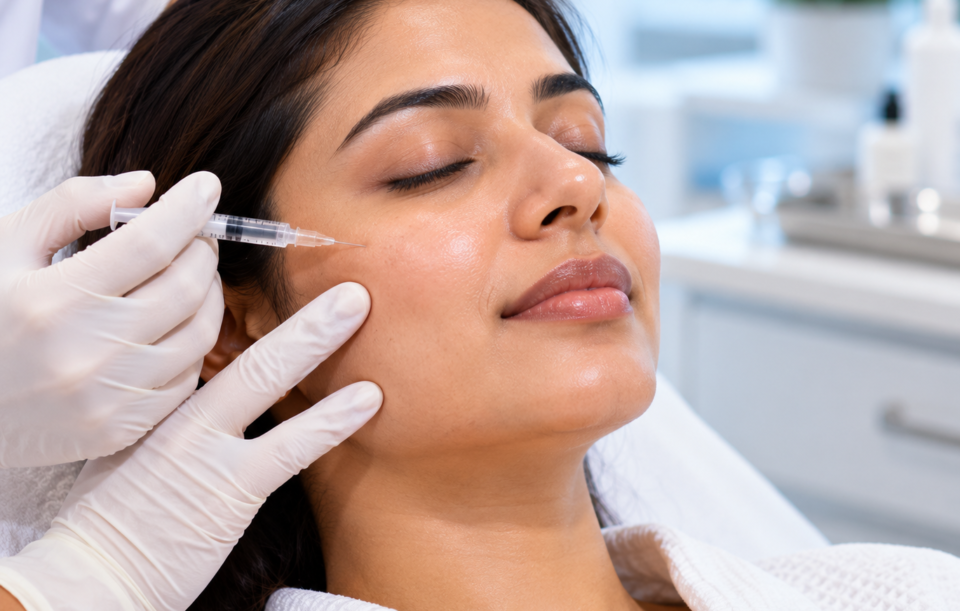
A series of small injections across the treatment area, and a short period afterwards where it is visible that you have had injections.
The technique described in the literature is many small deposits placed close together across the area, using fine needles, rather than one or two larger placements. That is why the appointment involves more injection points than a filler appointment would.
The reported side effects, stated as the review lists them rather than softened:
- Injection related pain, described as mild to moderate.
- Redness and mild swelling at the treated area.
- Bruising.
- Less commonly, small lumps or papules at the injection points.
Plan the timing around anything that matters. The honest version is that this is a low-downtime treatment rather than a no-downtime one, and booking it two days before a wedding is a decision people regret for cosmetic rather than medical reasons.
Who should not have this treatment?
This is the section worth reading before the ones about results, and most pages on this subject do not have it at all.
The contraindications listed in the dermatology review are:
- Hypersensitivity to any component of the product being used.
- Pregnancy.
- Breastfeeding.
- Active infection at the injection site. This includes a spot or a cold sore in the area, not only something obviously infected.
- Bleeding disorders, and by extension it is worth declaring any blood thinning medication.
- A tendency to keloid.
The keloid one is the item people most often do not think to mention, because they associate keloid with surgery rather than with injections. If you have ever had a raised, spreading scar from a piercing, a cut or an operation, say so before treatment rather than after.
Beyond that list, the NHS advice on what to do before any cosmetic procedure applies here: “All cosmetic procedures have some risks”. It advises asking the practitioner “about the procedure, the products they’ll use and what could go wrong”, and says they should “be trained and experienced in the procedure you’re having and have the right insurance to correct anything that goes wrong”.
It also says something worth carrying into any aesthetic consultation: “Remember, you can walk away if you’re not completely comfortable.”
When is dull skin a sign of something to treat first?
When the thing you are describing as dullness is actually a different problem wearing its clothes. Three come up repeatedly.
| What it might actually be | The clue | Where it is dealt with |
|---|---|---|
| Surface congestion | Oily skin, visible pores, blackheads, worse by afternoon | A surface treatment, not an injectable |
| Pigmentation | Patchy rather than uniform, with defined areas | Assessed and treated on its own terms first |
| Under-eye shadowing | Confined to the eye area, unchanged elsewhere | Has three distinct causes and its own page |
| Genuine skin dehydration | Tightness, fine texture, uniform across the area | This page |
If the concern is confined to the eye area, start with which type of dark circle you actually have, because the three types respond to completely different things and a hydration treatment addresses none of them directly.
How long do results last, and what does maintenance mean?
The published figures for this category run to around nine months, and up to nine to twelve months depending on which product is used.
Three qualifications that matter more than the number:
- That is the effect of a completed course, not of a single session.
- It fades gradually. Nothing stops on a particular date, and there is no point at which the skin is suddenly worse than before.
- Maintenance means repeating part of the course, not a permanent commitment. The result is not conditional on continuing forever, and a clinic presenting it that way is selling a subscription.
Whether to repeat it is a decision to make at the end of the first course, with your own result in front of you, rather than at the start on the strength of someone else’s.
How is skin quality assessed at Elegance, Surat?
By deciding which layer the problem is in before deciding what to do about it, because the surface and the dermis need different treatments and the words people use describe both.
In our practice in Surat, the most common version of this is someone who has booked a hydration treatment for what turns out to be surface congestion, or who has spent months on surface treatments for what is genuinely a dermal issue. Neither person got a bad treatment. They got a treatment aimed at the wrong depth, and the assessment is what prevents that.
On qualifications, one thing worth stating because it is not uniform across this industry: injectable aesthetic work in India falls within the scope of an M.Ch. in plastic surgery under current National Medical Commission guidance, and that is the qualification behind this page. If you are comparing clinics, the primary qualification of whoever holds the needle is a fair question to ask anywhere, and the answer should be given without hesitation.
Other treatments on this site are covered separately, including what to check before booking permanent lip makeup and the broader face makeover and laser treatment pages.
Next step
If you are not sure whether your concern sits at the surface or in the skin itself, that is the question a consultation answers, and it decides the treatment rather than the other way round. Book an assessment with Dr. Ashutosh Shah at Elegance, Surat.
This article is for education and is not a substitute for professional assessment. It describes a category of treatment rather than any individual product, and does not recommend one. Suitability, the number of sessions and the expected result can only be decided after examining your own skin. Please consult a qualified practitioner.
A skin booster is an injectable placed into the upper layers of the skin to improve hydration and quality. Published descriptions define it as hyaluronic acid, sometimes with vitamins, amino acids and antioxidants, used to stimulate the skin’s own collagen and elastin rather than to add volume.
A filler works mechanically, adding volume to change shape or support a contour. A skin booster does not. Published dermatology literature puts it directly: skin boosters exert no mechanical effect and work biochemically, stimulating collagen and elastin. One changes structure, the other changes skin quality.
It is a course rather than a single appointment, and the number depends on which product is used. Published protocols commonly run two to three sessions about four weeks apart, with maintenance later. Anyone quoting you a fixed number before assessing your skin is guessing.
No. Tightening and lifting are structural changes, and a skin booster works biochemically on skin quality rather than mechanically on shape. If loose skin is the concern, this is the wrong treatment and a consultation should say so rather than sell you a course anyway.
Published figures for this category run to around nine months, and up to nine to twelve months depending on the product used. That is the effect of a completed course, not of one session, and it fades gradually rather than stopping on a particular date.
Little, but it is an injection and it looks like one briefly. Reported effects include injection related pain, redness, mild swelling and bruising, and less commonly small lumps or papules at the injection points. Plan around anything important in the days immediately afterwards.
No. Pigment is a different problem with different treatments, and a hydration treatment will not correct it. If patchy pigmentation is your main concern, that needs assessing on its own terms first, because treating skin quality around unaddressed pigment rarely gives the result people expect.


Category
Latest From Blog
Small Black Warts on Face and Neck: Removal and Recurrence
Can Facial Ageing Be Treated Without Surgery?
Red Veins On The Face: What Causes Them And Which Vascular Laser Fits