




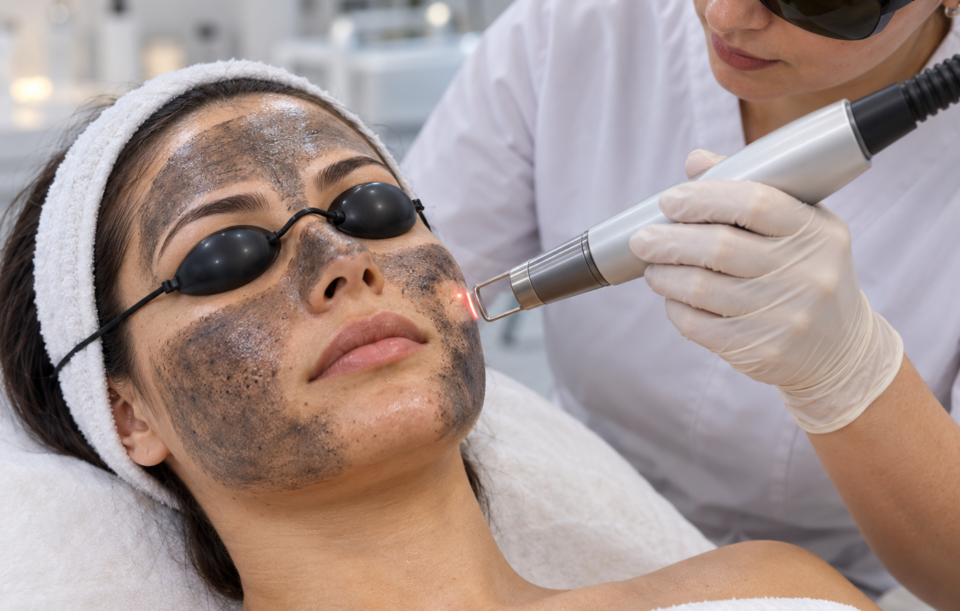
A carbon laser facial is a cosmetic skin treatment used mainly for oily, congested and dull looking skin. It is also commonly called a carbon peel treatment or Hollywood laser facial.
The treatment uses a thin layer of carbon suspension followed by laser treatment. The carbon is applied to the skin and allowed to settle before the laser is passed over the treated area. The laser interacts with the carbon on the skin and helps remove surface material and debris. Depending on the laser technique used, the treatment may also have effects on oil production and the appearance of pores.
A carbon laser facial can leave the skin looking cleaner, smoother and brighter. However, it is important to understand what this treatment can realistically do. It is generally better considered a maintenance treatment for selected skin concerns rather than a replacement for medical acne treatment, scar treatment or deeper laser resurfacing.
What Does The Carbon Layer Actually Do During The Treatment?
The carbon layer is an important part of the procedure.
After the skin is cleansed, a thin carbon suspension is applied across the treatment area. The carbon can settle around the openings of the hair follicles and interact with surface oil, dead skin cells and other debris.
The laser is then passed over the carbon coated skin. The laser energy interacts with the carbon particles and helps remove the carbon along with material attached to it.
This process is one reason the treatment can make congested skin appear cleaner and smoother.
The carbon layer should not be thought of as a substance that permanently removes pores or permanently stops the skin from producing oil. Sebaceous glands continue to function after treatment, and skin continues to produce new cells and surface oil.
The exact effect also depends on the laser used, its settings, the condition being treated and the individual person’s skin.
Which Skin Concerns Does A Carbon Laser Facial Genuinely Improve?
A carbon laser facial is most commonly considered for oily skin, congestion, enlarged looking pores and dull skin.
Oily And Congested Skin
People with oily skin may notice that their face becomes shiny during the day and that oil contributes to congestion around the nose, cheeks and other areas.
A carbon laser facial can help improve the appearance of oily and congested skin by removing surface material and targeting material within the follicular openings.
Research has also investigated carbon assisted Nd laser treatment for enlarged pores and skin appearance. One randomized study in Asian women found improvement in pore appearance and skin lightness following Nd treatment, although adding the carbon component did not produce a significant additional benefit compared with the laser treatment alone.
This is important because a carbon laser facial should not be presented as a treatment that permanently shrinks or removes pores.
Blackheads
Blackheads are open comedones that develop when material within a hair follicle becomes exposed to air.
A carbon laser facial may help selected cases of congestion and blackheads, particularly when excess oil is contributing to the problem.
However, persistent or widespread blackheads may require a structured acne treatment plan rather than repeated cosmetic facials alone.
Dull Looking Skin
The removal of surface debris can make the skin appear fresher and brighter.
This temporary brightening is one reason carbon laser facial treatments are often chosen before social occasions or as part of a maintenance routine.
The improvement should not be interpreted as permanent skin lightening. New surface cells continue to develop and normal oil production continues after treatment.
Active Acne
This area needs realistic expectations.
A carbon peel treatment has been studied as an option for acne. In a prospective study of 35 people with grade II to IV acne and skin of color, three carbon peel laser sessions were performed at two week intervals. The study reported significant improvement in acne lesions, with minimal reported complications.
This does not mean that every person with active acne needs a carbon laser facial.
Acne can range from mild comedonal acne to inflammatory and nodular disease. Some people require topical medication, oral medication or other medical treatment. A carbon facial may be considered in selected situations, but it should not automatically replace evidence based acne care.
Does A Carbon Facial Help Acne Scars?
A carbon laser facial is not the same as laser resurfacing for established acne scars.
If the main problem is an atrophic acne scar, the skin has a structural change that may require a treatment specifically designed to remodel scar tissue.
Fractional laser resurfacing has been studied extensively for atrophic acne scars. Different fractional laser technologies can improve scar appearance, although treatment can involve more discomfort, redness and recovery than a superficial maintenance facial.
For this reason, someone asking specifically for acne scar treatment should have the scar type assessed rather than assuming that a carbon laser facial is sufficient.
Can A Carbon Laser Facial Help Deep Pigmentation?
A carbon laser facial should not be treated as a universal solution for pigmentation.
Pigmentation can have many causes, including sun exposure, melasma, acne related inflammation and other skin conditions. The appropriate treatment depends on the cause.
Laser procedures can also cause temporary or persistent changes in pigmentation, particularly when the skin is prone to post inflammatory pigmentation.
People with brown or darker skin therefore need appropriate assessment and carefully selected treatment settings.
If deep pigmentation is the main concern, a dermatologist or qualified skin professional can determine whether a carbon treatment, medical peel, pigment specific treatment or another approach is more appropriate.
How Long Does A Carbon Laser Facial Last?
One of the most common questions is, how long does a carbon facial last?
There is no single number of days that applies to everyone.
The immediate brightening and smoother appearance are temporary. Skin continues to produce oil, shed cells and respond to environmental exposure after treatment.
How long the visible effect lasts depends on factors such as skin type, oil production, congestion, skincare routine, sun exposure and the underlying condition being treated.
For this reason, a carbon laser facial is better viewed as a maintenance treatment rather than a permanent correction.
How Often Can A Carbon Laser Facial Be Repeated?
The treatment interval depends on the person’s skin and the purpose of treatment.
There is no universal repeat schedule that should apply to everyone.
In the prospective acne study involving skin of color, participants received three sessions at two week intervals.
That study protocol should not automatically be treated as a recommendation for every person seeking a carbon facial.
Someone receiving the procedure for general skin maintenance may have a different treatment plan from someone receiving it as part of an acne treatment programme.
The skin should be allowed to recover, and the treatment frequency should be decided according to the individual’s response.
Is There Any Downtime?
A carbon laser facial is generally considered a treatment with relatively limited recovery compared with deeper resurfacing procedures.
Some people may experience temporary redness, warmth or sensitivity after treatment.
In the prospective study of carbon peel laser treatment in skin of color, six of 35 participants developed erythema and one participant reported mild tolerable pain. No post inflammatory hyperpigmentation or hypopigmentation was observed in that study.
This does not mean that pigmentation changes or irritation are impossible.
Every laser procedure has potential risks. People who are prone to pigmentation should discuss this before treatment and follow appropriate aftercare.
Is It Safe On Brown Skin?
Carbon laser facial treatment has been studied in people with skin of color.
The prospective study mentioned above included people with skin of color and reported significant acne improvement with minimal complications. No post inflammatory hyperpigmentation or hypopigmentation was observed in that particular study.
However, one study cannot guarantee the same result for every person.
Brown skin can develop post inflammatory pigmentation after different forms of skin injury. Laser settings, recent tanning, existing pigmentation, inflammation and individual sensitivity all need to be considered.
The treatment should therefore be selected and performed with the person’s skin type and pigmentation history in mind.
Can It Be Done Before An Event?
A carbon laser facial may be chosen before an event because it is intended to provide a temporary improvement in skin appearance without the recovery associated with deeper resurfacing.
However, it is not sensible to try an unfamiliar cosmetic procedure immediately before an important event.
Even a treatment designed to have limited downtime can produce temporary redness, sensitivity or irritation.
If you are considering a carbon laser facial before an event, it is better to allow enough time for your skin to show how it responds.
Who Should Choose A Different Treatment Instead?
A carbon laser facial may not be the most appropriate treatment when the main concern is deep acne scarring, significant pigmentation, severe or persistent acne, or another medical skin condition.
The treatment should be matched to the actual skin problem.
For example, someone with deep atrophic acne scars may need a scar specific treatment such as fractional laser resurfacing. Fractional laser treatment has a different mechanism and is specifically used for structural acne scar improvement.
Someone with persistent acne may need medical acne treatment rather than relying only on cosmetic maintenance procedures.
Someone with deep pigmentation may first need a diagnosis to determine whether the pigmentation is caused by melasma, post inflammatory changes, sun exposure or another condition.
Carbon Laser Facial Suitability Table
| Skin concern | Does a carbon facial help? | Better alternative or next step | Repeat interval |
|---|---|---|---|
| Oily congested skin | May improve oiliness and surface congestion | Medical skin assessment if persistent | Individualised |
| Blackheads | May help selected cases of congestion | Acne focused skincare or medical treatment when needed | Individualised |
| Dull skin tone | Can provide temporary brightening | Chemical peel or another treatment depending on the cause | Individualised |
| Active acne | May help selected acne cases | Medical acne treatment when required | Depends on the treatment plan |
| Acne scars | Limited role for established scars | Fractional resurfacing or another scar specific treatment | Depends on treatment |
| Deep pigmentation | Not suitable for every pigmentation problem | Diagnosis and pigment specific treatment | Depends on diagnosis |
Carbon Laser Facial Compared With A Medical Peel
A carbon laser facial and a medical chemical peel are different treatments.
A carbon laser facial uses carbon suspension together with laser energy. Its main appeal is improving the appearance of surface congestion, oiliness, pores and dull skin.
A medical peel uses a selected chemical solution to produce a controlled effect on the skin. Different peel formulations and strengths can be chosen for different concerns.
The appropriate peel depends on the person’s skin type, condition and treatment goal.
A peel should therefore not be selected simply because it is described as stronger than a facial.
Carbon Laser Facial Compared With Laser Resurfacing
Laser resurfacing is also different from a carbon facial.
A maintenance carbon laser facial generally focuses on superficial skin concerns and temporary improvement in appearance.
Fractional laser resurfacing is designed to create controlled microscopic treatment zones within the skin and can be used for concerns such as atrophic acne scars and textural changes. Evidence from systematic reviews supports fractional laser treatment as an option for acne scar improvement, although treatment can involve pain, redness and recovery.
Therefore, a person seeking treatment for deep scars should not expect a carbon facial to produce the same type of result as resurfacing.
A carbon laser facial can be useful for selected people who want temporary improvement in oily, congested or dull looking skin.
It may help improve the appearance of pores and surface congestion, and clinical research has also reported improvement in selected acne patients, including people with skin of color.
However, it is best understood as a maintenance treatment rather than a permanent solution.
It is not the same as a treatment specifically designed for deep acne scars or deeper resurfacing. Persistent acne and significant pigmentation may also require a more targeted medical approach.
The best treatment depends on what is actually causing the skin concern. A proper assessment can help determine whether a carbon laser facial, carbon peel treatment, medical peel, laser resurfacing or another treatment is appropriate.
Frequently Asked Questions
The visible brightening and smoother appearance are temporary. The duration varies according to skin type, oil production, skincare routine and the concern being treated.
It may improve overall skin appearance, but it is not a primary treatment for established deep acne scars. Scar specific treatments such as fractional resurfacing may be considered depending on the scar type.
Downtime is generally limited compared with deeper resurfacing, although temporary redness, warmth or sensitivity can occur.
There is no single interval suitable for everyone. Treatment frequency should depend on the skin condition and response. Published acne research has used two week intervals, but that protocol should not automatically be applied to every person.
Carbon peel laser treatment has been studied in skin of color with encouraging results, but individual pigmentation risk varies. Appropriate laser settings and assessment are important.
It can be considered because recovery is generally limited, but trying a new treatment immediately before an important event is not advisable because temporary redness or sensitivity can occur.
These names are commonly used to describe the same general type of carbon assisted laser facial treatment. The actual procedure can vary depending on the laser, settings and treatment protocol used.
It can be useful for selected people with oily and congested skin. However, persistent excessive oil production or acne may require a more comprehensive medical treatment plan.
No. Suitability depends on the skin condition, skin type, pigmentation history and treatment goal. A different treatment may be more appropriate for deep scars, significant pigmentation or persistent acne.


Category
Latest From Blog
Small Black Warts on Face and Neck: Removal and Recurrence
Can Facial Ageing Be Treated Without Surgery?
Red Veins On The Face: What Causes Them And Which Vascular Laser Fits