




Written by Dr. Ashutosh A Shah, M.B.B.S., M.S., M.Ch., D.N.B., Consultant Plastic, Cosmetic and Reconstructive Surgeon, Elegance Clinic, Surat. Reg. no. [REG NO]. 22+ years in aesthetic and reconstructive practice.
Medically reviewed by Dr. Ashutosh A Shah · Published [DD Month 2026] · Last reviewed [DD Month 2026]
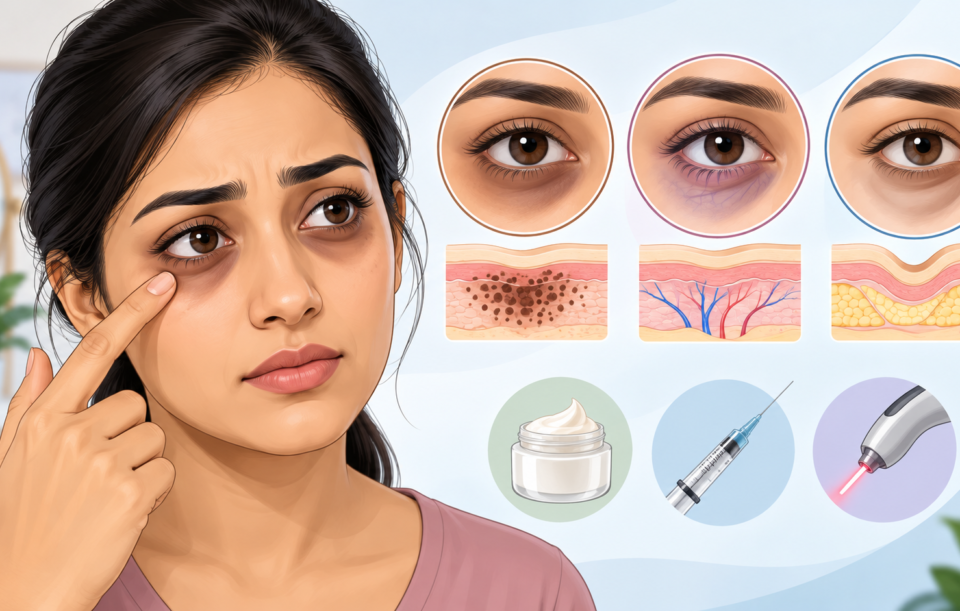
Dark circles have three main causes: pigmentation in the skin, hollowing under the eye that casts a shadow, and thin skin showing the vessels beneath. Creams only help the pigmented type, and only modestly. Hollowing needs volume replacement, and visible vessels need laser or skin thickening, which is why one product cannot fix all three.
If you have bought three different eye creams and none of them worked, the most likely explanation is not that you chose badly. It is that your dark circles were never a pigment problem in the first place, and a cream that lightens pigment cannot fill a hollow or hide a vein.
This page shows you how to work out which type you have, using two tests you can do at home in about thirty seconds, and then what actually addresses each one. It is worth knowing before you spend anything.
What are the three types of dark circle, and which one do you have?
A comprehensive review of periorbital hyperpigmentation classifies dark circles into four categories: pigmented, vascular, structural, and mixed, where two or three occur together.
Mixed is the commonest, which is exactly why single-product solutions disappoint so many people.
| Type | What it looks like | What is actually happening | Does a cream help? |
|---|---|---|---|
| Pigmented | A brownish hue under the eye. Colour sits in the skin itself | Melanin deposited in the upper or deeper layers of the skin | Modestly, and only with the right active, used correctly, for months |
| Vascular | A blue, pink or purple hue, with or without puffiness | Blood vessels sitting close to the surface, visible through thin eyelid skin | No. There is nothing to lighten. The colour is underneath the skin |
| Structural (hollow) | A groove or shadow rather than a colour. Worse in overhead light | Loss of fat, prominent bone, eyelid bags or lid drooping, all casting a shadow | No. A shadow is an absence of light, not a stain |
| Mixed | Two or three of the above together | Most adults, particularly beyond the mid-thirties | Partially at best, which is why progress plateaus |
One demographic note that surprises people. In an Indian epidemiological study cited by that review, dark circles were most prevalent in the 16 to 25 age group, affecting 95 of 200 patients, and were far more common in women at 81 percent. This is not a condition that starts in your forties. For many people it starts in their teens and is largely constitutional.
The mirror test: how do you tell which type you have at home?
Two tests, thirty seconds, better information than most people get from a shop counter. Do them in natural light, facing a window, with no makeup on.
- The stretch test. Place a fingertip beside the outer corner of your eye and gently stretch the lower eyelid skin sideways, flattening it. The review states that manual stretching of the lower eyelid skin helps differentiate true pigmentation from a shadowing effect.
- The colour stays as you stretch: pigment. The colour is in the skin.
- The colour fades or disappears: shadow. You have a structural hollow, not a stain.
- The colour becomes more blue or purple as you stretch: a vascular contribution. Stretching thins the skin further and the vessels show more.
- The head-tilt and light test. Tilt your chin up towards a ceiling light, then tilt it down.
- The darkness largely disappears when light hits the area directly from below or in front: structural. You were looking at a shadow.
- It looks the same from every angle and in every light: pigment or vascular, and the stretch test above separates those two.
Write down what you find and take it to a consultation. It genuinely shortens the conversation and it stops you being sold the wrong thing.
What a clinician adds. An examination establishes how much of each type you have, since most people have a mix. A Wood’s lamp can be used to distinguish pigment sitting in the upper layers of the skin from pigment sitting deeper, which matters because the deeper kind responds much less well to anything applied on top.
Type 1, pigmented: what causes it and what genuinely lightens it?
Pigmented dark circles are melanin deposited in the skin under the eye. The review lists the main drivers as genetic predisposition, dermal melanocytosis, post-inflammatory pigmentation following atopic or allergic dermatitis, extension of a natural pigmentary demarcation line, and ocular hypotensive eye drops of the prostaglandin analogue class.
That last one is worth pausing on. If you use prescription eye drops for raised eye pressure, darkening of the skin around the eye is a recognised effect of some of them. Do not stop your drops. Do mention it to your eye doctor, because it changes what is worth trying.
What actually helps, in order of evidence:
- Sun protection. Unglamorous and non-negotiable. Sunlight drives melanin production, and every other treatment works against a headwind without it. Sunglasses do real work here, not just sunscreen.
- Prescription topical depigmenting agents. These exist, they work modestly, and they must be prescribed and supervised. Eyelid skin is the thinnest on the body and strong actives used carelessly there cause irritation that leads to more pigment, which is the opposite of the goal. Anything bought over a counter and applied without advice is a genuine risk on this area.
- Superficial chemical peels. Glycolic and lactic acid peels at appropriate strengths, done by someone experienced with the eye area.
- Lasers. Q-switched devices at 694 nm and 1064 nm are described in the literature for pigmented dark circles. Published experience suggests a course rather than a single session, with combination approaches using a lightening agent before laser producing better results over three to four laser treatments.
Two things to expect. Pigment responds slowly, in months rather than weeks. And pigment that sits deeper in the skin responds considerably less than pigment near the surface, which is why two people on the same regimen get different results.
If your pigmentation extends beyond the eye area onto the rest of the face, that is a different assessment and often a different treatment plan. Our carbon laser peel page explains where surface treatments help and where they stop, and it is honest about the fact that a carbon peel is not primarily a pigmentation treatment.
Type 2, hollow: why is this a shadow rather than a stain?
Because the skin under your eye may be a perfectly normal colour, and you are looking at the shade cast into a groove.
The review describes the structural type as arising from infraorbital palpebral bags, drooping of the upper lid, and loss of fat with underlying bony prominence. In plain terms: the fat pad that used to fill the space between your lower lid and your cheek thins and descends with age, the bone underneath becomes relatively more prominent, and a valley forms. Light falls across it and produces a dark line.
How to be sure this is you: the stretch test makes it fade, the head-tilt test makes it fade, it looks dramatically worse in overhead lighting and in front-facing camera photos, and it looks better when you are well rested because you are less puffy, not because the pigment changed.
What addresses it. Only replacing the missing volume or repositioning what is there.
- Hyaluronic acid filler into the tear trough, which is the commonest approach. See the dedicated section below, because this is the option with the most to say about safety.
- Fat transfer, using your own fat. Longer lasting than filler but partially resorbs, and the amount that survives is not fully predictable.
- Surgery where the problem is genuine eyelid bags rather than pure volume loss. A transconjunctival approach repositions or removes the herniated fat from inside the lid, leaving no external scar.
What will not address it: any cream, any serum, any home remedy, any amount of sleep. A shadow is an absence of light. Nothing you apply to the surface changes the shape underneath it.
Type 3, vascular: are you seeing the vessels through thin skin?
If the colour is blue, purple or pink rather than brown, and it intensifies when you stretch the skin, you are most likely seeing what is underneath the skin rather than something in it.
The review describes the vascular type as an infraorbital blue, pink or purple hue with or without periorbital puffiness, caused by superficially located blood vessels showing through thin eyelid skin. Puffiness from allergy or fluid retention can make it worse by increasing the volume of vessel visible.
This is the type most often misdiagnosed, because people see darkness and assume pigment. Then they use a lightening cream for six months on skin that has no excess pigment at all.
What actually helps:
- Vascular-targeting lasers. Nd:YAG at 1064 nm is described in the literature as effective for the vascular component, with pulsed dye and diode lasers also used.
- Thickening the overlying skin, so there is more tissue between the vessel and the outside world. Microneedling and platelet-rich plasma are used with this aim, and results are gradual and modest.
- Treating the cause of any puffiness, particularly allergy. See the lifestyle section below.
Be realistic about this one. The vessels are normal and they are meant to be there. Treatment makes them less visible; it does not remove them, and nothing makes eyelid skin permanently thicker. This type is managed rather than resolved.
Laser options available here are described on our laser treatments page.
Why do creams and home remedies fail?
Because two of the three types have nothing for a topical product to act on, and because the remedies that get passed around have no mechanism by which they could work.
The honest position on creams. A well-formulated eye cream with a proven active, used consistently for several months on genuinely pigmented dark circles, produces a modest improvement. That is a real thing and it is worth doing if pigment is your type. It is also a long way from what the packaging implies, and it does nothing at all for the other two types.
Now the remedies.
- Cucumber slices. Cool and pleasant. The effect is temporary reduction of puffiness from the cold, which can make a vascular circle look briefly better. It lightens nothing. A cold spoon does the same thing.
- Potato juice, tomato juice, lemon juice. No mechanism for reaching pigment in the dermis. Lemon juice in particular is acidic and phototoxic and has no business anywhere near eyelid skin.
- Used tea bags and coffee grounds. Caffeine applied topically can cause brief vasoconstriction, so there may be a small, short-lived reduction in the vascular type. It does not last and it does not accumulate.
- Almond oil, coconut oil, ghee. Moisturise. Moisturised skin looks slightly better. They do not reach pigment or fill a hollow.
- Massage. Pleasant, may help fluid drainage briefly. Vigorous rubbing of eyelid skin is actively counterproductive, because friction causes post-inflammatory pigmentation. Some people have made their dark circles worse this way.
The common thread: everything on that list either reduces puffiness for an hour or moisturises. None of it has a route to the actual cause of any of the three types.
What do sleep, salt, allergies and screen time actually contribute?
Less than people think about the colour, and more than people think about how bad it looks on a given day. That distinction is the whole point.
Sleep. Genuinely contributes, though not by creating pigment. Lack of sleep and fatigue cause paleness of the skin, which allows the blood underneath to become more visible and look bluer and darker. So sleep makes the vascular type look worse and rest makes it look better, on a daily cycle. It does not cause or cure the underlying circle. If you have slept nine hours and your circles are unchanged, you have a pigmented or structural type.
Salt and fluid. A high-salt meal or alcohol the night before produces fluid retention and puffiness around the eyes. Puffiness worsens both the shadow and the visible-vessel types. A real day-to-day effect, not a cause.
Allergies. The most underrated item on this list. Anything that makes your eyes itch leads to rubbing, and rubbing causes darkening. Hay fever sufferers in particular notice under-eye smudges during allergy season. Repeated rubbing over years causes post-inflammatory pigmentation that becomes a permanent feature of the skin, and at that point you have converted a temporary problem into a pigmented one. If you have allergic eyes, treating the allergy is a dark circle treatment.
Screen time. No direct evidence that screens cause dark circles. What screens do is reduce blink rate and cause eye strain and rubbing, and late screen use delays sleep. The route is indirect.
Iron and vitamin B12. Deficiency is believed to contribute to dark circles. If yours appeared alongside fatigue, breathlessness or heavy periods, a blood test is worth doing before you spend money on lasers.
Sun. Sunlight increases melanin production, and the skin around the eye is thin and frequently missed by sunscreen. This one drives the pigmented type directly.
Which treatment suits which type?
Matching matters more than choosing the most advanced-sounding option, and this table is the summary of everything above.
| Treatment | Pigmented | Vascular | Hollow | Notes |
|---|---|---|---|---|
| Sun protection and sunglasses | Yes, essential | No direct effect | No | Free, and everything else works better with it |
| Prescription topical lightening agents | Yes, modestly | No | No | Must be prescribed and supervised on eyelid skin |
| Superficial chemical peels | Yes | No | No | Needs an operator experienced with the eye area |
| Q-switched laser | Yes | Partly, at 1064 nm | No | A course, not a single session |
| Vascular lasers | No | Yes | No | Reduces visibility rather than removing vessels |
| Microneedling and platelet-rich plasma | Some help | Some help, by thickening skin | Minimal | Gradual and modest. Several sessions |
| Hyaluronic acid filler | No | Can worsen if placed badly | Yes, the main option | Temporary. Read the safety section below first |
| Fat transfer | No | No | Yes | Longer lasting than filler, partially resorbs |
| Eyelid surgery | No | No | Yes, where there are true eyelid bags | Transconjunctival approach leaves no external scar |
Read down the columns rather than across the rows. If your column is mostly “No”, that tells you why your last three purchases did not work.
Under eye filler: what does it do well, and where does it go wrong?
Tear trough filler is the most effective option for the hollow type and it is also the option with the longest list of things that can go wrong. Both are true and you should know both before you book.
What it does well. Replaces volume in the groove so light no longer casts a shadow into it. When it is done well, in the right candidate, the change is immediate and looks natural.
What can go wrong. Drawing on published guidance on complications of hyaluronic acid fillers:
- The Tyndall effect. A blue-grey discolouration that appears when too much filler is placed too superficially. Blue light scatters more than longer wavelengths when it passes through the small particles, so the area takes on a blue cast. Deeply ironic outcome: you treated a dark circle and produced a different dark circle. It is correctable by dissolving the filler.
- Malar oedema. Persistent puffiness over the cheekbone, reported in up to 11 percent of cases with tear trough filler. It happens because the anatomy in this area compartmentalises fluid and excess volume compresses lymphatic drainage. Firmer, denser gels carry higher risk. Management is dissolving the filler and, if appropriate, re-treating later with a different product.
- Delayed nodules. Lumps appearing in about 0.5 percent of hyaluronic acid filler treatments, anywhere from four weeks to more than a year afterwards.
- Infection. Uncommon, but it happens, and delayed infections can involve unusual organisms needing prolonged treatment.
- Vascular occlusion and vision loss. Rare and serious. Filler entering an artery can travel backwards and reach vessels supplying the eye. Around 190 cases of blindness from injectable aesthetic treatments were reported between 1906 and 2019, and most involved injected fat rather than hyaluronic acid. Treatment options have limited success, which is precisely why prevention and operator skill matter more here than anywhere else on the face.
The single most useful question you can ask, and most people never do: is hyaluronidase available in this room right now. Hyaluronidase is the enzyme that dissolves hyaluronic acid filler, and published guidance is that it should be on hand during any hyaluronic acid filler procedure. It is the fix for a Tyndall effect, for malar oedema, for early nodules, and it is the emergency treatment for a vascular event.
If the answer is no, or vague, do not have the injection that day. That is not a difficult question for a properly equipped clinic to answer, and a clinic that cannot answer it is telling you something important.
Two more rules. Filler is temporary and resorbs, so this is a maintained result, not a one-time fix. And filler is the wrong treatment for pigmented and vascular circles, where it will not help and can make a vascular circle look worse.
What are the side effects, who should avoid each option, and how long does it take?
| Option | Common effects | Timeline to judge it |
|---|---|---|
| Topical lightening agents | Irritation, redness, dryness. Irritation on eyelid skin can cause more pigment, so stop and ask rather than pushing through | Months, not weeks |
| Chemical peels | Stinging, redness, light flaking. Risk of pigment change if done too strongly on darker skin | A course of sessions |
| Laser | Redness, swelling, temporary darkening before lightening | Published experience suggests roughly 4 to 6 sessions for visible change |
| Microneedling and PRP | Redness, pinpoint bleeding, swelling for a day or two | Several sessions, gradual |
| Filler | Swelling, bruising, and the complication list above | Immediate, settling over 2 to 4 weeks |
| Fat transfer and surgery | Swelling and bruising, longer recovery, surgical risks discussed individually | Months for the final result |
Who should wait or avoid. Anyone with an active infection or inflamed skin in the area. Anyone pregnant or breastfeeding, for elective injectable and laser treatments. Anyone with a bleeding disorder or on blood-thinning medication, which changes the plan and must be declared. Anyone with untreated allergic eye disease, because treating that first may be all that is needed. Anyone with a history of keloid or unusual scarring, for procedures that break the skin. And anyone whose darkness has appeared suddenly, is on one side only, or comes with swelling, pain or vision change, all of which need medical assessment rather than a cosmetic appointment.
What does dark circle treatment cost in Surat?
These are researched market ranges across India for 2026, given so you can sanity-check a quote. They are not a quotation from this clinic.
| Treatment | Typical market range, India 2026 |
|---|---|
| Chemical peel, laser toning or PRP session | Published figures generally start from around Rs 3,500 per session, with a course needed |
| Under eye hyaluronic acid filler, per session | Rs 20,000 to Rs 70,000, with per-millilitre figures commonly quoted around Rs 15,700 to Rs 26,000 |
| Under eye filler, Gujarat reference point | Ahmedabad figures published at roughly Rs 25,000 to Rs 35,000 |
| Fat transfer | Around Rs 50,000 per session |
An honest caveat about these numbers. Published pricing for under-eye fillers in India is reasonably consistent. Published pricing for peels, laser and PRP mostly appears as “starting from” figures, which are marketing floors rather than real ranges, so treat the first row as a lower bound and not an estimate.
What actually moves your number: which type you have and therefore which treatment you need, how many sessions, the volume of product used, who performs it, and whether consultation, review visits and any corrective treatment are included. Ask what the quoted figure excludes before you compare two clinics.
One thing worth paying for. On the under-eye area specifically, operator experience is not a luxury item. The complication list in the previous section is the reason.
Dark circle assessment at Elegance Clinic, Surat
The approach here starts with establishing which type you have, because that single question determines whether the answer is a cream, a laser course, a filler, surgery, or an allergy referral.
What an assessment involves: examination in good light, the stretch and shadow assessment described above done properly, an estimate of how much of each type is contributing, a check for the treatable contributors such as allergic eye disease or anaemia, and a plan matched to the finding.
Dr. Ashutosh A Shah is a Consultant Plastic, Cosmetic and Reconstructive Surgeon with M.Ch. and D.N.B. qualifications and over 22 years in practice, covering both non-surgical and surgical options for the eye area, which matters because a clinic offering only one modality tends to find that every patient needs it.
Three things you will not be told here. That your dark circles can be removed permanently, because for two of the three types that is not how the anatomy works. That one session will do it. Or that a product will fix a shadow.
Wider facial treatment options are on our face makeover page.
Next step
Before you buy another eye cream, spend thirty seconds on the two tests in this article. Knowing your type is worth more than any product on a shelf.
- Do the stretch test and the head-tilt test in daylight, with no makeup, and note what happened
- Note when the circles first appeared and whether anyone in your family has them
- Mention any itchy eyes, allergies or eczema, and any eye drops you use
- Bring a list of what you have already tried, so nobody suggests it again
Book an under eye assessment at Elegance Clinic, Surat
Medical disclaimer. This article is general health information and is not a substitute for examination, diagnosis or treatment by a qualified doctor. Cost figures are researched market ranges for orientation only and are not a quotation. Prescription treatments must be prescribed and supervised; do not apply strong actives to eyelid skin without advice. Seek medical assessment rather than cosmetic treatment if darkness around the eye appears suddenly, affects one side only, or comes with swelling, pain, or any change in vision.
Three main causes, often combined. Pigmented circles are melanin in the skin, driven by genetics, sun, post-inflammatory pigmentation from rubbing or eczema, and some prescription eye drops. Vascular circles are blood vessels visible through thin eyelid skin, appearing blue, pink or purple. Structural circles are shadows cast by a hollow, caused by fat loss, prominent bone or eyelid bags. Most adults have a mixture, which is why single products disappoint.
Only for the pigmented type, and only modestly over several months. A cream cannot fill a hollow or hide a blood vessel, so it does nothing for the structural or vascular types, which together account for a large share of cases. If you have used eye creams consistently with no change, that is useful information: it suggests your circles are not primarily a pigment problem. Do the stretch test before buying another one.
No, and anyone promising that is overselling. Structural circles are caused by bone shape and fat position, and fillers resorb while fat transfer partly resorbs. Vascular circles are normal vessels under thin skin, and nothing makes eyelid skin permanently thicker. Even pigmented circles are often constitutional and tend to return. Dark circles are managed with maintenance, which is a genuinely good outcome, just not a permanent one.
It is effective for hollow circles but it carries the longest complication list of any option here. Reported problems include a blue-grey Tyndall discolouration from filler placed too superficially, persistent cheek swelling in up to 11 percent of tear trough cases, delayed lumps in about 0.5 percent of hyaluronic acid treatments, infection, and rarely vascular occlusion which can affect vision. Ask whether hyaluronidase, the dissolving enzyme, is available in the room before you agree to treatment.
Not usually. Lack of sleep causes paleness of the skin, which makes the blood underneath more visible, so poor sleep makes existing circles look worse on the day. It does not create the underlying cause. If you sleep well and your circles are unchanged, you most likely have a pigmented or structural type, both of which are unrelated to sleep. Treat sleep as something that affects how bad they look, not why you have them.
It depends entirely on the type. Published experience with laser for pigmented circles suggests roughly four to six sessions for visible change, with combination approaches using a lightening agent alongside laser reported to do better over three to four treatments. Microneedling and platelet-rich plasma also need a course. Filler for a hollow gives an immediate result that settles over two to four weeks, but it resorbs and needs repeating.
Researched India-wide market ranges for 2026 put peel, laser toning or PRP sessions from around Rs 3,500 per session with a course needed, under-eye hyaluronic acid filler at roughly Rs 20,000 to Rs 70,000 per session, Ahmedabad filler figures at about Rs 25,000 to Rs 35,000, and fat transfer around Rs 50,000. Your actual cost depends on which type you have, how many sessions and what the quote includes, so it can only be confirmed after an assessment.


Category
Latest From Blog
Small Black Warts on Face and Neck: Removal and Recurrence
Can Facial Ageing Be Treated Without Surgery?
Red Veins On The Face: What Causes Them And Which Vascular Laser Fits