




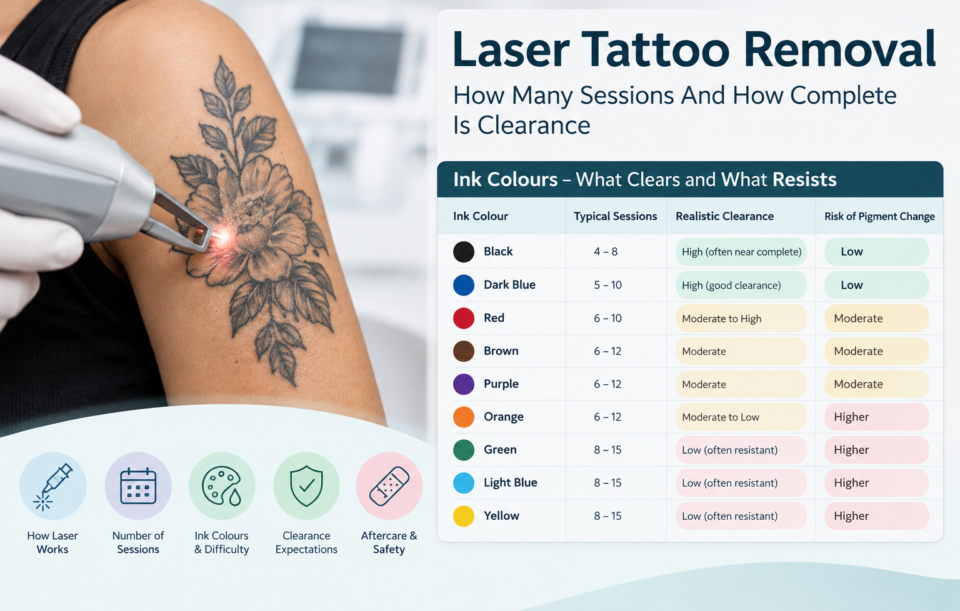
Laser tattoo removal does not erase ink in one sitting. The laser breaks tattoo pigment into smaller fragments, after which the body gradually clears those fragments over the following weeks. Sessions are therefore spaced apart, commonly around six to eight weeks, and a complete course can take several months. Black and dark blue usually respond most reliably, while green, light blue and yellow can be more resistant. Significant fading is realistic, but complete clearance without any remaining pigment or skin change cannot always be promised.
How does laser break down tattoo ink, and why does it take months?
Laser tattoo removal uses very short pulses of light to target tattoo pigment. Depending on the tattoo colour, skin type and device, different wavelengths can be selected. Q switched and picosecond lasers are commonly used because their short pulses can fragment pigment while limiting unnecessary heating of surrounding tissue.
After the laser pulse, the ink is fragmented into smaller particles. The body’s immune and lymphatic systems then gradually remove some of these particles. This biological clearance is one reason why the tattoo can continue becoming lighter between appointments.
Having another treatment too soon does not necessarily make the tattoo disappear faster. The skin needs time to recover and the body needs time to clear the fragmented pigment. Clinical studies have used intervals ranging from about four to eight weeks, with six to eight weeks commonly used in tattoo removal protocols. Some treatments may use longer intervals as the course progresses.
This is why laser tattoo removal sessions should be planned as a course rather than as a series of treatments performed as close together as possible.
Which ink colours clear easily and which resist treatment?
Tattoo colour is one of the biggest factors in colour tattoo removal difficulty.
Black pigment generally responds well because it absorbs a broad range of laser wavelengths. Dark blue and blue black tattoos can also respond particularly well to appropriate Nd:YAG or alexandrite laser treatment.
Green, light blue and yellow can be more challenging. However, colour alone does not determine the outcome. Modern picosecond lasers have shown useful results with blue, green and yellow pigments in some studies, so it would be misleading to say that these colours cannot be removed.
White, flesh coloured and some cosmetic tattoo pigments can behave unpredictably. Certain pigments containing titanium dioxide or iron oxide may even darken after particular laser treatments. This is especially important when treating permanent makeup rather than conventional body tattoos.
Why the same colour can behave differently
Two black tattoos can require very different numbers of sessions because the pigment may differ in:
- Depth
- Density
- Chemical composition
- Age
- Application technique
- Location on the body
- Amount of scarring or tissue change
Professional tattoos may contain more pigment and may be placed deeper than many amateur tattoos, making clearance slower or less complete.
What decides the session count: age, depth, size and skin tone?
There is no single number of sittings that applies to every tattoo.
A clinician considers several factors before estimating the course.
Age of the tattoo: Older tattoos may sometimes respond well because they have already undergone some natural fading. However, age alone does not guarantee faster clearance. Published evidence is mixed, so it should be treated as one factor rather than a promise.
Depth and density: Deeper or heavily saturated pigment generally requires more treatment than a lightly applied tattoo.
Size: A larger tattoo takes longer to treat and contains more pigment, although size by itself does not determine how many sessions are needed.
Colour: Black and dark blue often respond more predictably, while some green, light blue, yellow and cosmetic pigments can be resistant.
Skin tone: Darker skin requires particular care because epidermal melanin can compete with the tattoo pigment for laser energy. This increases the risk of temporary or persistent pigment changes if the wavelength and settings are poorly selected.
Location: Blood supply, lymphatic clearance and local tissue characteristics can influence how quickly a tattoo fades.
Type of tattoo: Amateur tattoos may sometimes need fewer treatments than professional tattoos. One clinical source notes that amateur tattoos commonly require around four to six treatments, while professional tattoos may need eight or more, although individual results vary considerably.
What is realistic: full clearance or significant fading?
The safest expectation is progressive fading, not guaranteed erasure.
Some tattoos can become extremely difficult to see after a course of treatment. Others leave a faint outline or small areas of residual pigment. A study of tattoo removal outcomes found that complete clearance was achieved in only a minority of patients, demonstrating why promising 100 percent removal before treatment can be misleading.
Even when the pigment has been substantially cleared, the skin may not look exactly as it did before the tattoo.
Possible residual changes include:
- Small areas of remaining pigment
- Temporary redness
- Temporary lightening or darkening
- Changes in skin texture
- Scarring in some cases
- A faint residual tattoo outline
The goal should therefore be discussed in terms of realistic clearance, rather than assuming that every tattoo can return perfectly to untreated skin.
How is scarring and pigment change avoided on brown skin?
Tattoo removal scarring is uncommon when treatment is appropriately selected and performed, but it remains a possible complication. Pigment changes are particularly important in darker skin because increased epidermal melanin can absorb some of the laser energy intended for the tattoo.
For brown and deeper skin tones, the clinician may select a longer wavelength such as 1064 nm Nd:YAG when appropriate for the tattoo pigment. This wavelength has lower absorption by epidermal melanin than some shorter wavelengths and has been used extensively for tattoo removal in darker skin.
Safety also depends on conservative parameter selection, adequate cooling, appropriate spacing between treatments and careful sun protection.
A recent review of laser treatment in skin of colour highlights the increased risk of hyperpigmentation, hypopigmentation, blistering and scarring in darker phototypes and recommends careful device selection, parameter adjustment and photoprotection.
Clearance expectation by tattoo colour and type
The following table provides planning ranges rather than guaranteed results. Actual session requirements can be substantially different between individuals.
| Ink colour and tattoo type | Typical session range | Realistic clearance level | Risk of pigment change |
|---|---|---|---|
| Black amateur tattoo | 4 to 6+ | Often high, sometimes near complete | Low to moderate |
| Black professional tattoo | 6 to 10+ | High fading, complete clearance not guaranteed | Low to moderate |
| Dark blue or blue black | 4 to 8+ | Often high | Low to moderate |
| Red | 5 to 10+ | Moderate to high | Moderate |
| Green | 6 to 12+ | Variable, often more resistant | Moderate |
| Light blue | 6 to 12+ | Variable, can be resistant | Moderate |
| Yellow | 6 to 12+ | Often difficult and incomplete | Moderate |
| Multicolour tattoo | 6 to 12+ | Depends heavily on individual pigments | Moderate |
| Cosmetic or permanent makeup | Highly variable | Unpredictable | Moderate to high |
These ranges should not be interpreted as a treatment promise. Studies report wide variation in treatment numbers and outcomes. Picosecond technology may improve clearance for some blue, green and yellow pigments, but the evidence does not mean every difficult colour will clear completely.
How long is the gap between sessions?
A common interval is six to eight weeks. Some protocols use four to eight weeks, while others extend the interval to eight to twelve weeks later in the course. The correct interval depends on how the skin has healed and how the tattoo is responding.
The important point is not to shorten the interval simply because the tattoo still looks dark. Pigment clearance continues after the laser session, so allowing adequate time can be part of achieving a better result.
Will the skin look exactly as it did before?
Not necessarily.
The best possible outcome is substantial or complete pigment clearance with minimal visible change to the surrounding skin. However, some people experience temporary or persistent pigment alteration, textural change or residual ink. The risk is influenced by skin type, tattoo characteristics, laser selection and treatment parameters.
This is particularly relevant for brown skin, where both hyperpigmentation and hypopigmentation need to be considered.
Is tattoo removal painful?
Laser tattoo removal can be uncomfortable. People commonly describe the sensation as sharp snapping, stinging or a hot elastic band feeling.
Pain varies according to tattoo location, size, pigment density, treatment settings and individual sensitivity. Cooling can reduce discomfort and swelling during treatment. Some clinics may also discuss topical or other forms of anaesthesia depending on the treatment area and patient.
Can an old amateur tattoo clear faster?
It can, but there is no guarantee.
Amateur tattoos often contain less predictable or less densely packed pigment than professional tattoos, and some studies report fewer treatments for amateur tattoos. Older tattoos may also have undergone natural fading. However, tattoo age by itself is not enough to predict the result, and published findings on whether older tattoos always clear faster are mixed.
A consultation should therefore assess the actual tattoo rather than promising a specific number based only on its age.
Tattoo removal aftercare
Good tattoo removal aftercare helps the treated skin recover and reduces avoidable complications.
After treatment:
- Follow the clinic’s wound care instructions.
- Keep the area clean and avoid unnecessary friction.
- Protect the treated area from direct sun exposure.
- Do not pick crusts or blisters.
- Avoid irritating products unless specifically advised.
- Report increasing pain, spreading redness, significant swelling or signs of infection.
- Attend the next session only after the skin has adequately recovered.
Sun protection is especially important for darker skin because inflammation and ultraviolet exposure can contribute to unwanted pigmentation.
What should you ask before starting laser tattoo removal?
Before beginning a course, ask the clinic:
- Which laser wavelength will be used for each ink colour?
- How many sessions are realistically expected?
- How long will the interval between sessions be?
- What level of fading is realistic for this tattoo?
- What is the risk of pigment change for your skin tone?
- What aftercare is required?
- What happens if a pigment does not respond?
- Could any pigment darken instead of lightening?
- What happens if scarring or significant pigmentation develops?
- When will progress be photographed and reviewed?
These questions help turn a vague promise of “tattoo removal” into a more realistic treatment plan.
FAQs
Many tattoos need several sessions, commonly around four to ten or more. Professional and multicolour tattoos can require additional treatments. The exact number depends on the pigment, depth, density, size, location and skin type.
Green, light blue and yellow can be more resistant than black and dark blue. Modern picosecond lasers may improve clearance of some resistant colours, but complete removal is not guaranteed.
A common interval is six to eight weeks. Some tattoos require longer intervals depending on healing and response.
Not always. Significant fading may be achieved, but residual pigment, temporary or permanent pigment changes and occasional textural changes can occur.
Yes, it can be uncomfortable. Cooling and, when appropriate, anaesthetic measures can help reduce discomfort.
Sometimes. Amateur tattoos may need fewer sessions than professional tattoos, and older tattoos may already have faded. However, age alone cannot predict the final result.
Laser Tattoo Removal Consultation
The number of laser tattoo removal sessions should be estimated after examining the tattoo rather than relying on a fixed package. Colour, depth, age, size, tattoo type and skin tone all affect the plan.
For information about the laser technology and treatment options, see:
YAG advanced laser skin treatment
Advanced laser skin treatment in Surat
The most realistic approach is to plan for progressive fading over multiple sessions, allow enough time between treatments, protect the skin during recovery and understand that significant clearance is achievable in many tattoos, while complete clearance without any skin change is not guaranteed.


Category
Latest From Blog
Small Black Warts on Face and Neck: Removal and Recurrence
Can Facial Ageing Be Treated Without Surgery?
Red Veins On The Face: What Causes Them And Which Vascular Laser Fits