




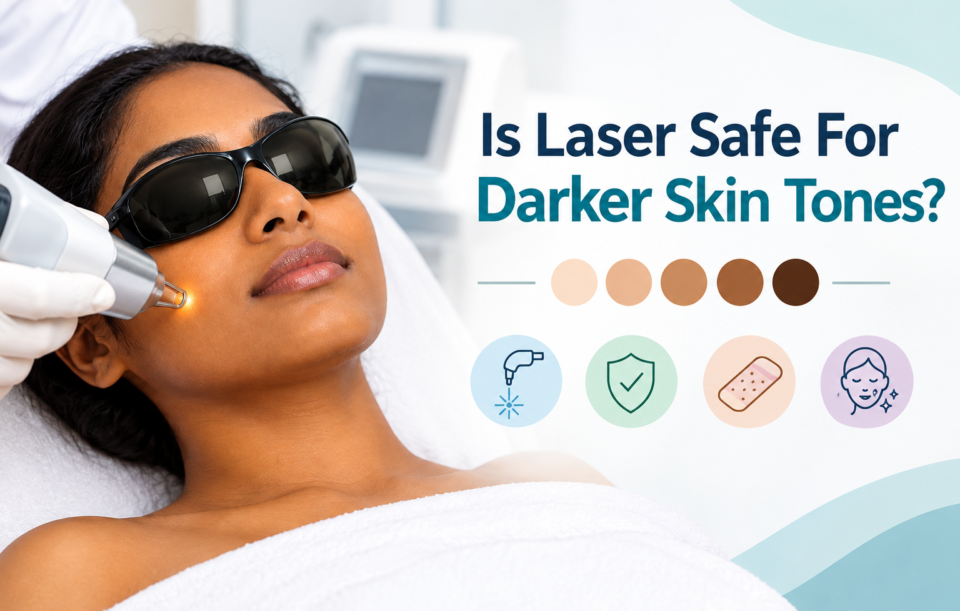
Laser is safe on melanin-rich skin when the wavelength, energy and cooling are matched to skin type and a test patch is done first. Longer wavelengths are generally safer on deeper tones. The real risk is not the laser itself but wrong settings, recent tanning and skipped test patches.
How does skin type change the laser settings that can be used safely?
Darker skin contains more epidermal melanin. That matters because laser energy intended for a target such as hair, pigment or a deeper skin structure can also be absorbed by melanin in the surrounding epidermis.
This is why laser treatment cannot be approached with one setting for every patient.
The clinician needs to consider the patient’s skin tone, whether the skin is recently tanned, the treatment target, the laser wavelength, pulse duration, energy level, spot size and cooling system. Longer wavelengths can penetrate more deeply while generally producing less absorption by epidermal melanin than shorter wavelengths.
For laser on brown skin, this personalised approach is particularly important. A treatment that is appropriate for lighter skin may need different parameters for Fitzpatrick skin types IV, V or VI.
Cooling is another important part of the safety plan. Appropriate epidermal cooling helps protect the surface of the skin while allowing the intended target to receive treatment. Reviews of cosmetic procedures in skin of colour specifically emphasise careful parameter selection and cooling.
So the question is not simply, “Is laser safe for dark skin?”
The better question is:
Is this particular laser, at this particular setting, appropriate for this patient’s skin type and treatment target?
Which laser wavelengths suit deeper skin tones and which do not?
There is no single laser that is safest for every condition. The correct wavelength depends on what is being treated.
For hair removal in darker skin, long pulsed 1064 nm Nd:YAG is widely used because its longer wavelength penetrates more deeply and has less interaction with epidermal melanin than shorter wavelengths. Recent reviews describe long pulsed 1064 nm Nd:YAG as a preferred or gold standard option for many patients with Fitzpatrick IV to VI skin undergoing laser hair removal.
This does not mean that every 755 nm, 810 nm or other device is automatically unsafe. Some can be used in selected darker skin types with appropriate settings, pulse duration and cooling. The safety margin depends on the specific device and treatment protocol.
For pigmentary treatments, the situation is more complicated. A wavelength suitable for one pigment condition may not be suitable for another. For example, 1064 nm Nd:YAG has an established role in several pigmentary disorders, while some shorter wavelength treatments carry greater pigmentary risk in darker skin.
For melasma specifically, laser should not automatically be treated as a first line treatment. An Indian expert consensus recommends laser only in selected resistant cases after appropriate counselling and preferably test treatment, with particular caution around post inflammatory hyperpigmentation.
The important point is that wavelength selection is only one part of safety. Energy, pulse duration, cooling, treatment area, recent sun exposure and the patient’s individual response all matter.
Why is a test patch non-negotiable, and how long is it observed?
A test patch before laser gives the clinician an opportunity to see how the patient’s skin responds before treating a larger area.
This is especially valuable in darker skin because pigmentary complications can be more noticeable and can sometimes persist.
A test patch should be performed using the planned or appropriately conservative treatment parameters. The exact observation period is not universal because it depends on the device and procedure. Immediate reactions can be assessed during the appointment, while delayed redness, swelling, blistering or pigmentary changes may require observation over the following days. Some treatments may require a longer assessment period before proceeding.
The clinician should explain exactly how long the test area will be monitored before the full treatment.
A test patch does not guarantee that a complication can never occur. It reduces uncertainty and provides useful information about how that person’s skin responds.
For darker skin, this step is particularly important when there is a history of pigmentation, previous laser complications, recent tanning or sensitivity.
What causes post-inflammatory hyperpigmentation after laser, and how is it prevented?
PIH after laser, meaning post inflammatory hyperpigmentation, occurs when inflammation or injury stimulates increased pigment production or causes pigment to become deposited within the skin.
PIH is more common in darker skin and is a recognised complication of laser and other light based procedures. Its severity depends on factors including baseline skin colour, the degree of inflammation and the depth of the injury.
Laser can therefore produce darker patches when excessive heat or inflammation affects the skin.
Risk reduction begins before the laser is used.
Important measures include:
- Assessing skin type and current tanning
- Choosing an appropriate wavelength
- Using conservative energy settings when indicated
- Using suitable pulse duration
- Providing adequate cooling
- Performing a test patch
- Avoiding treatment over recently tanned skin
- Following the recommended pre treatment pause for irritating skincare products
- Using careful aftercare
- Protecting the treated skin from sunlight after treatment
Recent reviews specifically identify strict photoprotection and appropriate cooling as important measures for reducing pigmentary complications in skin of colour.
A patient who develops unusual darkening after treatment should contact the treating clinic rather than repeatedly applying strong active products or undergoing another laser session without assessment.
Which pre-treatment mistakes raise the risk?
Recent tanning is one of the most important issues to discuss before laser.
When the skin has more active pigment, there can be greater competition between the treatment target and epidermal melanin. That can reduce the safety margin.
This is why a clinician may postpone treatment after significant sun exposure or tanning rather than simply increasing or changing the settings.
Skincare products also matter. Retinoids and other potentially irritating actives may need to be paused before certain laser procedures because irritation or barrier disruption can increase sensitivity. However, there is no universal retinol stopping period for every laser. The appropriate pause depends on the procedure, product and patient’s skin.
Other important questions before treatment include:
- Have you had a recent sunburn?
- Have you used a tanning bed or intentional tanning product?
- Have you previously developed PIH?
- Have you had a laser reaction before?
- Are you using retinoids or other potentially irritating actives?
- Are you taking medicines that may increase photosensitivity?
- Is the treatment area currently irritated or inflamed?
These details should be discussed during the consultation rather than hidden from the clinician.
Risk reduction checklist
| Safety step | What should happen | Why it matters |
|---|---|---|
| Skin type assessment | Fitzpatrick type and individual pigmentation risk considered | Helps guide device and settings |
| Treatment target | Hair, pigment, scar, texture or another concern identified | Different targets require different approaches |
| Recent tanning check | Recent sun exposure or tanning assessed | Increased epidermal melanin can reduce the safety margin |
| Device selection | Appropriate wavelength selected for the target and skin type | Longer wavelengths can be advantageous in darker skin for selected treatments |
| Test patch | Small area treated before wider treatment | Allows the skin response to be assessed |
| Test patch timing | Observation period explained according to the procedure | Delayed reactions may not appear immediately |
| Pre treatment pause | Irritating actives paused when clinically appropriate | Reduces unnecessary irritation |
| Cooling | Appropriate epidermal cooling used | Helps limit thermal injury |
| Post treatment pigment protection | Sun avoidance and photoprotection advised | Helps reduce PIH risk |
| Unexpected pigmentation | Clinic contacted for assessment | Early evaluation can guide appropriate management |
Which laser is safest for brown skin?
There is no universal safest laser for every skin condition. For laser hair removal, long pulsed 1064 nm Nd:YAG is commonly preferred for darker skin because its longer wavelength reduces epidermal melanin absorption compared with shorter wavelengths.
For pigmentation, acne scars, resurfacing or other concerns, the appropriate device can be different. Non ablative fractional lasers and selected Nd:YAG treatments have favourable safety profiles in darker skin when used with appropriate settings.
The safest choice therefore depends on the condition being treated, skin type, treatment history and device settings.
For more information, see Advanced laser skin treatment in Surat:
Advanced laser skin treatment in Surat
How long before treatment should a test patch be done?
There is no single test patch interval that applies to every laser procedure. The timing depends on the device, treatment target and expected reaction.
Some immediate reactions can be assessed during the appointment, while delayed redness, swelling, blistering or pigmentary changes may take longer to appear. The treating clinician should therefore specify how long the patch will be observed before proceeding with the full treatment.
A patient with darker skin or a history of PIH may require particularly careful assessment.
Can laser cause dark patches on brown skin?
Yes. Laser can cause PIH or, less commonly, other pigmentary changes, particularly when excessive inflammation or thermal injury occurs. Darker skin has a greater tendency toward PIH after inflammatory injury.
This does not mean laser should be avoided automatically. Appropriate wavelength selection, conservative settings, cooling, test treatment and strict photoprotection can reduce the risk.
Should I stop retinol before laser?
Retinol or prescription retinoids may need to be paused before some laser procedures because they can increase irritation or sensitivity, but there is no universal stopping period for every laser.
The required pause depends on the laser, treatment intensity, skin condition and product being used. Patients should tell the clinician about all retinoids, acids and other active skincare products before treatment and follow the clinic’s specific instructions.
Is recent sun exposure a reason to postpone?
Recent significant sun exposure or tanning can be a reason to postpone laser treatment, particularly in darker skin.
Tanning increases epidermal melanin and can change the safety margin for treatment. Treating recently tanned skin can increase the risk of unwanted heating, burns and pigmentary complications. A clinician should assess the skin before deciding whether treatment can safely proceed.
How is a burn managed if it happens?
If significant pain, blistering or a suspected burn occurs, laser treatment should stop and the area should be cooled appropriately while the patient is assessed by the treating clinician.
Do not deliberately break blisters or apply strong active skincare products without medical advice. The clinic should assess the depth and severity of the injury and provide appropriate wound care. New or worsening pigmentation should also be reported because PIH can follow inflammatory injury.
Related laser treatment information
For additional information about treatment options and safety, see:
- Advanced laser skin treatment in Surat
Advanced laser skin treatment in Surat
- YAG advanced laser skin treatment
YAG advanced laser skin treatment
- Laser hair removal side effects
Laser hair removal side effects
- Laser treatment services
The key safety message for darker skin
Laser treatment can be performed safely on darker skin, but safety depends on the right device, wavelength, energy, pulse duration, cooling and patient selection, rather than simply choosing a machine marketed as suitable for brown skin.
A test patch before laser, careful assessment of recent tanning, appropriate preparation and strong post treatment pigment protection are important parts of reducing complications.
The risk is not that dark skin can never undergo laser treatment. The greater concern is inappropriate treatment, excessive energy, inadequate cooling, unsuitable device selection or proceeding without properly assessing how the patient’s skin responds. Evidence and expert reviews support careful, individualised treatment rather than a one setting fits all approach.
Frequently Asked Questions
Long pulsed 1064 nm Nd:YAG is often preferred for darker skin, with suitable settings and cooling.
The timing depends on the laser and treatment. Your clinician should decide the observation period.
Yes. PIH after laser can occur, especially with excessive heat, tanning or unsuitable settings.
Often, yes, but the pause depends on the treatment. Follow your clinician’s instructions.
Yes. Recent tanning or sunburn can increase laser burn and pigmentation risk.
Treatment should stop, the area should be assessed, and appropriate cooling and wound care should be provided.


Category
Latest From Blog
Small Black Warts on Face and Neck: Removal and Recurrence
Can Facial Ageing Be Treated Without Surgery?
Red Veins On The Face: What Causes Them And Which Vascular Laser Fits