




Written by Dr. Ashutosh A Shah, M.B.B.S., M.S., M.Ch., D.N.B., Board Certified Plastic Surgeon, Elegance Clinic, Surat. Reg. no. [REG NO]. 22+ years in cosmetic and laser practice.
Medically reviewed by Dr. Ashutosh A Shah · Published 21 September 2026 · Last reviewed 21 September 2026
A carbon laser peel applies a liquid carbon layer that sinks into pores, then a Q-switched Nd:YAG laser shatters it, lifting out oil, dead cells and blackheads while stimulating collagen. One session takes 20-30 minutes with no downtime, and most people need 4-6 sessions spaced 2-4 weeks apart for visible pore and oil control.
The carbon laser peel is one of the most requested skin treatments in Surat, largely because it does something most facials cannot: it reaches into the pore itself. It is also one of the most oversold, with clinics promising scar removal and permanent pore closure that the technology simply does not deliver.
This post gives you the honest version. What a carbon laser peel treats well, what it does not treat at all, exactly what happens in a session, realistic session counts, side effects on Indian skin, how it compares with a chemical peel and a hydrafacial, and current cost ranges in Surat.
What is a carbon laser peel, and why is it called the Hollywood Peel?
A carbon laser peel is a non-invasive skin treatment that combines a topical liquid carbon suspension with a Q-switched Nd:YAG laser at 1064 nm. It earned the nickname Hollywood Peel because actors used it before red carpet events for an immediate glow with no visible recovery time.
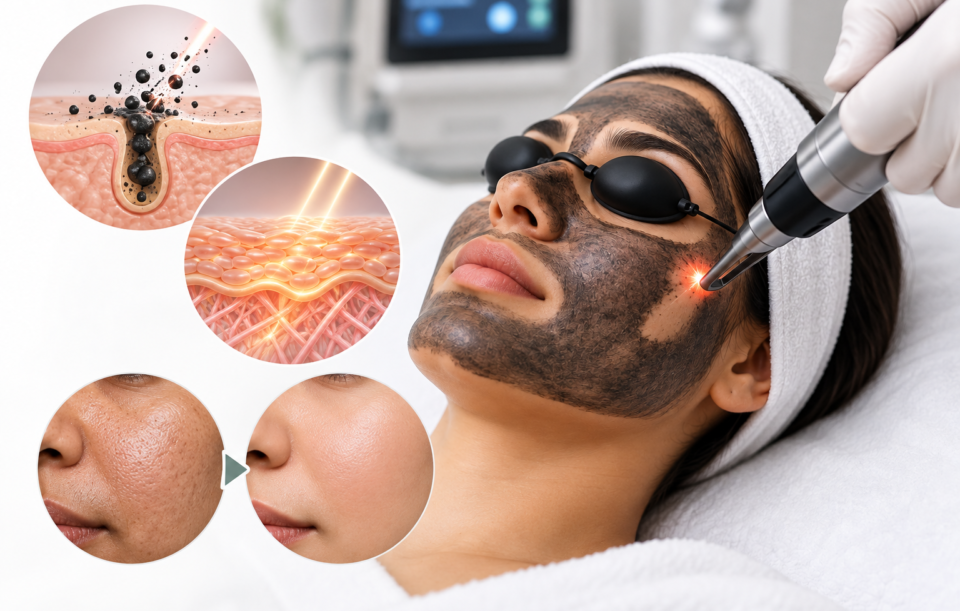
The mechanism is straightforward once you see it. Liquid carbon is painted over the face and allowed to settle into the pores, where it binds oil, dead skin cells and debris. Laser light is then passed over the skin. Carbon absorbs that specific wavelength very strongly, so the energy is concentrated exactly where the carbon sits.
Each laser pulse fragments the carbon particles, and the carbon leaves the skin taking the trapped pore contents with it. A second, lower-energy pass delivers gentle heat into the deeper skin, which is the part that nudges collagen production over a course of sessions.
Peer-reviewed dermatology literature on the carbon peel laser technique describes this same two-part effect: superficial exfoliation with the carbon, plus a mild photothermal effect in the dermis.
What does a carbon laser peel actually treat?
A carbon laser peel works best on surface and pore-level problems: enlarged open pores, excess oil, blackheads, dullness, rough texture and mild active acne. It gives an immediate brightening effect and improves skin clarity progressively over a course of sessions.
Realistic indications:
- Open or enlarged pores. Pores look smaller because they are emptied and the surrounding skin tightens slightly. They are not permanently shrunk.
- Oily and combination skin. Sebum output is temporarily reduced, which is why oily-skinned patients notice the biggest difference.
- Blackheads and congestion. The carbon physically lifts the plug rather than dissolving it chemically.
- Dullness and uneven tone. Removing the dead cell layer restores light reflection, which is the instant glow people describe.
- Mild inflammatory acne. Studies of laser carbon peel in acne report reduced lesion counts, mainly through oil control and an antibacterial effect.
- Rough or textured skin. Smoother feel from session one, with gradual improvement over a course.
In our Surat practice, the patients who are happiest with this treatment are almost always people in their twenties and thirties with oily, congested, large-pored skin who want a maintainable routine. They see something on day one, which keeps them consistent.
What does a carbon laser peel NOT treat?
This treatment will not remove deep or boxcar acne scars, will not reliably clear melasma, and will not permanently shrink pores or replace acne medication. Expecting any of these is the main reason patients feel disappointed after paying for a course.
Being specific about the limits:
- Deep acne scars, ice-pick and boxcar scars. These are dermal volume defects. They need fractional CO2 or erbium resurfacing, subcision, microneedling with radiofrequency or fillers. A carbon peel works at the surface and cannot reach them.
- Melasma. This is a stubborn, relapsing pigment condition. Some patients improve with low-fluence laser toning, but others flare. It needs a dedicated, dermatologist-supervised plan, not a Hollywood Peel package.
- Deep wrinkles and sagging. Collagen stimulation here is mild. Established folds need resurfacing, energy-based tightening or surgical options.
- Permanent pore reduction. Pore size is largely genetic and oil-driven. Results fade without maintenance.
- Severe nodulocystic acne. This needs medical treatment first. Lasering active cystic acne can aggravate it.
- Moles, warts and skin tags. Different lesions, different devices.
If deep scarring or stubborn pigmentation is your actual concern, a combined plan is discussed on our laser treatment for beauty page rather than a carbon peel alone.
What happens during a carbon laser peel session?
A session takes 20 to 30 minutes and needs no anaesthesia or numbing cream. You feel warmth and a light snapping sensation, and you can return to work straight afterwards with makeup on if you wish.
The sequence:
- Cleansing. Makeup, sunscreen and surface oil are removed completely, because any residue interferes with carbon contact.
- Carbon application. A thin, even layer of liquid carbon is brushed over the treatment area and left for a few minutes to settle into the pores.
- Eye protection. Opaque shields are placed. This is not optional, and a clinic that skips it is a clinic to leave.
- First laser pass. The Q-switched laser is passed over the skin to fragment and remove the carbon along with the trapped debris. You hear a light crackle and smell a faint burnt note. This is normal.
- Second toning pass. A lower-energy pass warms the deeper skin to stimulate collagen and even out tone.
- Soothing and sunscreen. A calming serum or mask, then broad-spectrum sunscreen before you leave.
Most people describe the sensation as a warm rubber band flick, entirely tolerable. Skin looks brighter and feels smoother by the time you reach the car park.
Is there downtime, and what are the side effects?
There is effectively no downtime after this treatment. Mild redness and warmth are usual and typically settle within a few hours, occasionally up to a day. Serious complications are uncommon when the treatment is performed at correct settings by trained hands.
What to expect and what to watch for:
- Common and short-lived: redness, warmth, mild tingling, slight dryness or flaking for a day or two, temporary sensitivity to active skincare.
- Less common: transient darkening of some spots before they clear, a brief acne purge as pores empty, mild swelling in very sensitive skin.
- Uncommon but important: post-inflammatory hyperpigmentation, especially with sun exposure right after a session, and rarely blistering or burns if settings are wrong for the skin type.
Aftercare is simple and it matters. Sunscreen every single day without exception. Skip retinoids, AHAs, BHAs and scrubs for about five to seven days. No sauna, steam, swimming or heavy workouts for 48 hours. Keep the skin well moisturised, and do not pick at flaking.
How many carbon laser peel sessions do you need, and how long do results last?
Most people need 4 to 6 sessions spaced 2 to 4 weeks apart for meaningful pore and oil control. The glow from a single session lasts roughly one to two weeks, while the results of a completed course generally hold for three to six months with maintenance.
A practical way to think about the timeline:
- After session 1: immediate brightness, smoother texture, cleaner-looking pores. This is the effect people book before a wedding or a shoot.
- After sessions 2 and 3: noticeably less oil through the day, fewer blackheads, more even tone.
- After sessions 4 to 6: the pore and texture change that actually shows in photographs, plus gradual collagen benefit.
- Maintenance: one session every 4 to 8 weeks, adjusted to how oily your skin is and the season.
Be honest with yourself about the maintenance part. This is a managed-result treatment, not a one-time fix. Oily skin that stops treatment entirely will drift back toward its baseline over a few months.
Carbon laser peel vs chemical peel vs hydrafacial: which one do you need?
Choose a carbon peel for oily, large-pored, congested skin that needs deep pore cleaning with zero downtime. Choose a chemical peel for pigmentation, tan and superficial acne marks. Choose a hydrafacial for dry, dull or sensitive skin that mainly needs hydration and gentle exfoliation.
| Factor | Carbon laser peel | Chemical peel | Hydrafacial |
|---|---|---|---|
| How it works | Carbon plus Q-switched laser energy | Acid solution such as glycolic, salicylic or TCA | Vacuum suction with serum infusion |
| Best for | Open pores, oily skin, blackheads, dullness | Pigmentation, tan, acne marks, uneven tone | Dehydration, dullness, sensitive skin |
| Depth of action | Surface plus mild dermal heating | Superficial to medium, depends on the acid | Surface only |
| Downtime | None | None to about a week of peeling | None |
| Sensation | Warmth, light snapping | Stinging or burning during application | Comfortable, like a suction massage |
| Helps pigmentation | Mildly | Yes, this is its strength | Minimally |
| Sessions for a course | 4 to 6 | 4 to 8, acid dependent | Monthly, ongoing |
| Typical cost per session | Mid | Low to mid | Mid to high |
These three are not rivals, they are tools. Combination plans are common: a carbon peel course for oil and pores, then chemical peels for the pigment left behind. Wider skin and facial rejuvenation options sit on our face makeover page.
What is the cost of a carbon laser peel in Surat?
A carbon laser peel in Surat is commonly quoted between about ₹2,000 and ₹5,000 per session, with packages of 4 to 6 sessions usually landing in the ₹8,000 to ₹25,000 range. Price is driven by the laser platform, the treatment area and who operates the device.
What legitimately changes the price:
- The machine. A genuine, serviced, FDA-cleared Q-switched Nd:YAG costs very differently to run than an unbranded import.
- Treatment area. Face only, versus face with neck, or face with back for acne.
- Who performs it. A doctor-supervised protocol with settings chosen for your skin type, versus a technician running a fixed preset.
- Package versus single session. Courses are nearly always cheaper per session.
- Add-ons. Post-peel masks, serums or combined toning passes.
Treat unusually cheap offers with caution. On Indian skin, the wrong fluence is not a cosmetic disappointment, it is a pigmentation risk that takes months to settle. Ask which machine is being used and who is setting the parameters before you ask for a discount.
Who should avoid a carbon laser peel?
This treatment should be avoided if you have active skin infection, open wounds or severe inflamed acne in the treatment area, a recent tan or sunburn, or if you are pregnant. It is also postponed after recent isotretinoin use or other recent resurfacing.
Discuss it carefully with your doctor if any of the following apply:
- Active herpes or cold sores near the treatment area
- A strong personal history of post-inflammatory hyperpigmentation or keloid scarring
- Photosensitising medication, including some antibiotics and acne drugs
- Isotretinoin within the last six months
- Uncontrolled diabetes or an immune-suppressing condition affecting healing
- Any recent laser, peel or microneedling in the same area
A proper consultation covers your Fitzpatrick skin type, current skincare, medication and sun exposure before anything is switched on.
Carbon laser peel at Elegance Clinic, Surat
Dr. Ashutosh A Shah is a board certified plastic surgeon with over 22 years of cosmetic and laser practice in Surat, Gujarat. Indian skin, largely Fitzpatrick types IV and V, needs conservative starting fluences and a test pass rather than a one-setting-fits-all preset, and that is how every session here is planned. Published work on carbon peel laser in skin of colour supports this cautious approach.
Patients are also told plainly when a carbon peel is not the right treatment, which happens often with deep scarring and melasma. Full details of the protocol are on our laser carbon peel treatment page.
Next step
If open pores, oiliness or dullness are your main concern, a short consultation will confirm whether a carbon laser peel is the right fit or whether your skin needs something else first. Book an appointment with Dr. Ashutosh Shah at Elegance Clinic, Surat, or call +91 83205 00350.
Medical disclaimer: This article is for education only and is not a substitute for professional diagnosis or treatment. Please consult Dr. Ashutosh A Shah or a qualified skin specialist about your own skin before starting any laser treatment.
A carbon laser peel uses liquid carbon and a Q-switched Nd:YAG laser to deep-clean pores, lift out oil, dead cells and blackheads, and brighten dull skin. A second lower-energy pass warms the deeper skin to stimulate collagen. Skin looks clearer and smoother immediately after the session.
Yes, when performed at conservative settings by a trained practitioner. Indian skin is usually Fitzpatrick type IV or V, which carries a higher risk of post-inflammatory hyperpigmentation, so fluence must be lowered and daily sunscreen is essential. A test pass before the first full session is sensible.
Most people need 4 to 6 sessions spaced 2 to 4 weeks apart for visible pore and oil control. A single session gives a short-lived glow lasting one to two weeks. After a completed course, maintenance every 4 to 8 weeks holds the result for three to six months.
No. A carbon peel works at the skin surface and cannot correct deep, boxcar or ice-pick scars, which are volume defects in the dermis. Those need fractional CO2 resurfacing, subcision, microneedling with radiofrequency or fillers. Carbon peel can improve active acne and overall texture.
Carbon laser peel in Surat is commonly quoted between about ₹2,000 and ₹5,000 per session, with 4 to 6 session packages usually in the ₹8,000 to ₹25,000 range. The laser platform, treatment area and whether a doctor sets the parameters all affect the final price.
There is effectively no downtime. Mild redness and warmth are normal and usually settle within a few hours. You can wear makeup and return to work the same day. Avoid sauna, steam, swimming and heavy workouts for 48 hours, and use sunscreen daily.
Neither is better, they treat different problems. Choose a carbon peel for oily skin, open pores, blackheads and dullness with zero downtime. Choose a chemical peel for pigmentation, tan and acne marks. Many patients do a carbon peel course first, then chemical peels for remaining pigment.


Category
Latest From Blog
Small Black Warts on Face and Neck: Removal and Recurrence
Can Facial Ageing Be Treated Without Surgery?
Red Veins On The Face: What Causes Them And Which Vascular Laser Fits