




Clinical Article Reviewed With: Dr. Ashutosh Shah, M.Ch., DNB
Field of Practice: Plastic, Cosmetic & Aesthetic Surgery
Professional Experience: More Than 22 Years
At Elegance Clinic: Founder & Director
Medical Content Update: August 2026
Jaw Botox, commonly called masseter Botox, is used to reduce the activity of the masseter muscles on the sides of the jaw. In appropriately selected people, this can gradually make a muscle-heavy lower face appear slimmer.
But can jaw Botox cause side effects?
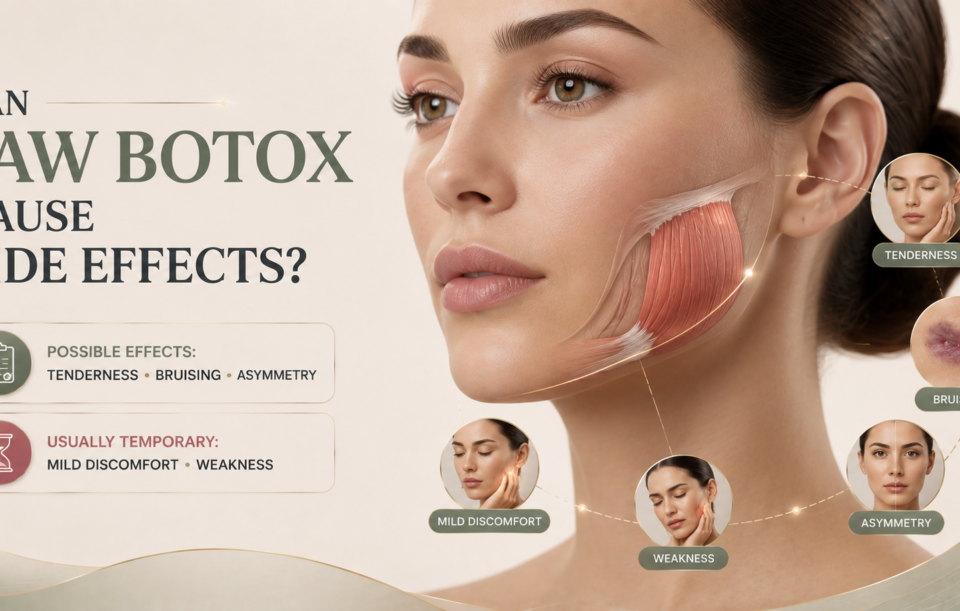
Yes. Jaw Botox can cause temporary side effects such as pain, bruising, swelling, chewing weakness, smile asymmetry or an unwanted change in facial shape. Less common complications can occur if the toxin affects nearby muscles or if the treatment is not appropriately planned.
Understanding these risks is important before deciding whether jaw-slimming Botox is suitable for you.
Key Takeaways
- Jaw Botox is usually injected into the masseter muscles.
- Temporary injection-site discomfort and bruising can occur.
- Chewing may temporarily feel weaker.
- Too much muscle reduction can make the lower face appear overly narrow or hollow.
- Incorrect placement can affect nearby facial muscles and alter the smile.
- Existing facial proportions should be assessed before treatment.
- Botox results are temporary rather than permanent.
- More Botox does not necessarily produce a better jawline.
- Treatment should be individualised according to muscle size and facial anatomy.
- A qualified medical professional should assess suitability before treatment.
What Is Jaw Botox?
Jaw Botox is a nonsurgical treatment in which botulinum toxin is injected into selected areas of the masseter muscle to temporarily reduce its activity.
The masseter is a strong muscle used during chewing. It sits near the angle of the lower jaw.
Some people naturally have prominent masseter muscles, while others may develop enlargement associated with habitual clenching or grinding.
Elegance Clinic provides assessment and treatment for masseteric hypertrophy, which may include botulinum toxin treatment in appropriately selected patients.
Why Is Botox Used in the Jaw?
One cosmetic reason is to make a lower face that appears broad because of enlarged masseter muscles look less square.
Botulinum toxin temporarily reduces signalling between the nerve and treated muscle. With reduced activity, the masseter can gradually decrease in prominence.
However, a broad jaw is not always caused by muscle.
Its appearance can also be influenced by:
- jawbone structure,
- facial fat,
- skin laxity,
- chin shape,
- cheek volume,
- and overall facial proportions.
This distinction matters because Botox acts on muscle, not bone.
What Are the Side Effects of Jaw Botox?
Most side effects, when they occur, are temporary. Their likelihood and severity depend on factors such as anatomy, injection placement, dose and individual response.
| Possible Side Effect | What You May Notice |
|---|---|
| Injection-site discomfort | Mild tenderness after treatment |
| Bruising | Small bruises around injection points |
| Swelling | Temporary local puffiness |
| Chewing weakness | Foods may temporarily feel more tiring to chew |
| Facial asymmetry | One side may respond differently |
| Smile change | Nearby muscle involvement may affect expression |
| Excessive slimming | Lower face may become narrower than desired |
| Hollow appearance | Reduced muscle bulk can reveal or exaggerate existing hollowness |
| Headache | May occur temporarily in some patients |
| Unsatisfactory contour | Facial shape may not change as expected |
Not every patient experiences these effects, and this table does not cover every possible complication.
Can Jaw Botox Make Chewing Difficult?
Yes, temporary chewing weakness can occur because the masseter is one of the main muscles involved in chewing.
Botox intentionally reduces activity in this muscle.
Some people may notice that prolonged chewing or particularly firm foods feel more tiring after treatment.
The effect is generally temporary as botulinum toxin activity gradually wears off.
Significant or persistent difficulty should be discussed with the treating clinician.
Can Masseter Botox Change Your Smile?
It can in some cases.
The masseter is located near other muscles responsible for facial movement and expression.
If botulinum toxin affects an unintended nearby muscle, a person may notice:
- an asymmetric smile,
- difficulty making certain expressions,
- or an unusual movement around the mouth.
Knowledge of facial anatomy and careful injection placement are therefore important.
Can Jaw Botox Make Your Face Look Uneven?
Yes.
Natural faces are already somewhat asymmetric. The two masseter muscles may also differ in size and strength.
If one side responds more strongly than the other, temporary asymmetry can become more noticeable.
This is one reason the same amount of Botox does not necessarily need to be injected on both sides.
Treatment should be based on anatomy rather than following a fixed injection formula.
Can Too Much Jaw Botox Make Your Face Look Too Thin?
Potentially.
Reducing a prominent masseter can soften a square lower face, but excessive reduction may create an appearance that the patient does not prefer.
The lower face can look:
- overly narrow,
- less supported,
- hollow,
- or disproportionate to the cheeks and chin.
A conservative treatment plan may therefore be preferable to aggressively weakening the muscle in a single session.
Can Masseter Botox Cause Facial Sagging?
This question requires context.
The masseter contributes to lower-face volume. Reducing that volume changes facial contour.
In someone with good skin elasticity, this may simply produce a slimmer appearance. In someone who already has lower-face laxity or reduced soft-tissue support, decreasing masseter volume may make existing looseness more noticeable.
Botox does not literally remove skin, but changing the underlying muscle volume can change how the lower face looks.
Does Jaw Botox Cause Jowls?
Not automatically.
Jowls develop because of several factors, including:
- ageing,
- skin laxity,
- changes in facial fat,
- ligament support,
- bone structure,
- and facial volume loss.
Masseter reduction can alter the lower-face contour. In a person already prone to jowling, that change could potentially make existing laxity more apparent.
This possibility should be considered during facial assessment.
Can Jaw Botox Make the Face Look Hollow?
Yes, particularly when a large masseter is reduced substantially or the person already has limited facial volume.
What looks attractive on one facial structure may not work on another.
A very slim face may not benefit from aggressive masseter reduction simply because a V-shaped jawline is desired.
The goal should be facial balance rather than maximum muscle reduction.
Can Jaw Botox Affect Your Bite?
Jaw Botox changes muscle activity rather than repositioning the teeth or jawbone.
However, because the masseter contributes to chewing and jaw function, altering its activity can temporarily change how chewing feels.
Someone with significant jaw pain, temporomandibular joint symptoms, bite problems or severe teeth grinding may require a broader assessment rather than assuming cosmetic Botox alone will solve the problem.
Can Botox Fix Every Wide Jaw?
No. Jaw Botox primarily helps when enlarged masseter muscles contribute significantly to lower-face width.
If the width comes mainly from the mandibular bone, Botox cannot shrink that bone.
Similarly, if facial fullness comes predominantly from fat, another approach may be required.
Before recommending Botox, the clinician should determine whether the broad appearance is primarily due to:
Muscle: Masseter Botox may help selected patients.
Bone: Botox cannot reduce skeletal width.
Fat: Muscle treatment alone may have limited effect.
Loose skin: Reducing muscle volume may not address laxity.
Mixed anatomy: A combined or alternative approach may need consideration.
Who May Be a Good Candidate for Jaw Botox?
A suitable candidate may have:
- visibly or palpably enlarged masseter muscles,
- a square lower face caused partly by muscle bulk,
- realistic expectations,
- and no contraindication to botulinum toxin treatment.
During assessment, the clinician may ask the patient to clench their teeth so the masseter muscle becomes easier to evaluate.
Who Should Be Careful About Jaw Botox?
Extra consideration may be appropriate for people who have:
- naturally narrow or thin faces,
- significant lower-face laxity,
- facial asymmetry,
- swallowing or neuromuscular problems,
- active infection at the injection area,
- previous facial procedures affecting anatomy,
- or unrealistic expectations about jaw reduction.
Pregnancy and breastfeeding should also be discussed with the treating medical professional, as elective cosmetic treatment is generally deferred when appropriate safety evidence is lacking.
Is Jaw Botox Permanent?
No.
Botulinum toxin works temporarily.
Muscle activity gradually returns as its effect wears off. The visible contour change can also evolve over time.
Some patients choose repeat treatment, but the need, timing and dose should be reassessed rather than automatically repeating the previous injection pattern.
How Long Does Jaw Botox Take to Work?
Botox does not instantly make a broad jaw narrow.
Muscle activity begins changing before the full contour effect becomes visible.
Because facial slimming depends partly on gradual reduction in muscle bulk, visible jawline changes may take several weeks to become apparent.
Individual responses vary.
Can You Reverse Jaw Botox?
There is no routine instant reversal treatment comparable to dissolving certain hyaluronic acid fillers.
If an unwanted Botox effect occurs, it generally improves as the botulinum toxin effect gradually wears off.
This is another reason careful dosing and placement matter.
How Can the Risks of Jaw Botox Be Reduced?
Risk cannot be reduced to zero, but appropriate patient selection and technique matter.
Before treatment, the clinician should evaluate:
- facial proportions,
- masseter size,
- baseline asymmetry,
- skin laxity,
- jaw function,
- previous treatments,
- medical history,
- and the patient’s expected result.
The aim should be to use an appropriate treatment plan rather than simply injecting the maximum possible dose.
When Should You Seek Medical Help After Botox?
Contact your treating clinician if you develop an unexpected or concerning reaction.
Urgent medical attention is particularly important for symptoms such as significant difficulty swallowing, speaking or breathing, marked generalized weakness, or other severe symptoms.
These reactions are uncommon in cosmetic treatment but should not be ignored.
Is Jaw Botox Safe?
Jaw Botox can be performed safely in appropriately selected patients, but it is still a medical procedure with potential side effects and complications.
Safety depends on more than the Botox product itself. Facial anatomy, dose, placement, patient selection and follow-up all matter.
The broader Botox and filler treatments at Elegance Clinic include facial aesthetic procedures that should be selected according to individual anatomy rather than trends alone.
A Safer Approach Starts With Understanding Your Jaw
A square or broad jaw does not automatically mean you need Botox.
The first question should be: Is the width actually coming from the masseter muscle?
Dr. Ashutosh Shah is a board-certified Plastic, Reconstructive and Cosmetic Surgeon with M.Ch. and DNB qualifications and more than 22 years of surgical experience. Patients considering facial aesthetic treatment can read more about Dr. Ashutosh Shah and Elegance Clinic before deciding on treatment.
The safest goal is not to create the smallest possible jaw. It is to achieve a proportionate facial contour while preserving natural expression and function.
If you are considering jaw Botox but are concerned about chewing weakness, facial sagging, asymmetry or an unnatural result, contact Elegance Clinic for an individual facial assessment before treatment.
Frequently Asked Questions
Yes. Bruising, swelling, chewing weakness and temporary facial changes can occur.
Yes, unintended spread to nearby muscles can temporarily affect facial expression.
Reducing masseter volume may make existing lower-face laxity more noticeable in some people.
No. Botulinum toxin has a temporary effect.
There is no routine instant reversal. Unwanted effects generally improve as Botox wears off.

Category
Latest From Blog
Small Black Warts on Face and Neck: Removal and Recurrence
Can Facial Ageing Be Treated Without Surgery?
Red Veins On The Face: What Causes Them And Which Vascular Laser Fits