




Clinical Guidance By: Dr. Ashutosh Shah, M.Ch., DNB (Plastic Surgery)
Specialty: Plastic, Reconstructive & Cosmetic Surgery
Experience: 22+ Years
Position: Founder & Director, Elegance Clinic, Surat
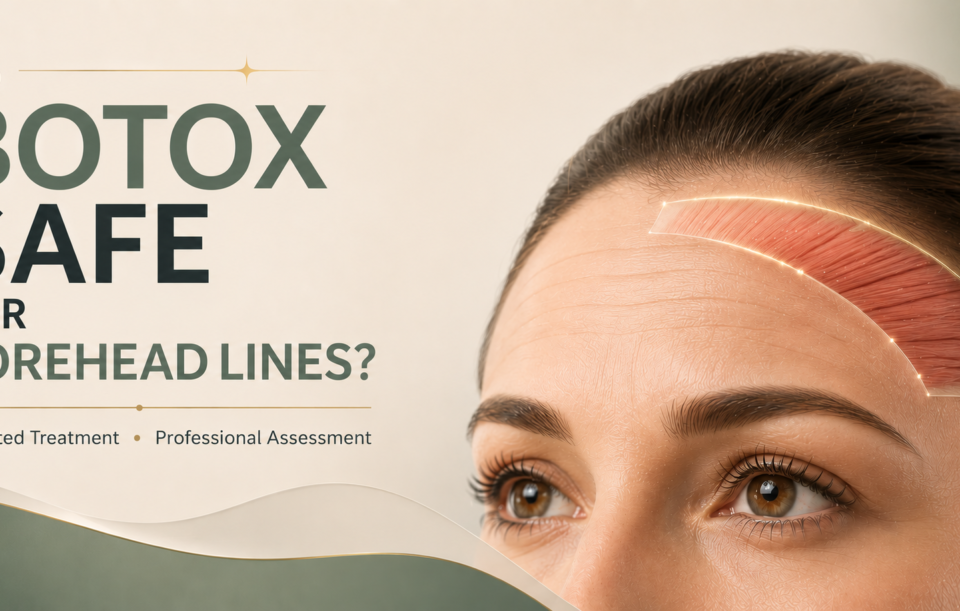
Forehead lines are among the most noticeable expression lines on the face. They often become visible when you raise your eyebrows and may gradually remain present even when your face is relaxed.
Botox is commonly used to soften these lines, but many people considering treatment have a more important question: Is Botox safe for forehead lines?
For appropriately selected adults, botulinum toxin treatment is generally considered safe when performed by a qualified medical professional using an appropriate product, dose and injection technique. However, forehead treatment requires careful planning because the muscles that create forehead lines also help control eyebrow position.
At Elegance Clinic in Surat, forehead Botox can be planned according to facial anatomy, muscle activity and the patient’s desired degree of movement.
Key Takeaways
- Botox can soften forehead lines caused by repeated muscle movement.
- Treatment is generally considered safe for appropriately selected patients when administered by a qualified medical professional.
- Forehead Botox does not permanently remove wrinkles.
- Correct dose and injection placement are important for maintaining eyebrow balance.
- Temporary bruising, swelling, headache or tenderness can occur.
- Unwanted eyebrow or eyelid drooping is possible, although uncommon.
- Too much treatment may produce an excessively heavy or frozen appearance.
- Static forehead lines may not disappear completely with Botox alone.
- Botox results develop gradually rather than immediately.
- Natural-looking treatment aims to soften excessive movement without unnecessarily eliminating facial expression.
Why Do Forehead Lines Develop?
Forehead lines form largely because of repeated contraction of the frontalis muscle.
This muscle helps raise the eyebrows.
Every time you look surprised, raise your brows or make certain facial expressions, the forehead skin folds horizontally.
When skin is younger and more elastic, these lines usually disappear when the muscle relaxes.
Over time, repeated movement combined with changes in collagen, elasticity, sun exposure and skin ageing can make the creases more persistent.
Eventually, forehead lines may remain visible even when you are not raising your eyebrows.
What Is the Difference Between Dynamic and Static Forehead Lines?
Understanding this difference helps explain what Botox can realistically achieve.
Dynamic Forehead Lines
Dynamic lines mainly appear when you move your forehead or raise your eyebrows.
Because muscle activity is an important contributor, these lines often respond well to appropriately administered Botox.
Static Forehead Lines
Static lines remain visible even when the forehead is relaxed.
These creases may involve both muscle movement and structural changes within the skin.
Botox can reduce the repeated movement that contributes to them, but established static lines may not disappear completely.
Additional skin-quality or resurfacing treatments may sometimes be considered depending on the patient’s needs.
How Does Botox Work on Forehead Lines?
Botox temporarily reduces communication between nerves and selected facial muscles, decreasing the muscle contraction that repeatedly folds the skin.
When carefully placed into selected forehead muscles, it can reduce excessive movement and soften dynamic horizontal lines.
Elegance Clinic provides Botox treatment for forehead lines as part of its facial anti-wrinkle services.
The objective should not automatically be to stop every movement.
Instead, treatment can be adjusted according to the patient’s muscle strength, eyebrow position and preference for a more natural or more restricted degree of movement.
Is Botox Safe for Forehead Lines?
Botox is generally considered safe for forehead wrinkles when an appropriate botulinum toxin product is administered to a suitable patient by a trained medical professional.
Like any medical procedure, however, it is not completely risk-free.
Safety depends on several factors:
- correct diagnosis,
- facial anatomy,
- injection location,
- dose,
- product handling,
- patient medical history,
- and the experience of the treating professional.
The forehead requires particular care because weakening one muscle can influence the balance of surrounding muscles.
This is why Botox should be viewed as a medical injectable treatment rather than simply a beauty product.
Why Does Forehead Anatomy Matter?
The frontalis muscle has an important function: it raises the eyebrows.
Some people naturally use this muscle more than others to maintain their eyebrow position.
If the forehead is treated too aggressively, the eyebrows may feel or appear heavier.
The clinician therefore needs to assess more than the wrinkles.
Before treatment, it can be useful to examine:
- natural eyebrow height,
- eyebrow shape,
- forehead length,
- muscle strength,
- eyelid position,
- existing brow heaviness,
- facial asymmetry,
- and movement patterns.
A standard injection pattern is not necessarily appropriate for every face.
Can Botox Cause Drooping Eyebrows?
Yes, unwanted brow lowering can occur.
This is one reason conservative forehead treatment and proper injection planning are important.
The frontalis muscle raises the brows. Excessive weakening can reduce that lifting action and create a heavy-brow sensation or appearance.
Patients who already rely strongly on their forehead muscles to lift their brows may require particularly careful assessment.
The possibility of brow heaviness should be discussed before treatment rather than after it occurs.
Can Botox Cause a Droopy Eyelid?
Temporary eyelid drooping, known as ptosis, is a recognised potential complication of botulinum toxin injections around the upper face.
It can occur if the treatment affects muscles involved in eyelid position.
Correct injection technique and anatomical knowledge help reduce this risk, but no injectable procedure can be described as having zero risk.
Patients should contact their treating clinician if they notice an unexpected change in eyelid position after treatment.
Will Forehead Botox Make My Face Look Frozen?
It does not necessarily have to.
A frozen appearance is more likely when excessive muscle activity is suppressed or when treatment does not account for the patient’s desired expression.
Some patients prefer very little forehead movement.
Others want their wrinkles softened while retaining natural facial expression.
The amount and distribution of Botox can be planned accordingly.
A consultation at Elegance Clinic’s Botox and filler service can focus on the degree of correction rather than assuming every patient wants the same result.
Can Botox Lift the Eyebrows?
Botulinum toxin can influence eyebrow position by altering the balance between muscles that raise and lower the brows.
A subtle change may sometimes be created in appropriately selected patients.
However, Botox is not equivalent to a surgical brow lift.
Significant eyebrow descent, excess upper-eyelid skin or true eyelid ptosis may require a different treatment strategy.
Patients should therefore avoid assuming that additional forehead Botox will automatically lift heavy eyebrows.
What Are the Common Side Effects of Forehead Botox?
Temporary effects around injection sites can include:
- mild redness,
- swelling,
- tenderness,
- bruising,
- headache,
- and small temporary bumps immediately after injection.
These effects are generally different from complications involving unwanted muscle weakness.
Less common problems can include:
- eyebrow asymmetry,
- brow heaviness,
- eyelid drooping,
- an unnatural eyebrow shape,
- excessive muscle weakness,
- or dissatisfaction with the cosmetic result.
Rare systemic adverse effects are also possible with botulinum toxin products and should be discussed as part of informed consent.
Can Botox Make One Eyebrow Higher Than the Other?
Temporary eyebrow asymmetry can occur.
Faces are naturally asymmetric even before treatment, and muscle activity can differ between the two sides.
Sometimes reducing activity in one area changes the balance of untreated muscle fibres, making one eyebrow appear more elevated.
This is one reason photographs and facial movement assessment before treatment can be helpful.
A follow-up assessment can determine whether any adjustment is appropriate.
Does Forehead Botox Hurt?
Most people experience only brief discomfort from the injections.
The needles used for cosmetic botulinum toxin treatment are typically small.
Individual sensitivity varies, so some people may feel more discomfort than others.
Temporary tenderness at injection points can occur afterward.
How Long Does Forehead Botox Take to Work?
Botox does not smooth forehead movement immediately after injection.
Its effect develops gradually over the following days.
Patients should therefore avoid judging the final outcome immediately after leaving the clinic.
The treatment continues settling as muscle activity decreases.
A follow-up may be appropriate after sufficient time has passed to assess the response.
How Long Does Forehead Botox Last?
Botulinum toxin treatment is temporary.
Muscle activity gradually returns as the effect wears off.
The duration varies between individuals and can depend on:
- dose,
- muscle strength,
- metabolism,
- treatment area,
- product used,
- and previous treatment history.
Repeated treatment should be based on clinical reassessment rather than assuming everyone needs injections at exactly the same interval.
Can Botox Permanently Remove Forehead Lines?
No.
Botox does not permanently eliminate the muscles responsible for facial expression.
Its effect gradually wears off.
Reducing repeated folding over time may help keep dynamic lines less prominent while treatment remains effective, but skin continues to age.
Deep static creases may also remain partially visible even when forehead movement is reduced.
What If Botox Does Not Completely Remove My Forehead Lines?
This does not necessarily mean the treatment failed.
If a wrinkle has become deeply established within the skin, reducing muscle movement may soften it without making it disappear completely.
The clinician may then assess whether the remaining concern involves:
- skin texture,
- collagen loss,
- sun damage,
- dehydration,
- or another structural factor.
Selected patients may benefit from treatments aimed at improving skin quality rather than simply adding more Botox.
Can Fillers Be Used for Forehead Lines?
Dermal fillers and Botox work differently.
Botox reduces selected muscle activity.
Fillers add material to selected tissue planes.
Because the forehead contains important blood vessels, filler treatment in this region requires particular anatomical expertise and carries risks, including rare but serious vascular complications.
It should not automatically be considered simply because Botox has not completely removed a static line.
The safest treatment plan depends on individual anatomy.
Who May Be Suitable for Forehead Botox?
An adult bothered by dynamic horizontal forehead lines may be considered after medical assessment.
The clinician should evaluate:
- wrinkle pattern,
- muscle strength,
- brow position,
- eyelid position,
- previous Botox,
- medical history,
- medications,
- and treatment expectations.
Suitability cannot be determined solely from age.
Some younger adults have strong dynamic lines, while some older adults may have more static skin changes requiring a broader treatment strategy.
Who Should Avoid or Postpone Botox?
Botox may not be appropriate in certain circumstances.
Patients should tell their doctor about:
- pregnancy or breastfeeding,
- known allergy to ingredients in the proposed product,
- infection at the planned injection site,
- neuromuscular conditions,
- previous adverse reactions to botulinum toxin,
- medications and supplements,
- and other significant medical conditions.
The treating doctor can then determine whether treatment should proceed, be modified or be postponed.
Is Botox Safe During Pregnancy?
Cosmetic Botox is generally avoided during pregnancy because elective aesthetic treatment is not necessary during this period and safety data are limited.
Patients who are pregnant, planning pregnancy or breastfeeding should discuss this with their healthcare professional.
Elective cosmetic treatment can usually wait until an appropriate time.
What Should You Tell Your Doctor Before Treatment?
Provide an accurate medical history.
Mention:
- previous facial surgery,
- previous Botox or fillers,
- medications,
- supplements,
- allergies,
- neurological or muscular disorders,
- pregnancy or breastfeeding,
- eyelid or eyebrow problems,
- and previous complications from injectables.
Also explain what type of result you want.
“Completely smooth” and “natural but softer” are different aesthetic goals.
What Should You Avoid After Forehead Botox?
Aftercare recommendations can vary according to the product and clinician.
Patients should follow the specific instructions provided by their injector rather than relying on social-media rules.
Avoid pressing or manipulating the treated area unless instructed otherwise.
If unusual symptoms develop, contact the treating clinic rather than attempting to correct the result yourself.
Is It Safe to Keep Getting Forehead Botox?
Many patients undergo repeat botulinum toxin treatment, but every session should still be treated as a medical procedure.
Facial anatomy, muscle activity and aesthetic goals can change over time.
The same dose used several years earlier may not necessarily remain appropriate indefinitely.
Regular reassessment helps avoid unnecessary or excessive treatment.
Can Long-Term Botox Make the Forehead Muscles Weaker?
Repeated reduction of muscle activity can lead to some degree of reduced muscle bulk or strength over time in treated muscles.
The clinical significance varies.
This does not mean long-term cosmetic Botox is automatically harmful, but it is another reason to use an individualised dose rather than treating more frequently or heavily than necessary.
How Can You Keep Forehead Lines From Becoming Deeper?
Botox is only one option.
Long-term skin care also matters.
Helpful measures include:
- regular broad-spectrum sunscreen,
- avoiding excessive UV exposure,
- not smoking,
- appropriate moisturisation,
- suitable anti-ageing skincare,
- and treatment of skin concerns when necessary.
Skincare cannot stop normal facial expression, but it can help protect the skin from avoidable environmental ageing.
What Makes Forehead Botox Look Natural?
Natural-looking treatment starts with understanding how the patient’s face moves.
The aim may be to reduce excessive folding while preserving enough movement for normal expression.
That requires attention to:
Dose + Placement + Muscle Strength + Brow Position + Patient Preference
Using more units does not automatically produce a better cosmetic result.
In some patients, conservative treatment may provide better facial balance.
Botox for Forehead Lines at Elegance Clinic, Surat
At Elegance Clinic in Surat, Botox is offered for several facial and neck concerns, including forehead lines. Patients can explore the clinic’s dedicated forehead line treatment to understand available options.
Dr. Ashutosh Shah holds M.Ch. and DNB qualifications in Plastic Surgery and has more than 22 years of surgical experience.
Patients considering injectable treatment can also learn about Dr. Ashutosh Shah and Elegance Clinic before deciding whether treatment matches their goals.
Don’t Aim for a Motionless Forehead – Aim for Facial Balance
Forehead Botox does not need to remove every expression to be successful.
The forehead plays an important role in eyebrow position and facial communication. Treating it safely means balancing wrinkle reduction with normal anatomy and the degree of movement you want to preserve.
If forehead lines are bothering you, a facial assessment can determine whether Botox alone is appropriate or whether static skin changes need another approach.
Patients in Surat can contact Elegance Clinic for an individual Botox consultation.
Frequently Asked Questions
Yes, when performed by a qualified medical professional using the appropriate dose and technique.
Temporary brow or eyelid drooping can occur, although careful injection planning reduces the risk.
It can soften them, but deep static lines may not disappear completely.
Not necessarily. Conservative treatment can soften lines while preserving natural expression.
Results develop gradually over several days.
No. The effects are temporary and gradually wear off.
It may create a subtle lift in selected patients, but it cannot replace a surgical brow lift.

Category
Latest From Blog
Small Black Warts on Face and Neck: Removal and Recurrence
Can Facial Ageing Be Treated Without Surgery?
Red Veins On The Face: What Causes Them And Which Vascular Laser Fits