


Brow Rejuvenation & Facial Ageing Guidance by Dr. Ashutosh Shah
Medical Guidance By: Dr. Ashutosh Shah, M.Ch., DNB (Plastic Surgery)
Specialty: Plastic, Reconstructive & Cosmetic Surgery
Experience: 22+ Years
Position: Founder & Director, Elegance Clinic, Surat
Last Updated: August 2026
A lower eyebrow position can make the upper face look tired, heavy or less open, even when you feel completely rested. However, what appears to be a sagging eyebrow may sometimes involve the forehead, upper eyelid or a combination of these areas.
At Elegance Clinic, facial rejuvenation is planned according to individual anatomy and the degree of ageing rather than using one brow-lifting treatment for every patient.
Have your eyebrows gradually started sitting lower than they used to? Perhaps the outer brow has dropped, your upper eyelids feel heavier, or you constantly raise your forehead to make your eyes look more open.
These changes may be related to brow ptosis, commonly described as sagging or drooping eyebrows.
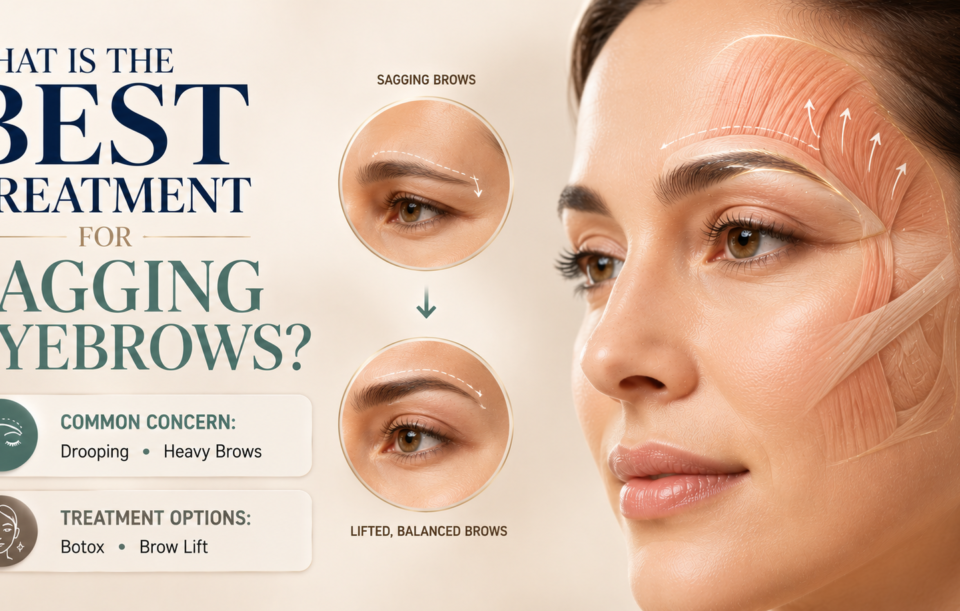
So, what is the best treatment for sagging eyebrows?
There is no single treatment that is best for everyone. Mild eyebrow descent related partly to muscle balance may sometimes be improved with Botox. Skin and tissue changes may benefit from selected nonsurgical rejuvenation procedures. More significant or persistent brow descent may require a surgical brow lift.
The important first step is determining what is actually sagging and why.
Key Takeaways
- Sagging eyebrows commonly develop with ageing and changes in forehead tissues.
- The outer portion of the eyebrow may descend more noticeably in some people.
- A low eyebrow and excess upper-eyelid skin are different problems.
- Botox may create a subtle temporary brow lift in appropriately selected patients.
- Botox cannot physically remove loose skin.
- Skin-tightening treatments have limitations when significant brow descent is present.
- Upper eyelid surgery and brow lift surgery address different anatomical problems.
- Significant brow ptosis may require surgical repositioning.
- Natural treatment should preserve eyebrow shape and facial expression.
- Proper assessment of the forehead, brows and eyelids is important before treatment.
What Are Sagging Eyebrows?
Sagging eyebrows occur when the brow sits lower than its previous or ideal anatomical position, sometimes creating heaviness around the upper eyelids and eyes.
The medical term commonly used for a descended eyebrow is brow ptosis.
The eyebrow does not function independently. Its position is influenced by the forehead muscles, muscles around the eyes, skin, soft tissue and underlying facial structure.
Age-related changes in several of these components can gradually alter brow position.
Some people experience more descent toward the outer eyebrow, while others notice heaviness across a larger portion of the brow.
Why Do Eyebrows Sag With Age?
Ageing affects several structures in the upper face.
Skin gradually loses some of its elasticity. Soft tissues change, and the balance between muscles that raise and lower the eyebrows can influence their resting position.
Repeated facial movement also contributes to changes in the forehead over time.
Genetics are important as well. Some people naturally have lower eyebrows or develop visible brow descent earlier than others.
The result can be a heavier appearance around the eyes even when the eyes themselves have not significantly changed.
How Do You Know If Your Eyebrows Are Actually Sagging?
One useful clue is whether you frequently raise your forehead to make your eyes feel or look more open.
Stand naturally in front of a mirror and allow your forehead to relax.
If your brows sit noticeably low and the tissue above your eyes feels heavy, brow descent may be contributing.
However, self-assessment has limitations.
Excess upper-eyelid skin can create a similar appearance, and some patients have both brow descent and eyelid skin excess.
That distinction can completely change the appropriate treatment.
Are Sagging Eyebrows the Same as Droopy Eyelids?
No.
This is one of the most important distinctions in upper-face rejuvenation.
A sagging eyebrow means the eyebrow itself has descended.
Excess upper-eyelid skin refers to loose skin affecting the upper eyelid.
True eyelid ptosis is another condition in which the eyelid margin itself sits abnormally low.
These problems can occur individually or together.
Treating the eyelid when the main issue is actually brow descent may fail to create the desired result. Likewise, lifting the eyebrow will not necessarily correct every eyelid problem.
Can Botox Lift Sagging Eyebrows?
Botox can create a subtle, temporary eyebrow lift in selected patients by changing the balance between muscles that raise and lower the brow.
Botulinum toxin temporarily reduces activity in specifically targeted muscles.
When appropriately placed around the upper face, this change in muscle balance can allow certain parts of the eyebrow to sit slightly higher.
Patients considering this approach can learn about Botox and facial injectable treatments offered through Elegance Clinic.
However, a Botox brow lift should be understood as a subtle nonsurgical adjustment, not the equivalent of surgical repositioning.
How Much Can Botox Lift the Eyebrows?
Usually, the expected change is modest.
Botox is most appropriate when a small improvement in brow position can be achieved by modifying muscle activity.
It cannot physically remove loose forehead skin or reposition significantly descended tissues.
This is important because patients sometimes expect a nonsurgical injection to produce the same degree of lift as surgery.
The two treatments work through completely different mechanisms.
Can Too Much Botox Make the Eyebrows Droop?
Yes, inappropriate treatment can affect eyebrow position.
The forehead contains muscles that help elevate the brows.
If these muscles are excessively weakened in a patient who already relies on them to keep the brows elevated, the eyebrows may feel or appear heavier.
This is particularly important in patients with pre-existing brow descent.
A clinician should therefore assess eyebrow position before treating forehead wrinkles rather than treating the forehead lines in isolation.
Can Botox Fix Severe Sagging Eyebrows?
Usually not.
Botox cannot physically reposition significantly descended tissue.
If substantial brow ptosis is caused by age-related tissue descent, surgery may provide a more meaningful structural correction.
This does not mean every older patient needs surgery.
The degree of sagging, eyebrow shape, forehead anatomy, eyelids and treatment expectations all need to be considered.
Can Skin-Tightening Treatments Lift the Eyebrows?
Selected nonsurgical treatments may improve skin quality or produce modest tightening in suitable patients.
However, their effect should not be confused with surgical brow repositioning.
When the main concern is mild skin ageing, a nonsurgical approach may be worth discussing.
When the eyebrow itself has descended significantly, skin treatment alone may not adequately address the anatomical problem.
Elegance Clinic provides broader facial rejuvenation and makeover options for patients whose upper-face concern involves more than one sign of ageing.
Can Laser Treatment Help Sagging Eyebrows?
Laser treatment may help selected skin-quality concerns, including texture, pigmentation and some fine lines, depending on the technology used.
But laser treatment does not directly perform the same function as a surgical brow lift.
If the primary problem is significant tissue descent, improving skin quality alone may not sufficiently change eyebrow position.
The clinic’s laser treatment options for facial skin may therefore be more relevant when skin ageing accompanies, rather than solely causes, the concern.
Can Fillers Lift a Drooping Eyebrow?
Dermal filler can change volume and contour in selected areas, but it should not automatically be used to treat brow descent.
Filler does not tighten loose skin or reproduce the structural repositioning of a surgical brow lift.
The upper face also contains important blood vessels, making detailed anatomical knowledge essential when injectable treatment is considered.
More filler is not necessarily better, particularly when heaviness is already a concern.
What Is a Surgical Brow Lift?
A brow lift is a surgical procedure designed to reposition descended eyebrow and forehead tissues to create a more appropriate brow position.
There are different brow-lifting techniques.
The choice depends on factors such as:
- degree of brow descent,
- forehead anatomy,
- hairline,
- eyebrow shape,
- skin and soft tissue,
- previous surgery,
- and the desired degree of correction.
The goal should not simply be to pull the eyebrows as high as possible.
A successful result should look balanced with the patient’s eyes, forehead and overall face.
When Is a Surgical Brow Lift Considered?
Surgery may be discussed when brow descent is significant enough that nonsurgical treatment is unlikely to produce the desired correction.
A patient may notice:
- persistently low eyebrows,
- significant outer-brow descent,
- heaviness over the upper eyelids,
- frequent forehead raising,
- a tired or stern appearance,
- or inadequate improvement from appropriate nonsurgical options.
The decision is aesthetic and anatomical rather than being based on age alone.
Is a Brow Lift Better Than Botox?
Neither is universally better.
They address different degrees and causes of eyebrow descent.
Botox may be appropriate when muscle balance contributes to mild brow lowering and the patient wants a temporary, subtle change.
A surgical brow lift can physically reposition tissues and may be more appropriate when sagging is substantial.
Choosing between them should therefore depend on the amount of correction required, not simply which procedure has less downtime.
What Is the Difference Between a Brow Lift and Blepharoplasty?
This is another common source of confusion.
Brow lift surgery repositions the eyebrow and forehead tissues.
Upper blepharoplasty primarily addresses excess upper-eyelid skin and related eyelid concerns.
If a patient has both a low brow and excess eyelid skin, addressing only one problem may leave part of the heaviness unchanged.
In selected patients, both areas may need to be considered as part of an overall upper-face rejuvenation plan.
Can Eyebrow Sagging Affect Only One Side?
Yes.
Human faces are naturally asymmetrical.
One eyebrow may naturally sit lower than the other, or ageing may make an existing difference more noticeable.
Muscle activity can also differ between sides.
The objective of treatment should therefore be improved balance rather than promising mathematically perfect symmetry.
Pre-existing asymmetry should be identified before any injectable or surgical treatment.
Why Does the Outer Eyebrow Sag First?
Many patients notice that the outer or lateral portion of the brow becomes lower or flatter with age.
The appearance reflects the complex interaction of soft-tissue support and the muscles acting on the brow.
As the lateral brow descends, the tissue above the outer upper eyelid can appear heavier.
This can change the shape of the eye region and make the face appear more tired.
The appropriate treatment depends on whether the change is mild and dynamic or more established and structural.
Can Eyebrow Exercises Lift Sagging Brows?
Facial exercises cannot reliably reposition significantly descended brow tissues.
They may increase awareness of facial muscle movement, but there is limited evidence that exercises can create the structural lifting effect patients often expect.
Repeatedly raising the forehead can also make forehead expression lines more prominent.
For significant sagging, assessment of the actual anatomical cause is more useful than relying on exercises.
Can Creams Tighten Sagging Eyebrows?
Skincare can support skin hydration and overall skin quality.
Certain evidence-based skincare ingredients can also help with signs of photoageing over time.
However, creams cannot physically reposition a significantly descended eyebrow.
A moisturiser may make the skin look smoother, but this is very different from lifting deeper forehead and brow tissues.
Will Losing Weight Lift Sagging Eyebrows?
Weight loss is not a reliable treatment for brow ptosis.
The position of the eyebrow depends on several anatomical structures and muscle forces.
In some people, substantial changes in facial volume can actually make certain age-related features more noticeable.
Treatment should therefore be based on the upper-face anatomy rather than body weight alone.
Can Sagging Eyebrows Make You Look Tired?
Yes.
Lower eyebrows and tissue heaviness around the upper eyelids can visually reduce the openness of the eye area.
This can create a tired, angry or serious appearance even when the person’s mood does not match that expression.
Many patients therefore seek treatment not because they want dramatically higher eyebrows, but because they want the upper face to look more rested.
That distinction is useful when planning a natural result.
What Does a Natural Eyebrow Lift Look Like?
A natural result should fit the person’s existing facial anatomy.
The ideal eyebrow position is not identical for everyone.
Gender, forehead height, eye shape, natural eyebrow arch and facial proportions all influence what looks appropriate.
An excessively high or sharply arched eyebrow can create a surprised or artificial appearance.
The objective should therefore be restoration and balance rather than maximum elevation.
How Long Does a Botox Brow Lift Last?
Botox effects are temporary.
Muscle activity gradually returns over time, and the subtle lifting effect can diminish with it.
The exact duration varies between patients.
Repeat treatment may be considered after reassessment, but patients do not need to continue Botox indefinitely.
Each session should still be based on current muscle activity and eyebrow position.
How Long Does Brow Lift Surgery Take to Settle?
Surgical recovery is different from injectable treatment.
Swelling and bruising can occur initially, and tissues need time to settle.
The recovery timeline depends on the surgical technique and individual healing.
Patients should expect gradual improvement rather than judging eyebrow position immediately after surgery.
Your surgeon should provide personalised instructions about activity, wound care and follow-up.
What Are the Risks of Brow Lift Treatment?
Risks depend on the treatment selected.
Botox can cause temporary unwanted changes in muscle balance, including eyebrow or eyelid position changes.
Injectables can cause bruising, swelling and other complications.
Surgical brow lifting has surgical risks such as bleeding, infection, scarring, altered sensation, asymmetry, hair-related changes depending on technique, and the possibility of revision.
An individual consultation should include discussion of benefits, limitations and procedure-specific risks.
How Do You Choose the Right Sagging Eyebrow Treatment?
The most useful starting point is identifying the cause and degree of the problem.
Ask:
Is the eyebrow itself low?
Is excess eyelid skin creating the heaviness?
Does forehead muscle activity influence the brow position?
Is the sagging mild or structurally significant?
Do both sides behave the same way?
Once these questions are answered, treatment can be matched to the anatomy.
This is more reliable than choosing Botox, filler or surgery based on social-media before-and-after photographs.
When Should You Consider a Professional Brow Assessment?
Consider assessment if your eyebrows have become noticeably lower, the upper eyelids feel heavy, you constantly raise your forehead to see or look more alert, or you are unsure whether the concern involves your brows or eyelids.
Patients considering forehead Botox should also mention pre-existing eyebrow heaviness before treatment.
A complete upper-face assessment should examine the forehead, eyebrows and eyelids together.
Conclusion
The best treatment for sagging eyebrows depends on what is causing the brow to sit lower and how much correction is required.
Mild eyebrow descent related partly to muscle balance may sometimes respond to a carefully planned Botox brow lift. Skin-focused treatments can support skin quality but have limitations when significant tissue descent is present.
More established brow ptosis may require surgical brow lifting, while excess upper-eyelid skin may need a different treatment altogether.
The goal should not be to create the highest possible eyebrow. Good facial rejuvenation aims for a more rested, balanced upper face while preserving natural eyebrow shape and expression.
Upper-Face Rejuvenation at Elegance Clinic
At Elegance Clinic in Surat, eyebrow concerns can be assessed as part of the entire upper face rather than treating the brow in isolation.
Patients with mild movement-related concerns may explore Botox and facial injectable treatments, while those experiencing broader signs of facial ageing can learn about facial rejuvenation options.
Dr. Ashutosh Shah, M.Ch., DNB (Plastic Surgery), Founder and Director of Elegance Clinic, has more than 22 years of experience in plastic, reconstructive and cosmetic surgery. Treatment planning considers facial anatomy, muscle movement, tissue laxity and the degree of correction required before deciding between nonsurgical and surgical options.
Heavy Brows Don’t Always Mean You Need a Brow Lift
Sometimes the problem is the brow. Sometimes it is the eyelid. In other patients, both contribute.
If your eyes look increasingly heavy or your eyebrows seem lower than before, an upper-face assessment can help identify the real cause before you choose a procedure. Visit Elegance Clinic to explore treatment options and consultation information in Surat.
Frequently Asked Questions
It depends on the cause and severity. Mild muscle-related brow descent may sometimes respond to Botox, while significant structural sagging may require a surgical brow lift.
Yes, Botox can create a subtle temporary brow lift in appropriately selected patients by changing the balance of muscles acting on the eyebrow.
It can if treatment excessively weakens muscles needed to elevate the brow. Existing eyebrow position should therefore be assessed before forehead Botox.
Fillers may alter volume and contour in selected cases, but they cannot reproduce the structural repositioning achieved by brow lift surgery.
Surgery can provide a longer-lasting structural change than Botox, but it does not stop the natural ageing process.
No. A brow lift repositions descended brow tissues, while upper blepharoplasty primarily addresses excess upper-eyelid skin and related eyelid concerns.
Category
Latest From Blog
Small Black Warts on Face and Neck: Removal and Recurrence
Can Facial Ageing Be Treated Without Surgery?
Red Veins On The Face: What Causes Them And Which Vascular Laser Fits