




Medical Article by Dr. Ashutosh Shah
Dr. Ashutosh Shah, M.Ch., DNB (Plastic Surgery)
Specialty: Plastic, Reconstructive, Cosmetic & Hair Transplant Surgery
Experience: 22+ Years
Position: Founder & Director, Elegance Clinic, Surat
Dr. Ashutosh Shah has more than 22 years of surgical experience in plastic, cosmetic and reconstructive surgery, with facial aesthetics forming an important part of his practice. His approach at Elegance Clinic considers facial anatomy and movement before selecting an aesthetic treatment.
Last Updated: August 2026
Introduction
A gummy smile means that more gum tissue than desired becomes visible when smiling. Botulinum toxin treatment can sometimes reduce this appearance by temporarily weakening selected upper-lip elevator muscles. However, the treatment is not appropriate for every cause of excessive gum display.
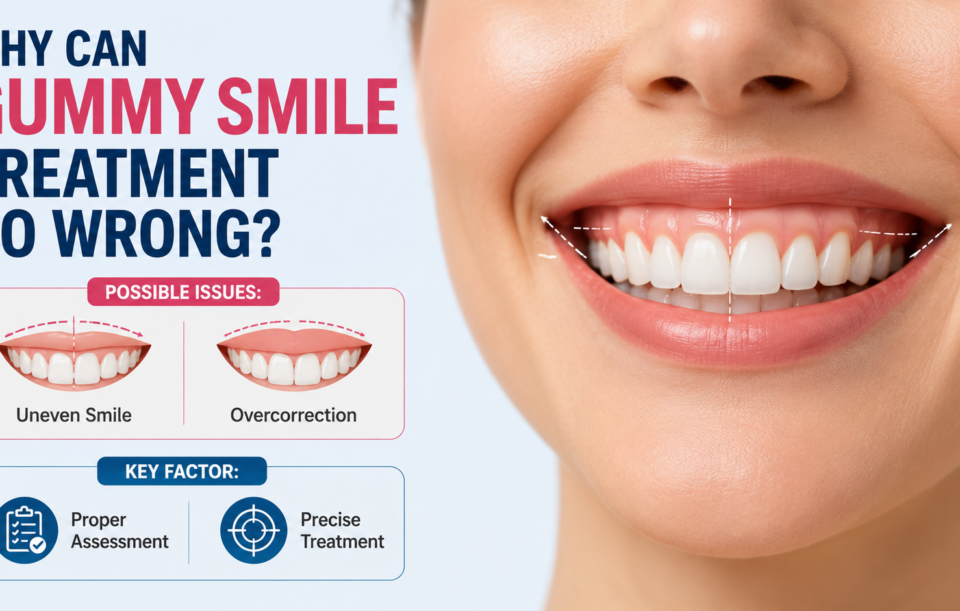
When gummy smile treatment goes wrong, a patient may notice an uneven smile, excessive reduction in upper-lip movement, an unnatural expression, difficulty producing the usual smile, or simply little improvement in the original concern.
The problem is not always the product itself. An unwanted result can occur when the cause of the gummy smile is misunderstood, the wrong muscles are targeted, treatment placement is inappropriate, or the muscle-relaxing effect is greater than intended.
Elegance Clinic includes gummy-smile treatment among its Botox and filler facial aesthetic options, where facial symmetry and proportions are considered during treatment planning.
Key Takeaways
- A gummy smile can have more than one underlying cause.
- Botox is most relevant when excessive muscle activity contributes to upper-lip elevation.
- Too much muscle relaxation may make the smile look unnatural.
- Unequal treatment effects can create temporary smile asymmetry.
- Botox cannot correct every dental, gum, skeletal or structural cause.
- An unwanted Botox result generally needs time to be reassessed because its muscle-relaxing effect is temporary.
- More treatment is not automatically the solution to a result that looks wrong.
- Facial movement should be assessed before deciding how to manage an unwanted outcome.
Why Can Gummy Smile Treatment Give an Unwanted Result?
A gummy smile treatment can produce an unwanted result when the treatment does not match the underlying cause or when muscle relaxation changes the smile more than intended.
A smile is created by several muscles working together. The upper lip must move naturally while remaining balanced with the cheeks, mouth corners and lower face.
Changing the activity of one group of muscles can therefore influence the overall expression.
A treatment plan should consider the smile both at rest and during movement, rather than judging the upper lip from a single photograph.
What Can Go Wrong After Gummy Smile Botox?
Different unwanted outcomes can have different explanations.
| What You Notice | Possible Reason | What May Be Considered |
|---|---|---|
| Smile looks uneven | Unequal muscle response or placement | Allow the result to develop fully and obtain professional assessment |
| Upper lip moves too little | Excessive muscle relaxation | Observation while the temporary effect gradually reduces |
| Smile looks unnatural | Normal muscle balance has changed | Facial movement assessment |
| Little improvement | Gummy smile may have another cause or treatment effect is insufficient | Reassess the underlying cause |
| One side shows more gum | Pre-existing or treatment-related asymmetry | Compare resting and dynamic facial movement |
| Lip appears different when speaking | Upper-lip movement has been altered | Clinical review before further treatment |
| Gummy smile remains despite treatment | Structural, dental or gum-related factors may contribute | Consider whether another treatment category is more appropriate |
This is why an unwanted result should be diagnosed before simply adding more injections.
Was the Cause of the Gummy Smile Identified Correctly?
This is one of the most important questions.
Excessive gum display can be influenced by several factors. Strong upper-lip elevator muscles are only one possibility.
The position and length of the upper lip, gum tissue, tooth proportions, dental position and underlying facial or jaw structure can also influence how much gum appears during smiling.
Botulinum toxin changes muscle activity.
It does not reshape teeth, remove gum tissue or reposition the underlying facial skeleton.
If the main cause is structural rather than muscular, relaxing the upper-lip muscles may produce limited improvement or create a result that does not address the patient’s actual concern.
Can Too Much Botox Affect the Smile?
Yes. Excessive relaxation of the muscles involved in upper-lip movement can change the way the smile appears.
The purpose of gummy-smile Botox should not be to stop the upper lip from moving.
The aim in appropriately selected patients is generally to reduce excessive elevation while preserving a natural expression.
If muscle activity is reduced more than desired, the upper lip may not rise normally during smiling. This can make the expression appear unfamiliar or restricted.
The wider facial aesthetic approach at Elegance Clinic combines surgical and nonsurgical options according to individual facial structure rather than treating every facial concern with the same technique.
Why Can One Side of the Smile Look Different?
Human faces are naturally asymmetric.
One side of the mouth may already move differently before treatment, even when the difference is subtle enough that the patient has never noticed it.
If the two sides respond differently to botulinum toxin, existing asymmetry can become more visible. Differences in injection placement or dose can also contribute.
This is why documenting the patient’s smile before treatment can be useful.
When asymmetry appears afterward, the clinician needs to determine whether it was already present, resulted from treatment, or represents a combination of both.
Can Gummy Smile Botox Be Reversed Immediately?
Botulinum toxin cannot generally be switched off immediately after its effect develops.
This is different from certain hyaluronic-acid filler complications, where an enzyme may sometimes be used to dissolve filler.
Botulinum toxin works by temporarily reducing nerve signalling to targeted muscles. Its effect gradually diminishes as neuromuscular function recovers.
For an unwanted aesthetic result, management therefore often involves assessment, monitoring and allowing time for muscle activity to return, depending on the specific problem.
Patients should not assume that adding more Botox elsewhere will automatically correct the result.
Should You Get More Botox to Fix an Uneven Smile?
Not automatically.
An uneven smile needs to be assessed before additional injections are considered.
In some situations, carefully selected treatment may potentially improve balance. In others, adding more toxin could worsen weakness or create another asymmetry.
Timing also matters because botulinum toxin does not reach its complete visible effect immediately.
A result that looks slightly different during the early days may continue changing as the treatment takes effect.
What If the Treatment Did Not Reduce the Gummy Smile?
A lack of improvement does not necessarily mean that a larger dose is required.
The first question should be whether excessive muscle activity was actually the main reason for the gummy smile.
If gum anatomy, tooth position, lip proportions or underlying skeletal structure is contributing significantly, another type of evaluation may be more appropriate.
This distinction prevents patients from repeatedly undergoing injections for a concern that Botox cannot fully address.
How Long Can an Unwanted Result Last?
Botulinum toxin treatment is temporary.
The website’s existing Botox information explains that treatment effects generally develop over several days and gradually wear off over subsequent months, although the exact duration varies between individuals and treatment areas.
An unwanted smile change therefore does not necessarily represent a permanent alteration.
However, patients should seek clinical assessment if they are concerned about the degree of weakness or asymmetry rather than trying to predict recovery from online photographs or another person’s experience.
What Should Be Checked Before Treating a Gummy Smile?
A useful assessment should look beyond the amount of gum visible.
The clinician may examine upper-lip movement, smile symmetry, muscle strength, lip length and position, facial proportions, previous treatments and whether dental or structural factors appear to contribute.
Patients should also explain what they actually want changed.
One person may want a subtle reduction in gum display, while another may expect the entire gum line to disappear. Those expectations can lead to very different treatment decisions.
Can a Bad Gummy Smile Result Be Prevented?
No cosmetic procedure can be guaranteed to produce a perfect result, but careful patient selection and treatment planning can reduce avoidable problems.
The goal should be controlled improvement rather than maximum muscle weakening.
Assessment of the resting face and active smile, conservative dosing where appropriate, knowledge of facial anatomy and realistic expectations are particularly important around the mouth because small changes in muscle activity can alter expression.
Conclusion
A gummy smile treatment can go wrong when the underlying cause is not suitable for Botox, muscle relaxation is excessive or uneven, or the treatment changes the balance of the smile in an unwanted way.
The answer is not automatically another injection.
The first step is identifying what changed and why. Some unwanted effects may gradually improve as botulinum toxin wears off, while persistent gummy-smile concerns may require reassessment of whether muscle activity is actually the main cause.
A natural smile depends on movement and balance. Treatment should therefore aim to reduce excessive gum display without unnecessarily restricting normal expression.
Facial Aesthetic Planning at Elegance Clinic
Rather than considering the upper lip as an isolated feature, Elegance Clinic assesses facial proportions, symmetry and movement when planning injectable treatments. Its Botox and fillers programme includes gummy-smile treatment alongside other facial aesthetic applications.
Dr. Ashutosh Shah, M.Ch., DNB (Plastic Surgery) is Founder and Director of Elegance Clinic and has more than 22 years of surgical experience in plastic, cosmetic and reconstructive surgery. Patients researching their treating doctor can read more about Dr. Ashutosh Shah and Elegance Clinic before considering facial treatment.
If Your Smile Looks Different After Treatment
If gummy-smile treatment has left your upper lip feeling too restricted, uneven or simply different from what you expected, avoid rushing into another correction before the first result is properly assessed. You can connect with the Elegance Clinic team to discuss whether the result needs observation, reassessment or another approach.
Frequently Asked Questions
Natural facial asymmetry, differences in muscle response, injection placement or treatment amount can contribute to an uneven result.
Botulinum toxin effects are temporary. An unwanted change in muscle movement generally reduces as the treatment effect wears off, although individual recovery varies.
There is no simple immediate reversal comparable with dissolving some hyaluronic-acid fillers. Management depends on the specific problem and may involve waiting for muscle activity to recover.
Not without assessment. Additional treatment can sometimes worsen imbalance if the cause of the asymmetry is misunderstood.
The gummy smile may not be caused primarily by excessive upper-lip muscle activity. Dental, gum, lip or skeletal factors may also contribute.
Because treatment influences muscles around the upper lip, excessive or unwanted muscle relaxation can alter normal movement.

Category
Latest From Blog
Small Black Warts on Face and Neck: Removal and Recurrence
Can Facial Ageing Be Treated Without Surgery?
Red Veins On The Face: What Causes Them And Which Vascular Laser Fits