




Written By: Dr. Ashutosh Shah
Specialty: Plastic, Reconstructive, Cosmetic & Hair Transplant Surgery
Experience: 22+ Years
Position: Founder & Director, Elegance Clinic, Surat
Dr. Ashutosh Shah holds M.Ch. and DNB qualifications in Plastic Surgery and has more than 22 years of surgical experience.
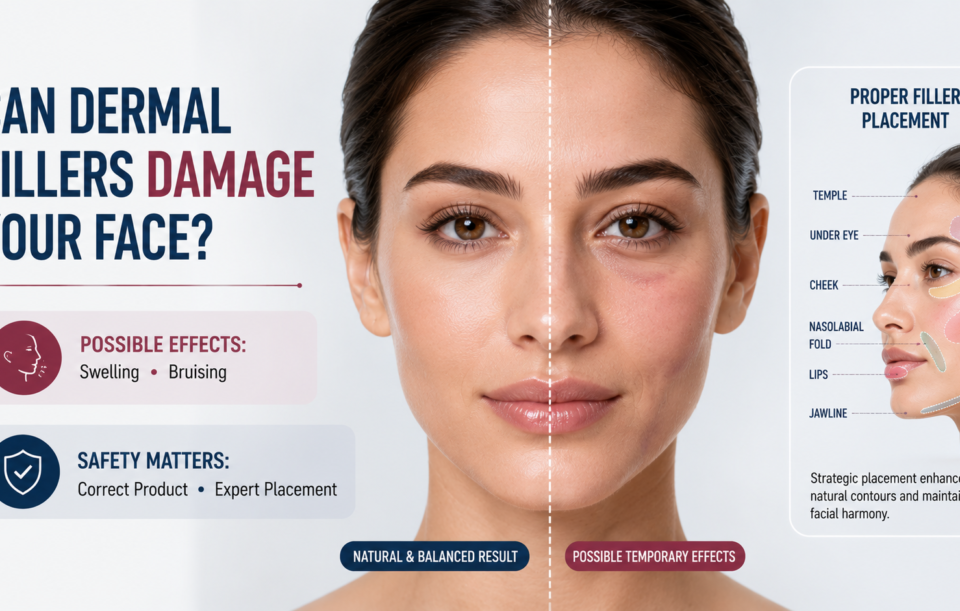
Dermal fillers are widely used to restore volume, soften selected facial lines, enhance contours, and improve facial proportions. But a common concern among patients is: can filler damage face tissues or permanently change the way the face looks?
The answer requires some context. Most expected reactions after filler treatment such as mild swelling, tenderness, redness, or bruising are temporary and do not mean that the face has been damaged. However, dermal fillers are medical injectable products, and complications are possible. Problems can range from an unwanted aesthetic result, such as excessive fullness or asymmetry, to uncommon but serious complications involving infection or disruption of blood flow.
The key is to separate three very different situations: normal recovery, an unsatisfactory cosmetic result, and a medical complication.
A face that appears slightly uneven immediately after treatment may simply be swollen. A face that remains disproportionately full after healing may have been overcorrected. By contrast, unusual pain accompanied by skin colour changes can indicate a problem requiring urgent medical assessment.
Because facial tissues contain a complex network of blood vessels, nerves, muscles, fat compartments, and connective tissues, filler treatment requires more than simply deciding where additional volume would look attractive. Facial anatomy, existing filler, skin quality, treatment depth, product choice, and overall facial proportions all matter.
Understanding these differences can help patients make more informed decisions before treatment and recognise when a post-filler change needs professional attention
Key Takeaways
- Temporary swelling or bruising after filler is not the same as facial damage.
- An unnatural filler result may come from excessive volume, inappropriate placement, or poor facial balance.
- Persistent lumps, inflammation, or infection require professional assessment.
- Interruption of blood supply is an uncommon but important filler complication.
- Not every unwanted filler result can be managed in the same way.
- Hyaluronic acid fillers may sometimes be dissolved, but assessment should come first.
- Severe pain, unusual skin colour changes, or visual symptoms after filler require urgent medical attention.
What Does Filler Actually Do to the Face?
Dermal filler adds material within or beneath selected facial tissues to create volume, support contours, or modify specific features. It does not simply sit on the skin surface, which is why anatomical assessment and appropriate placement are important.
Different areas of the face have different tissue thicknesses, movements, and vascular anatomy.
A filler plan for the lips, for example, should not simply be copied for the cheeks or chin. The amount, placement, depth, and aesthetic objective can differ significantly.
Dermal Filler: An injectable material used to add or restore volume in selected facial or soft-tissue areas.
This also explains why an attractive filler result is not determined only by how much product is used. Where the volume is placed can be just as important as how much volume is added.
When Is a Change After Filler Part of Normal Recovery?
Mild swelling, redness, tenderness, or bruising can occur after filler injections. These early effects can temporarily change facial symmetry or make the treated area look fuller than expected, so the immediate appearance does not always represent the settled result.
For example, one side of the lips may swell slightly more than the other. A cheek may initially appear more prominent because of local swelling.
This is different from persistent asymmetry or a contour problem that remains after the expected recovery period.
Patients should follow the aftercare instructions provided for their specific treatment and contact the treating clinician if symptoms become severe, unusual, or progressively worse.
How Can Filler Make a Face Look Unnatural?
Filler can create an unnatural appearance when added volume does not match the patient’s existing facial proportions. Excessive fullness, inappropriate placement, repeated treatment without reassessment, or poorly balanced correction can make individual facial features appear disproportionate.
Consider a patient who initially receives filler to restore mild cheek volume. If more filler is repeatedly added simply because the previous treatment date has passed, the cheeks may eventually become too dominant relative to the eyes, jawline, or lower face.
The issue is not necessarily that filler has physically “damaged” the cheek. The problem may be loss of facial proportion.
Overcorrection: A result in which more volume or change has been created than is appropriate for the intended facial balance.
This is why filler treatment should not be approached as “more product equals a better result.”
Can Filler Cause Actual Facial Tissue Damage?
Yes, complications capable of affecting facial tissue can occur, although they are different from common temporary post-treatment effects. Potential problems include infection, persistent inflammatory reactions, nodules, scarring, and tissue injury related to compromised blood circulation.
The U.S. Food and Drug Administration recognises infection, nodules, open or draining wounds, and tissue necrosis among reported dermal filler complications.
The important point is that the term “filler damage” is too broad to describe every unwanted outcome.
| What You Notice | What It Could Represent | What Matters |
|---|---|---|
| Mild early puffiness | Treatment-related swelling | Should generally improve |
| Small bruise | Injection-related effect | Usually temporary |
| Persistent unevenness | Placement or volume issue | Needs assessment |
| New persistent lump | Product or inflammatory issue | Professional evaluation |
| Increasing redness and pain | Possible complication | Prompt assessment |
| Unusual skin colour + pain | Possible blood-flow problem | Urgent assessment |
| Sudden visual symptoms | Potential emergency | Immediate medical care |
Diagnosis cannot be made from this table alone. Symptoms need to be considered in context.
Why Does Blood Supply Matter With Facial Fillers?
The face contains many blood vessels, and filler accidentally entering or significantly compromising a vessel can interfere with blood supply. This is an uncommon but potentially serious complication because tissues depend on continuous circulation for oxygen and nutrients.
Vascular Occlusion: A blockage that reduces or stops blood flow through a blood vessel.
If circulation to an area of skin is significantly compromised, tissue injury can occur. In very rare situations involving particular facial vascular pathways, filler complications can also affect vision.
The FDA identifies accidental injection into a blood vessel as the most serious risk associated with dermal fillers and notes potential consequences including tissue death, visual impairment, blindness, or stroke.
This is why severe or unusual pain, pale or discoloured skin, sudden visual changes, or neurological symptoms after filler should never be treated as routine swelling.
Can Filler Problems Develop Long After Treatment?
Not every filler-related concern appears immediately. Some patients can develop delayed lumps, inflammatory reactions, changes in contour, or other problems after the initial treatment period.
A late problem can be confusing because the patient may no longer associate it with previous filler.
For this reason, an assessment should include the patient’s treatment history. Useful information includes which filler was used, where it was injected, approximately when treatment occurred, and whether additional treatments were performed later.
Patients should avoid repeatedly pressing, massaging, or attempting to treat an unexplained lump without knowing what it represents.
Does Repeated Filler Permanently Stretch or Ruin the Face?
Repeated filler treatment does not automatically mean that the face will become permanently damaged.
The more useful concern is whether each new treatment is still necessary.
Facial ageing continues between appointments. Previous filler may also still contribute volume when a patient returns for another treatment. Automatically repeating the same quantity without reassessing current anatomy can gradually produce excessive fullness.
A better long-term strategy is to evaluate the face at each visit rather than treating according to a fixed schedule alone.
Can Unwanted Filler Be Corrected?
Some unwanted filler results can be improved, but the solution depends on what material was used and what problem has occurred. Hyaluronic acid fillers may sometimes be broken down using an enzyme called hyaluronidase, while other filler materials cannot necessarily be managed in the same way.
Hyaluronidase: An enzyme that breaks down hyaluronic acid and may be used clinically when certain HA fillers need to be reduced.
Dissolving filler should not be seen as a universal “undo button.”
A clinician first needs to determine whether the concern is excess product, swelling, asymmetry, a lump, inflammation, infection, or another complication.
For example, dissolving filler would not be an appropriate substitute for recognising and treating an infection.
What Makes Filler Treatment Safer?
There is no completely risk-free injectable procedure. However, thoughtful treatment planning can reduce avoidable problems.
The clinician should understand facial anatomy, evaluate existing volume, select an appropriate product and treatment depth, and avoid adding unnecessary filler.
Patients should also know what product is being injected and understand both expected reactions and warning symptoms before leaving the clinic.
An important aesthetic principle is simple:
The decision not to add more filler can sometimes be as valuable as the decision to inject it.
This approach prioritises facial proportion instead of treating every line or hollow independently.
When Should You Seek Medical Help After Filler?
Seek urgent medical attention after filler if you develop severe or unusual pain, pale or unusually discoloured skin around the treated area, sudden vision changes, weakness, speech difficulty, or other neurological symptoms.
Increasing redness, warmth, swelling, discharge, fever, or a persistent painful lump should also be professionally assessed.
Patients with mild expected swelling but no warning symptoms can usually follow the individual aftercare and monitoring instructions provided by their treating clinician.
If you are uncertain whether a symptom is normal, contacting the treating medical professional is safer than trying to diagnose it yourself.
Conclusion
So, can filler damage face tissues? Yes, complications are possible, but most temporary changes after treatment should not automatically be labelled as damage.
Mild swelling, bruising, and tenderness are very different from persistent lumps, infection, vascular compromise, or tissue injury. There is also another category: a technically uncomplicated filler treatment that simply produces too much volume or poor facial balance.
Understanding these differences is important because each situation requires a different response.
Good filler planning is therefore not only about deciding where to inject. It involves understanding facial anatomy, assessing existing volume, choosing an appropriate product and amount, maintaining facial proportions, and recognising when further filler is unnecessary.
Patients considering treatment—or concerned about a previous filler result should have the face assessed individually rather than relying on general treatment schedules or social-media comparisons.
About Dr. Ashutosh Shah and Elegance Clinic
Dr. Ashutosh Shah, M.Ch., DNB (Plastic Surgery) is a Board-Certified Plastic, Cosmetic and Reconstructive Surgeon with more than 22 years of surgical experience. He is the Founder and Director of Elegance Clinic in Surat, Gujarat.
Elegance Clinic was established in 2014 and provides cosmetic and plastic surgery, dermatology, facial aesthetics, hair restoration, laser and reconstructive treatments through its centres in Adajan and Vesu, Surat.
Considering facial fillers or concerned about a previous filler result?
A personalised facial assessment can help identify whether the concern relates to normal recovery, excess volume, placement, or a complication. Book a consultation with Dr. Ashutosh Shah at Elegance Clinic, Surat to discuss appropriate options.
For sudden vision changes, severe pain, significant skin colour changes, or neurological symptoms after filler, seek urgent medical care.
Frequently Asked Questions
Permanent complications are possible but are different from common temporary effects such as swelling and bruising.
Not necessarily. Mild swelling can be part of normal early recovery.
Yes. Excessive volume can alter natural facial proportions and create an overfilled appearance.
Lumps can occur for different reasons. Persistent or painful lumps should be professionally assessed.
Some hyaluronic acid fillers may be reduced with hyaluronidase. Other filler materials may require different management.
Rare vascular complications can potentially affect vision and require immediate medical attention.
Not necessarily. The face and any remaining filler should be reassessed before additional treatment.


Category
Latest From Blog
Small Black Warts on Face and Neck: Removal and Recurrence
Can Facial Ageing Be Treated Without Surgery?
Red Veins On The Face: What Causes Them And Which Vascular Laser Fits