




Written by Dr. Ashutosh Shah, M.Ch., DNB (Plastic Surgery)
Director, Elegance Clinic, Surat
Dr. Ashutosh Shah is a Board-Certified Plastic, Cosmetic and Reconstructive Surgeon with more than 22 years of surgical experience, with expertise in cosmetic surgery, breast procedures, reconstructive surgery, body contouring, and aesthetic treatment planning.
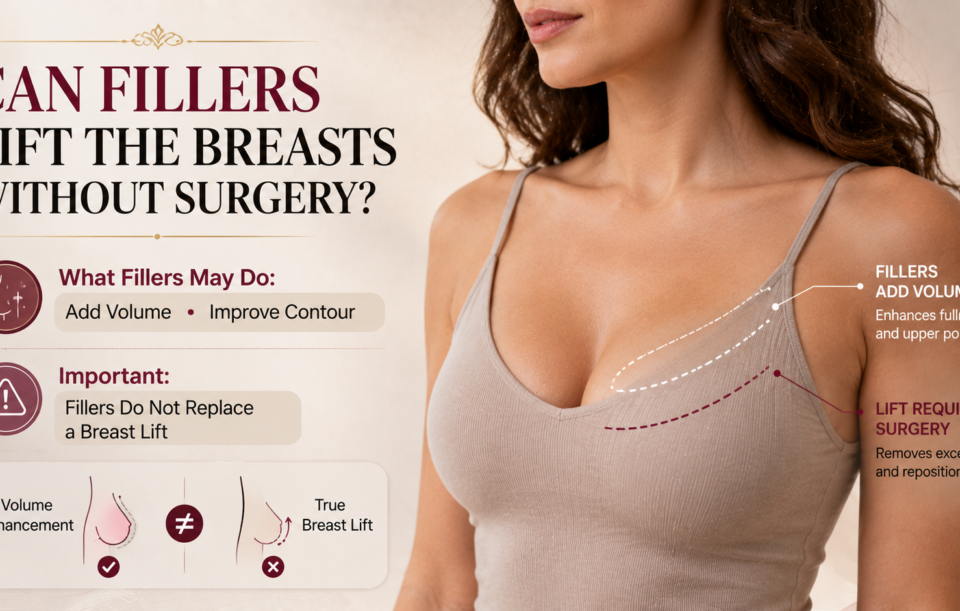
Breast fillers may sound like a simple way to create a fuller or lifted appearance without an operation, but they are not an established substitute for a surgical breast lift. Dermal fillers are designed mainly for selected facial and soft-tissue applications, and injectable fillers are not approved for breast enlargement or breast contouring. Injecting filler into the breasts can carry significant risks, including infection, scarring, tissue damage, filler migration, and problems that may interfere with breast examination or imaging.
A true breast lift, medically known as mastopexy, works differently. It reshapes and supports the breast tissue, removes appropriate excess skin, and can reposition the nipple and areola when needed. This allows the breast to sit higher on the chest rather than simply adding volume.
Some patients looking for a breast lift without implants may consider options such as fat transfer, supportive garments, or non-surgical skin treatments. These may improve selected aspects of breast appearance, but they should not be described as equivalent to a surgical lift. Fat grafting can add some volume in carefully selected patients, but it does not reliably correct significant breast drooping.
This article explains whether fillers can lift the breasts, why they are not a standard breast-lift treatment, what alternatives may be considered, and when a surgical assessment is more appropriate.
Key Takeaways
- Injectable fillers are not a standard or approved method for lifting or enlarging the breasts.
- A breast lift reshapes breast tissue and removes selected excess skin to raise a drooping breast.
- Fillers cannot tighten a stretched breast skin envelope in the same way as mastopexy.
- Fat transfer may provide selected volume enhancement but does not reliably lift significantly sagging breasts.
- Breast implants increase volume but do not automatically correct significant breast drooping.
- The best treatment depends on breast shape, skin laxity, nipple position, volume, and the patient’s goals.
- A qualified examination is important before choosing any breast enhancement procedure.
Can Fillers Really Lift the Breasts?
Fillers cannot reliably lift sagging breasts in the way a surgical breast lift can. Injectable fillers add material beneath the skin rather than removing excess skin or repositioning the breast tissue. They are also not approved for breast augmentation, and injecting fillers into the breasts can create serious complications.
The word lift is important here.
A breast appears lower mainly because the skin envelope, breast tissue, and nipple position have changed. A true lift addresses those structural changes.
Simply adding material under the skin does not recreate this process.
What happens with a filler?
A filler occupies space. Depending on its location, it may increase fullness in a selected area, but it does not tighten stretched skin or reposition a low nipple.
This is very different from mastopexy, where the surgeon reshapes the breast and tightens the skin envelope to create a higher contour.
Why Are Breast Fillers Not a Standard Lift Treatment?
Breast fillers are not a standard breast-lift procedure because the safety and effectiveness concerns are different from those associated with established breast surgery. Injectable fillers are approved for specific uses, largely involving facial soft-tissue correction, and current regulatory guidance specifically advises against using dermal fillers to enlarge the breasts.
There are several reasons why using filler in the breast can be problematic.
The breast is a complex anatomical area
Breast tissue contains glands, ducts, fat, blood vessels, connective tissue, and structures that may need to be examined clinically or through imaging.
Introducing a filler into this area can create additional findings that may be difficult to distinguish from other abnormalities.
Filler does not correct loose skin
If pregnancy, breastfeeding, ageing, or weight changes have stretched the skin, adding material beneath that skin does not recreate the supportive effect of a breast lift.
Complications can be significant
Injectable fillers can cause swelling, bruising, inflammation, infection, nodules, migration, and other reactions. Rare but serious complications can include tissue death and vascular injury.
Breast imaging can be affected
Injecting filler around the breast or chest area may create findings that complicate examination or imaging and can raise additional concerns during breast evaluation. Recent regulatory discussions have specifically highlighted these issues for filler use around breast-related areas.
Because of these concerns, injectable filler should not be presented as a simple “no-surgery breast lift.”
What Actually Creates a Breast Lift?
A true breast lift changes the position and shape of the breast by reshaping the breast tissue and removing appropriate excess skin. The nipple and areola can also be repositioned when necessary. This allows the breast to sit higher on the chest and creates a different contour.
Mastopexy: A surgical breast-lift procedure that raises and reshapes the breast by modifying the skin envelope and underlying breast tissue.
Several factors influence whether a lift may be needed.
Nipple position
A nipple that has moved downward with breast sagging may need repositioning during a lift.
Skin elasticity
If the skin has become stretched and loose, simply adding volume may not correct the shape.
Breast volume
Some breasts have enough existing tissue but need reshaping. Others have lost volume and may benefit from additional volume enhancement.
Degree of sagging
Mild changes and advanced breast drooping require different planning.
This is why breast augmentation and breast lifting are not interchangeable procedures. A patient may need one, the other, or a combination depending on the anatomy.
Can Fat Transfer Lift the Breasts Without Implants?
Fat transfer can increase breast volume without using an implant, but it should not be confused with a true breast lift. Fat is collected through liposuction from another area, processed, and strategically placed into the breast to improve selected areas of fullness and contour.
This may be considered by selected patients who:
- Have enough donor fat
- Want modest volume enhancement
- Prefer not to use implants
- Have relatively limited skin laxity
- Want subtle contour improvement
However, fat transfer has limitations.
It cannot reliably remove significant excess skin or reposition a markedly low nipple. Patients with substantial breast drooping may still require mastopexy.
Can fat transfer be combined with a lift?
Yes. In selected patients, fat grafting may be combined with a surgical breast lift to add volume or improve contour. This is different from using filler as a replacement for the lift itself.
The appropriate combination depends on the amount of tissue available, breast shape, skin quality, and the patient’s goals.
What Other Non-Surgical Options Can Improve Breast Appearance?
Non-surgical approaches can improve how the breasts are supported or how the skin looks, but they do not recreate the structural changes of mastopexy. The result is generally more modest.
Supportive garments
A well-fitted bra can temporarily improve breast position and shape under clothing. This changes appearance while the garment is worn but does not permanently alter the breast.
Skin-care treatments
Maintaining skin health may improve texture and hydration. However, creams cannot remove significant excess breast skin or reposition the nipple.
Weight stability
Repeated major weight changes can alter breast volume and skin. Maintaining a stable weight may help preserve a more consistent contour.
Exercise
Strengthening the chest muscles can improve the underlying chest contour, but exercises do not directly lift breast tissue because breast tissue itself is not muscle.
These options may be useful for appearance or overall body care, but patients should have realistic expectations.
When Is a Surgical Breast Lift More Appropriate?
A surgical breast lift is generally considered when the main problem is significant breast drooping, excess skin, or a downward-positioned nipple rather than simply a lack of volume. Mastopexy works by reshaping the breast and tightening the surrounding skin envelope.
You may notice signs such as:
- Nipples pointing downward
- Nipples positioned below the breast crease
- Significant loose skin
- Breast tissue sitting lower on the chest
- Flattened or elongated breast shape
- Loss of upper-breast fullness
- Changes following pregnancy or major weight loss
The degree of sagging is important.
A patient with mild sagging and good skin quality may require a different approach from someone with substantial tissue descent.
Can Breast Implants Lift Sagging Breasts?
Implants increase breast volume, but they do not automatically raise significantly drooping breast tissue. In some patients with mild changes, added volume may improve the upper-breast appearance, while patients with more significant sagging may need a formal lift.
This is an important distinction:
Implant: Primarily increases volume.
Breast lift: Primarily raises and reshapes the breast.
Lift plus augmentation: Can address both sagging and loss of volume when appropriate.
The correct combination depends on the patient’s existing breast tissue, skin quality, nipple position, and desired result.
How Is the Right Treatment Chosen?
There is no single breast enhancement treatment that is appropriate for every patient. The decision should be based on the amount of sagging, nipple position, available breast tissue, skin quality, volume, medical history, and the patient’s aesthetic goals.
| Main Concern | Possible Approach | Main Purpose |
|---|---|---|
| Mild loss of fullness | Selected volume-enhancement approach | Improve fullness |
| Moderate or significant sagging | Breast lift | Raise and reshape breast tissue |
| Sagging plus volume loss | Lift with augmentation or selected fat transfer | Address position and volume |
| Desire to avoid implants | Selected fat transfer | Add modest volume |
| Temporary support only | Supportive garment | Improve appearance while worn |
This table is a general guide, not a substitute for examination.
A consultation can clarify whether the primary issue is position, volume, skin laxity, or a combination.
Breast Lift Surgery
What Does Recovery Depend On?
Recovery depends heavily on the treatment chosen. A non-surgical approach may involve little downtime, while breast lift surgery requires a structured healing period because the skin and breast tissues have been surgically reshaped.
After a surgical lift, patients can experience:
- Swelling
- Bruising
- Tightness
- Tenderness
- Temporary changes in sensation
- Incision-related discomfort
The final breast shape does not appear immediately. Swelling decreases gradually, and the tissues continue settling during healing.
A surgical breast lift also creates scars, although their final appearance depends on the technique, incision pattern, skin type, and individual healing.
What Are the Risks of Breast Enhancement Procedures?
Every breast procedure has potential risks, and the specific risks depend on whether the treatment involves injections, fat transfer, implants, or surgery.
Breast lift surgery can involve risks such as bleeding, infection, changes in sensation, scarring, asymmetry, wound-healing problems, and changes in nipple or breast sensation. The possibility of revision surgery also needs to be discussed.
Fillers have their own risks. Common reactions can include swelling, bruising, redness, pain, and tenderness, while more serious complications can include infection, nodules, migration, tissue injury, and vascular complications.
Because injectable fillers are not approved for breast augmentation and regulatory guidance specifically warns against using them for breast enhancement, breast fillers should not be treated as a routine alternative to established breast surgery.
Can Pregnancy and Weight Changes Affect Breast Lift Results?
Pregnancy, breastfeeding, ageing, gravity, and significant weight changes can alter breast shape after treatment. These factors can stretch the skin and change breast volume over time.
For this reason, patients who are planning a future pregnancy may want to discuss timing with their surgeon.
Likewise, substantial weight fluctuations can change breast volume and skin. Maintaining a relatively stable weight can help preserve the contour, although it cannot prevent all future changes.
When Should You See a Specialist?
A specialist consultation is appropriate when you are considering a breast lift, want to restore lost fullness, or are searching for a way to improve breast shape without major surgery.
An assessment is particularly useful if:
- Your nipples point downward.
- The breasts sit significantly lower than before.
- You have loose or stretched skin.
- Pregnancy or weight loss changed your breast shape.
- You want more upper-breast fullness.
- You are considering fillers or injections into the breasts.
- You are unsure whether you need a lift, augmentation, fat transfer, or another option.
The consultation should focus on the structure of the breast, not simply on size.
For information about the clinic and available cosmetic procedures, visit Elegance Clinic Surat.
Dr. Ashutosh Shah, M.Ch., DNB (Plastic Surgery) is a Board-Certified Plastic, Cosmetic and Reconstructive Surgeon and Director of Elegance Clinic, Surat. He has more than 22 years of surgical experience and completed M.Ch. in Plastic Surgery from The M.S. University of Baroda and DNB in Plastic Surgery. He also received advanced training in microvascular surgery at Ganga Hospital, Coimbatore, and cosmetic surgery at Apollo Hospital, Chennai.
Elegance Clinic was established in Surat in 2014 and provides cosmetic surgery, plastic surgery, dermatology, hair restoration, laser treatments, and reconstructive procedures. The clinic focuses on personalised treatment planning, patient safety, and natural-looking outcomes.
Fillers cannot provide a true breast lift in the same way as mastopexy. A breast lift works by reshaping breast tissue, removing selected excess skin, and repositioning the nipple and areola when necessary. Injectable fillers, by contrast, add material and do not tighten a stretched skin envelope or reliably raise a sagging breast.
More importantly, injectable fillers are not approved for breast augmentation, and their use in the breasts can create serious complications, including infection, tissue injury, migration, scarring, and problems related to breast assessment or imaging.
For patients who want to avoid implants, carefully selected fat transfer may provide modest volume enhancement, but significant sagging may still require a surgical lift.
The most appropriate treatment depends on the amount of sagging, skin quality, nipple position, existing breast volume, and personal goals. An examination with Dr. Ashutosh Shah at Elegance Clinic, Surat can help determine which approach is suitable.
Book a consultation at Elegance Clinic, Surat, to discuss your breast shape, concerns, and treatment options
Frequently Asked Questions
A: No. Fillers are not a standard or recommended method for lifting breasts.
A: Dermal fillers are not approved for breast enlargement and may carry significant risks.
A: Fat transfer can add volume but does not reliably lift significantly sagging breasts.
A: A surgical breast lift may be appropriate when significant skin laxity or breast drooping is present.
A: Exercise can strengthen chest muscles but cannot reposition or tighten sagging breast tissue.
Category
Latest From Blog
Small Black Warts on Face and Neck: Removal and Recurrence
Can Facial Ageing Be Treated Without Surgery?
Red Veins On The Face: What Causes Them And Which Vascular Laser Fits