



Written by Dr. Ashutosh Shah, M.Ch., DNB (Plastic Surgery)
Director, Elegance Clinic, Surat
Dr. Ashutosh Shah is a Board-Certified Plastic, Cosmetic & Reconstructive Surgeon with more than 22 years of surgical experience, with expertise in facial aesthetics, cosmetic surgery, reconstructive procedures, and advanced facial rejuvenation.
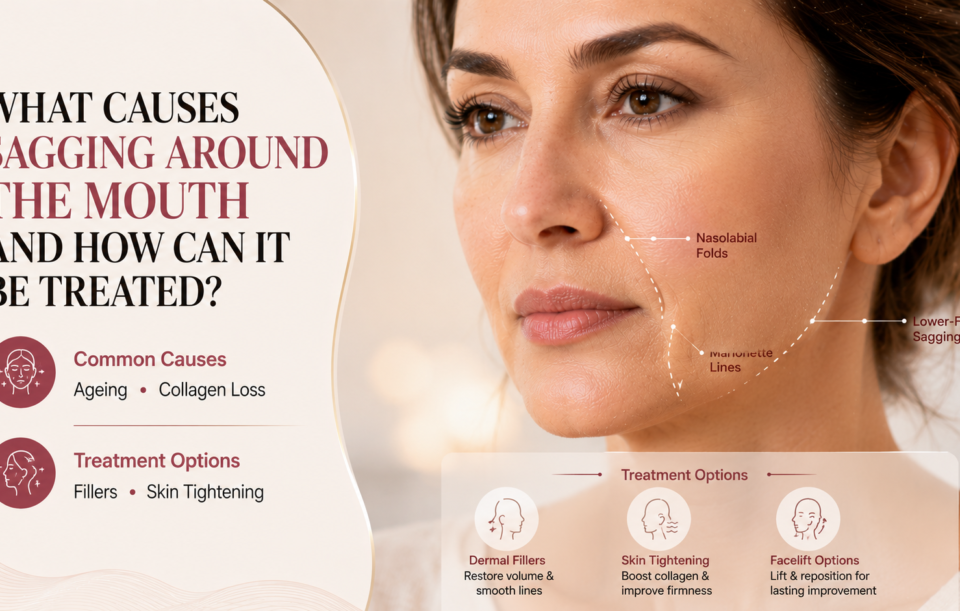
Sagging around the mouth can develop gradually as the skin loses elasticity, facial volume shifts, and the tissues supporting the lower face become less firm. It may appear as drooping mouth corners, deeper lines extending from the nose or mouth toward the chin, early jowls, or a heavier-looking lower face. Ageing is a major factor, but genetics, sun exposure, smoking, changes in facial volume, and natural changes in skin and soft tissue can also influence how quickly these changes become visible.
Treatment depends on what is causing the sagging. Mild changes may sometimes improve with non-surgical facial rejuvenation, such as carefully selected dermal fillers, muscle-relaxing injections, or skin-tightening treatments. These approaches may soften lines or restore selected areas of support, but they do not provide the same structural lift as surgery. More pronounced loose skin, jowls, or lower-face descent may be better addressed with a facelift or another surgical approach.
The aim is not simply to pull the skin upward. A natural result depends on understanding the relationship between facial volume, skin quality, muscle activity, and deeper supporting tissues. This article explains why the area around the mouth can sag, which treatments may help, what each option can realistically achieve, and when professional assessment is appropriate.
Key Takeaways
- Sagging around the mouth can involve loose skin, volume changes, muscle activity, and descent of the lower facial tissues.
- Drooping mouth corners and marionette lines do not always have the same underlying cause.
- Fillers may restore selected volume and soften facial lines but cannot reproduce a surgical facelift.
- Muscle-relaxing injections may help selected cases of downward muscle pull around the mouth.
- Significant jowls or loose lower-face skin may require a surgical lifting procedure.
- The most appropriate treatment depends on facial anatomy, skin laxity, volume loss, goals, and overall health.
Why Does Sagging Develop Around the Mouth?
Sagging around the mouth develops as several changes occur together rather than from one single cause. With ageing, skin becomes less elastic, facial fat can decrease or shift position, and supporting tissues can descend. These changes can deepen folds around the mouth and contribute to jowls or downward-turning mouth corners.
The lower face is particularly sensitive to these changes because it contains several moving structures.
Over time, you may notice:
- Deeper lines from the nose toward the mouth
- Lines from the mouth corners toward the chin
- Downward-turning mouth corners
- Less definition along the jawline
- Early or more pronounced jowls
- A heavier appearance around the lower face
Other factors that can contribute
Ageing is not the only influence. Genetics determine facial structure and the distribution of skin and soft tissue, while sun exposure and smoking can accelerate visible facial ageing. Weight changes can also alter facial volume and skin appearance.
What Is Causing the Drooping Appearance?
The appearance around the mouth can be confusing because similar-looking lines may have different underlying causes. A detailed assessment helps determine whether the primary issue is a loss of volume, skin laxity, downward muscle activity, or descent of deeper facial tissues.
Marionette lines: Lines that extend downward from the corners of the mouth toward the chin and can become more noticeable with facial ageing.
Loss of facial volume
Reduced volume in the cheeks and lower face can make folds and shadows around the mouth more noticeable. Restoring selected areas of volume may sometimes soften the transition between the cheek, mouth, and chin.
Skin laxity
As skin loses elasticity, it may hang more loosely around the lower face. When loose skin is a major concern, simply adding volume may not provide enough improvement.
Downward muscle pull
The muscles around the mouth influence the position and movement of the corners of the lips. In selected patients, excessive downward muscle activity may contribute to a downturned appearance.
Tissue descent and jowls
As deeper facial tissues shift downward, the lower face may become heavier and the jawline less defined. More pronounced jowling is one of the concerns that surgical lower-face lifting can address.
Can Non-Surgical Treatments Improve Sagging Around the Mouth?
Yes, non-surgical treatments can improve selected cases of mouth-area ageing, particularly when the concern is related to volume loss, early skin laxity, wrinkles, or muscle activity. However, these treatments generally produce more modest changes than surgery and are less suitable for severe loose skin or pronounced tissue descent.
Possible options include:
- Dermal fillers
- Muscle-relaxing injections
- Skin-tightening procedures
- Microneedling or resurfacing treatments in selected cases
- Combination approaches
The choice depends on the actual cause.
A patient with a mild downturned mouth may need a different strategy from someone with deep marionette lines and significant jowls.
For patients exploring facial rejuvenation at Elegance Clinic, the clinic’s Liquid Facelift Treatment page provides information about selected injectable approaches for facial volume loss and sagging.
When Are Fillers Useful for the Lower Face?
Dermal fillers may help when loss of volume contributes to folds, shadows, or reduced support around the mouth and lower face. They can be used to restore selected areas of volume and soften certain lines, including nasolabial and marionette lines.
The important point is that fillers should not always be injected directly into the deepest visible line. In some cases, improving support in another facial area can create a more balanced result.
What fillers can do
Fillers may:
- Restore selected volume
- Soften certain folds
- Improve facial contour
- Improve mild asymmetry
- Create a smoother transition between facial areas
What fillers cannot do
Fillers cannot:
- Remove significant excess skin
- Replace a facelift when substantial sagging is present
- Stop the ageing process
- Guarantee complete elimination of facial lines
Adding too much product can also make the face look heavy or overfilled. Treatment therefore requires careful assessment of the whole lower face rather than focusing on one line.
Can Muscle-Relaxing Injections Lift the Mouth Corners?
In selected patients, muscle-relaxing injections may help when downward muscle activity contributes to the appearance of turned-down mouth corners. However, treatment around the mouth requires precision because the surrounding muscles also control important movements involved in smiling, speaking, and eating.
Elegance Clinic specifically describes assessment of the lower facial movement and structure when considering treatment for downturned mouth corners, with injectable treatment and volume restoration selected according to the individual’s anatomy.
The aim is a subtle improvement rather than eliminating normal movement.
Why careful placement matters
Over-treatment or inaccurate placement can temporarily affect nearby muscles and may alter facial expression or symmetry. This is why lower-face injections should be performed by an appropriately trained medical professional.
When Is a Facelift More Appropriate?
A facelift may be more appropriate when sagging around the mouth is accompanied by significant loose skin, jowls, or descent of the lower facial tissues. Surgical facelift procedures can reposition deeper facial tissues and address loose skin more substantially than non-surgical treatments.
A lower-face lift can be particularly relevant when the main concerns include:
- Pronounced jowls
- Significant lower-face laxity
- Heavier tissue around the mouth
- Loss of jawline definition
- Deep folds associated with tissue descent
Non-surgical treatment may still have a role in selected patients, but it is important not to expect injectables or energy treatments to reproduce the lifting achieved by surgery.
What about a mini facelift?
A shorter-scar or mini facelift may be considered for selected patients with earlier or more limited lower-face ageing. The exact procedure depends on the distribution of sagging and the patient’s anatomy.
There is no single facelift technique that is best for everyone.
How Is the Treatment Selected?
The treatment should be chosen after evaluating the cause, severity, and distribution of the sagging rather than simply treating whatever line appears deepest.
During consultation, the surgeon may assess:
- Skin elasticity
- Lower-face volume
- Mouth-corner position
- Marionette lines
- Nasolabial folds
- Jowls
- Jawline definition
- Facial muscle activity
- Overall facial proportions
- Previous cosmetic treatments
- Medical history
A simple treatment framework
| Main concern | Possible approach | What it primarily addresses |
|---|---|---|
| Mild mouth-corner drooping | Muscle-relaxing injection in selected cases | Downward muscle activity |
| Volume loss around mouth | Dermal filler | Lost volume and contour |
| Early skin laxity | Selected non-surgical tightening | Skin firmness |
| Deeper folds with volume loss | Filler or combination treatment | Volume and contour |
| Significant jowls and loose skin | Lower-face facelift | Tissue descent and laxity |
This is only a general framework. A personal assessment is needed before deciding which option is appropriate.
How Does Treatment Planning Work?
A useful consultation starts with understanding what the patient sees rather than assuming every mouth-area concern is caused by wrinkles.
Step 1: Identify the main concern
The patient may be bothered by a downturned smile, marionette lines, jowls, loss of jawline definition, or a combination.
Step 2: Assess the underlying structure
The surgeon evaluates the skin, soft tissue, muscle activity, facial volume, and lower-face proportions.
Step 3: Decide whether volume or lifting is the priority
If volume loss dominates, restoring selected support may help. If loose skin and tissue descent dominate, lifting may be more appropriate.
Step 4: Consider combined treatment
Some patients may benefit from a combination approach when more than one factor contributes to the appearance.
Step 5: Set realistic expectations
The goal is improvement that remains appropriate to the patient’s face. No treatment can stop normal ageing or guarantee perfect symmetry.
What Can Recovery Look Like?
Recovery varies widely depending on the selected procedure. Non-surgical treatments usually involve less downtime than surgery, while facelift procedures require a longer period for swelling and bruising to settle.
After injectable treatments, temporary swelling, bruising, tenderness, or redness may occur.
After a facelift, patients can expect a more substantial recovery. Swelling, bruising, numbness, tightness, and temporary stiffness can occur, and the final result develops gradually rather than immediately.
Why does the face look different immediately after treatment?
Early swelling can temporarily distort facial contours. This means that the first few days or weeks are not necessarily representative of the final result.
Patients should follow their treating surgeon’s specific aftercare instructions and attend recommended follow-up appointments.
What Are the Risks?
Every facial rejuvenation procedure has potential risks. The type and severity depend on whether the treatment involves injections, energy-based devices, threads, or surgery.
Possible risks of non-surgical treatments can include:
- Bruising
- Swelling
- Tenderness
- Infection
- Asymmetry
- Lumps or unevenness
- Temporary muscle weakness
- Skin irritation
More serious complications are uncommon but can occur with certain procedures.
Facelift surgery has additional surgical risks, including bleeding, infection, poor wound healing, changes in sensation, facial nerve injury, asymmetry, scarring, fluid accumulation, and possible revision surgery.
The safest approach is not to assume that a less invasive procedure is automatically appropriate. It is to select a treatment that matches the patient’s anatomy and needs.
Can Sagging Around the Mouth Be Prevented?
The ageing process cannot be completely prevented, but several habits can help protect skin quality and reduce avoidable environmental damage. Facial ageing is influenced by genetics, sun exposure, smoking, and other factors.
Helpful measures include:
- Consistent sun protection
- Avoiding smoking
- Maintaining a stable weight
- Eating a balanced diet
- Following a sensible skincare routine
- Managing conditions that affect overall health
These steps support skin health, but they cannot completely prevent age-related changes in facial structure.
When Should You See a Specialist?
A specialist consultation is useful when sagging around the mouth becomes noticeable, progresses, or affects how you feel about your appearance. It is especially important when you are unsure whether the main problem is a wrinkle, volume loss, muscle activity, loose skin, or deeper tissue descent.
A professional assessment can help determine:
- Whether treatment is actually needed
- Which structure is creating the appearance
- Whether non-surgical treatment may be sufficient
- Whether a surgical lift would be more appropriate
- Whether combining treatments makes sense
- What degree of improvement is realistic
Sudden facial changes, especially when accompanied by weakness, numbness, pain, or other symptoms, should be assessed medically rather than assumed to be normal ageing.
Dr. Ashutosh Shah, M.Ch., DNB (Plastic Surgery) is a Board-Certified Plastic, Cosmetic & Reconstructive Surgeon and Director of Elegance Clinic, Surat. He has more than 22 years of surgical experience and has completed advanced training in microvascular surgery and cosmetic surgery.
Elegance Clinic was established in Surat in 2014 and provides cosmetic surgery, plastic surgery, dermatology, hair restoration, laser treatments, and reconstructive procedures. The clinic has centres in Adajan and Vesu and focuses on personalised treatment planning, patient safety, and natural-looking outcomes.
Sagging around the mouth is usually the result of several changes occurring together rather than one isolated wrinkle. Loss of facial volume, reduced skin elasticity, downward muscle activity, and descent of lower-face tissues can all contribute to drooping mouth corners, marionette lines, and jowls.
Mild changes may sometimes improve with carefully selected non-surgical treatments. Fillers can restore lost volume and soften certain folds, while muscle-relaxing injections may help selected cases where downward muscle activity contributes to a downturned mouth. More significant loose skin and tissue descent may require a lower-face or full facelift approach.
There is no single treatment that suits every patient. The most appropriate option depends on facial anatomy, skin laxity, volume changes, muscle movement, previous treatments, health, and the degree of correction desired.
A personalised assessment with Dr. Ashutosh Shah at Elegance Clinic, Surat can help determine whether a non-surgical treatment, combination approach, or surgical lifting procedure is appropriate.
Frequently Asked Questions.
A: Ageing, skin laxity, volume loss, muscle activity, genetics, and weight changes can contribute.
A: Fillers can restore volume and soften certain folds but cannot remove significant loose skin.
A: In selected cases, Botox may reduce downward muscle activity and improve the appearance of the mouth corners.
A: Yes. A lower facelift may improve significant jowling and lower-face skin laxity.
A: Consider an assessment when sagging is persistent, worsening, or affecting your appearance.

Category
Latest From Blog
What Are the Risks of an Eyebrow Lift?
Is Botox Safe for Forehead Lines?
How Can You Treat Horizontal Neck Lines?