



Written by Dr. Ashutosh Shah, M.Ch., DNB (Plastic Surgery)
Director, Elegance Clinic, Surat
Dr. Ashutosh Shah is a Board-Certified Plastic, Cosmetic & Reconstructive Surgeon with more than 22 years of surgical experience and extensive experience in facial aesthetics and cosmetic procedures.
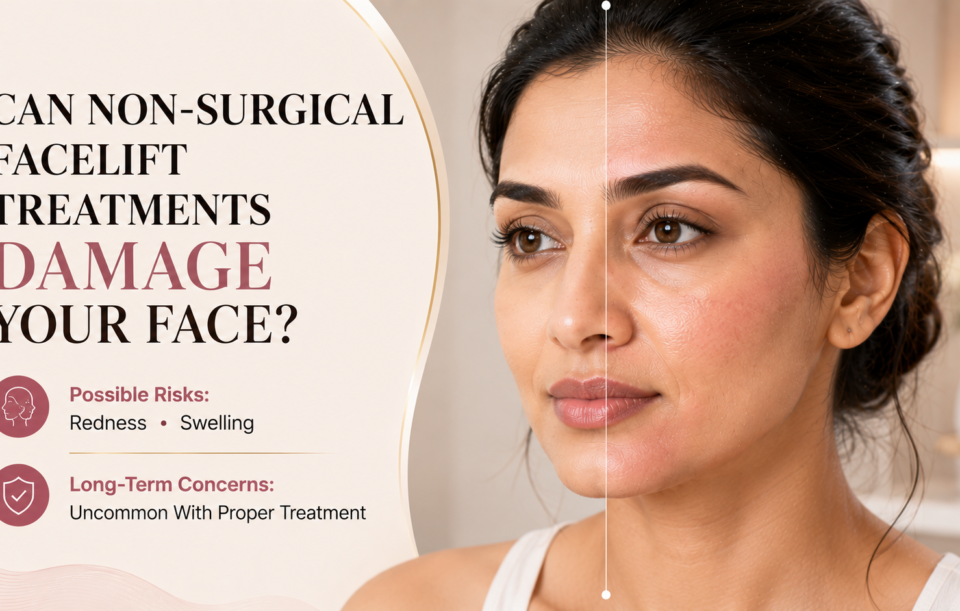
Non-surgical facelift treatments can improve facial lines, skin laxity, volume loss, and overall facial contour without traditional surgery, but they are not completely risk-free. Depending on the technique used, side effects can range from temporary redness, swelling, bruising, and tenderness to less common complications such as burns, infection, lumps, asymmetry, nerve irritation, skin injury, or vascular complications.
The term non-surgical facelift covers several different treatments, including dermal fillers, thread lifts, radiofrequency skin tightening, ultrasound-based treatments, and other energy-based procedures. Because each works differently, the potential risks also vary.
The possibility of facial damage depends on factors such as the treatment selected, the patient’s anatomy and medical history, the products or devices used, treatment settings, and the experience of the practitioner. Proper assessment and appropriate technique are therefore important.
This guide explains how non-surgical facelift treatments can affect the face, which side effects are usually temporary, which complications require medical attention, and how patients can make safer treatment decisions.
Key Takeaways
- Non-surgical facelift treatments can have side effects even though they do not involve traditional surgery.
- Common effects include swelling, bruising, redness, tenderness, and temporary discomfort.
- Fillers, threads, radiofrequency, and ultrasound treatments have different risks.
- Incorrect technique or inappropriate treatment settings can increase the risk of complications.
- Rare complications can cause skin injury, infection, nerve problems, or vascular damage.
- A proper consultation helps determine whether a particular treatment is suitable.
Can non-surgical facelift treatments damage your face?
Non-surgical facelift treatments can cause unwanted effects or complications, but serious facial damage is uncommon when an appropriate treatment is selected and performed correctly. The level of risk depends on the procedure, the patient’s anatomy, the treatment technique, and individual healing.
The phrase “non-surgical” can sometimes make these procedures sound completely harmless. However, treatments that inject substances into the skin or use heat, ultrasound, or threads can still affect deeper tissues.
Possible problems include:
- Swelling and bruising
- Redness and tenderness
- Temporary numbness or sensitivity
- Lumps or unevenness
- Infection
- Skin burns from energy-based treatments
- Thread visibility or irritation
- Nerve irritation
- Changes in facial symmetry
- Vascular complications associated with certain injectable treatments
Most patients do not experience serious complications, but understanding the risks is important before choosing treatment.
Facial asymmetry: A difference in the shape or position of one side of the face compared with the other. Some asymmetry is naturally present in most people.
What determines the risk?
Risk can be influenced by the patient’s age, skin condition, previous procedures, medications, allergies, anatomy, and treatment goals.
The experience of the practitioner also matters. Correct product placement, appropriate device settings, sterile technique, and careful patient selection can all contribute to safer treatment.
If you are considering facial rejuvenation, a professional assessment is more useful than choosing a treatment based only on its name or popularity.
If you are considering a non-surgical facial treatment, a personalised consultation can help determine whether it is appropriate for your facial anatomy and goals.
What treatments are considered non-surgical facelifts?
Non-surgical facelift procedures are a broad group of treatments designed to improve selected signs of facial ageing without traditional facelift surgery. They may target skin laxity, wrinkles, lost volume, or facial contour, but no single treatment corrects every ageing concern.
Common options include:
Dermal fillers
Fillers can restore selected areas of lost facial volume and may improve contour or soften certain folds. Different filler materials have different properties and risks.
Thread lifts
Thread lifts use temporary medical threads placed beneath the skin to provide lifting and contouring effects. They are more invasive than topical or energy-based treatments.
Radiofrequency treatments
Radiofrequency uses controlled energy to heat tissue and stimulate changes in the skin and supporting tissues.
Ultrasound-based treatments
Focused ultrasound devices deliver energy beneath the skin to produce controlled tissue effects that may improve selected areas of laxity.
Other skin-tightening procedures
Depending on the patient’s concern, treatments such as laser or other energy-based procedures may be considered for skin texture, pigmentation, or rejuvenation.
These procedures should not be treated as interchangeable. A treatment suitable for one person’s facial structure may not be appropriate for another.
What side effects are usually temporary?
Most minor side effects from non-surgical facial treatments are temporary and usually improve as the treated tissues recover. Patients may experience swelling, bruising, redness, tenderness, warmth, tightness, or mild discomfort, depending on the procedure used. Dermal fillers commonly cause temporary swelling or bruising, while thread lifts may cause tenderness, tightness, or swelling. Radiofrequency treatments can produce temporary warmth and redness, and ultrasound-based treatments may cause tenderness or mild swelling. Although these effects often settle with time, recovery varies from person to person. Less common complications, such as infection, lumps, thread migration, burns, nerve irritation, or vascular problems with fillers, may require medical assessment.
Inflammation: Inflammation is the body’s natural response to tissue irritation or injury and may cause redness, swelling, warmth, or tenderness.
Can fillers cause facial damage?
Dermal fillers can produce complications, although many side effects are temporary. Possible problems include swelling, bruising, tenderness, lumps, infection, asymmetry, and delayed inflammatory reactions. Rare but serious vascular complications can occur if filler enters or compresses a blood vessel.
This is one reason injectable treatments require detailed knowledge of facial anatomy.
Different areas of the face contain important blood vessels and nerves. Complications can vary depending on the injection site, filler material, injection technique, and individual anatomy.
Patients should also understand that filler is not simply a cosmetic substance placed anywhere under the skin. It interacts with surrounding tissues and should be used for an appropriate anatomical indication.
What can happen if too much filler is used?
Excessive filler can create an unnatural appearance, heaviness, puffiness, or changes in facial proportions. Repeated treatments without reassessing the overall facial structure may also lead to overcorrection.
A conservative treatment plan can help maintain natural facial proportions rather than focusing only on adding volume.
Can energy-based treatments burn the skin?
Energy-based treatments can cause skin injury if excessive energy reaches the tissue or if the device is used incorrectly. Depending on the technology, possible adverse effects can include prolonged redness, swelling, blistering, burns, pigmentation changes, or changes in skin texture.
Energy-based facial treatments include different technologies, so their safety profiles are not identical.
Treatment should take into account:
- Skin type
- Treatment area
- Device technology
- Energy settings
- Previous procedures
- Existing skin conditions
- Individual sensitivity
Thermal injury: Tissue damage caused by excessive heat. With energy-based cosmetic treatments, appropriate device settings and technique are important for reducing this risk.
Can thread lifts cause complications?
Thread lifts can cause swelling, bruising, tenderness, temporary tightness, asymmetry, infection, thread visibility, dimpling, or irritation. In some cases, threads may become palpable, move from their intended position, or require further medical management.
Because threads are inserted beneath the skin, the procedure requires careful understanding of the underlying facial anatomy.
Patients should have realistic expectations about the degree and duration of lifting. A thread lift is not equivalent to a surgical facelift, and it may not be appropriate for significant skin or tissue laxity.
How can you reduce the risk of complications?
The risk of complications can be reduced by choosing an appropriate treatment, undergoing a proper assessment, and having the procedure performed by a suitably qualified and experienced medical professional.
Important considerations include:
1. Have a proper facial assessment
The underlying cause of ageing or facial laxity should be evaluated before treatment. Skin quality, volume loss, muscle activity, tissue position, and facial proportions may all influence treatment planning.
2. Choose the treatment according to the problem
A patient with volume loss may benefit from a different approach than someone whose main concern is skin laxity.
3. Discuss previous procedures
Previous fillers, threads, surgery, or energy treatments can affect planning and should be disclosed during consultation.
4. Understand the limitations
Non-surgical treatments may improve selected concerns but cannot reproduce every result achievable with surgery.
5. Ask about possible complications
Understanding both common side effects and rare complications allows patients to make informed decisions.
For patients considering facial rejuvenation, Elegance Clinic Surat provides personalised assessment and treatment planning.
How should treatment be planned safely?
A safe treatment process generally begins with consultation rather than immediately selecting a procedure. The practitioner should first understand the patient’s concerns and determine whether those concerns are related to skin quality, volume, tissue laxity, facial structure, or a combination.
Step 1: Discuss your concerns
The consultation should identify what the patient wants to improve and what result they consider natural.
Step 2: Examine facial anatomy
The face should be assessed from different angles to understand symmetry, skin quality, volume, and tissue position.
Step 3: Review medical history
Previous cosmetic procedures, allergies, medications, and relevant medical conditions may affect treatment selection.
Step 4: Select an appropriate option
The treatment should be selected according to the patient’s anatomy and goals rather than simply choosing the most popular procedure.
Step 5: Plan follow-up
Follow-up allows the practitioner to assess healing, evaluate the response, and address unexpected symptoms when necessary.
When should you seek medical attention?
Unexpected or worsening symptoms after a cosmetic procedure should not be ignored. Severe or increasing pain, rapidly worsening swelling, significant skin colour changes, blistering, signs of infection, or new neurological or visual symptoms require prompt medical assessment.
The appropriate response depends on the treatment performed and the symptoms involved.
Patients should contact their treating medical professional if they are concerned about an unexpected change rather than attempting to manage a potentially serious complication themselves.
Warning signs that need prompt assessment
- Severe or worsening pain
- Rapidly increasing swelling
- Significant skin colour changes
- Blistering or burns
- Pus or other signs of infection
- New weakness or marked numbness
- Visual changes after facial injectable treatment
- Symptoms that are getting worse rather than improving
Serious complications are uncommon, but early recognition can be important when they occur.
Is a non-surgical facelift safer than a surgical facelift?
Non-surgical treatments generally avoid some of the risks associated with major surgery and general anaesthesia, but that does not mean they are risk-free. The appropriate comparison depends on the specific procedure, the patient’s health, the treatment area, and the desired result.
A surgical facelift involves incisions, tissue repositioning, and a longer recovery period, while non-surgical options generally involve less invasive techniques.
However, non-surgical treatments may have limitations when significant skin and tissue laxity are present. In some patients, surgery may provide a more appropriate structural correction.
The goal should therefore be to choose the right treatment for the actual concern, rather than automatically choosing a surgical or non-surgical option.
Which treatment has the lowest risk?
There is no single non-surgical facelift treatment that is safest for every patient. Risk depends on the procedure, treatment area, technique, device or product, practitioner experience, and individual anatomy. A treatment that is appropriate for one person may be unsuitable for another.
| Treatment | Main Purpose | Key Risk Considerations |
|---|---|---|
| Fillers | Restore selected volume and contour | Injection-related complications |
| Thread lift | Temporary lifting and contouring | Infection, asymmetry, thread-related problems |
| Radiofrequency | Skin tightening | Heat-related injury |
| Ultrasound | Tissue tightening | Pain or unintended tissue effects |
The safest approach is usually one that is medically appropriate, conservatively planned, and performed by a qualified professional.
For more information about Dr. Ashutosh Shah’s qualifications and experience, see Dr. Ashutosh Shah, Plastic Surgeon in Surat.
Dr. Ashutosh Shah, M.Ch., DNB (Plastic Surgery) is a Board-Certified Plastic, Cosmetic & Reconstructive Surgeon and Director of Elegance Clinic, Surat. He has more than 22 years of surgical experience and has completed advanced training in microvascular surgery at Ganga Hospital, Coimbatore, and cosmetic surgery at Apollo Hospital, Chennai.
Elegance Clinic was established in Surat in 2014 and provides cosmetic surgery, plastic surgery, dermatology, hair restoration, laser treatments, and reconstructive care. Treatment planning focuses on patient safety, appropriate procedure selection, and natural-looking outcomes.
Patients can explore relevant facial aesthetic and cosmetic treatment services based on their individual concerns.
Non-surgical facelift treatments can improve selected concerns such as wrinkles, volume loss, skin laxity, and facial contour, but they are not completely free from risk. Temporary swelling, bruising, redness, tenderness, or tightness may occur, while less common complications can include infection, burns, asymmetry, nerve irritation, filler-related problems, or other tissue injury.
The risk does not depend only on whether a treatment is labelled “non-surgical.” It also depends on the technology or product used, treatment technique, facial anatomy, medical history, and experience of the practitioner.
Choosing an appropriate treatment after a professional assessment is therefore important. Dr. Ashutosh Shah at Elegance Clinic, Surat, can evaluate your facial concerns and discuss whether a non-surgical approach or another option is appropriate.
Book a Consultation at Elegance Clinic Surat to discuss your concerns and receive an individualised treatment plan.
Frequently Asked Questions
A: Rarely, complications can occur, especially when treatments are performed incorrectly or by an unqualified provider.
A: Swelling, redness, bruising, and tenderness are often temporary and improve during recovery.
A: Rarely, fillers can cause infection, vascular complications, lumps, or tissue damage.
A: Nerve irritation is uncommon but can occur and may cause temporary changes in sensation or movement.
A: Seek medical advice if you develop severe pain, increasing swelling, skin colour changes, fever, or other unexpected symptoms.

Category
Latest From Blog
What Are the Risks of an Eyebrow Lift?
Is Botox Safe for Forehead Lines?
How Can You Treat Horizontal Neck Lines?