




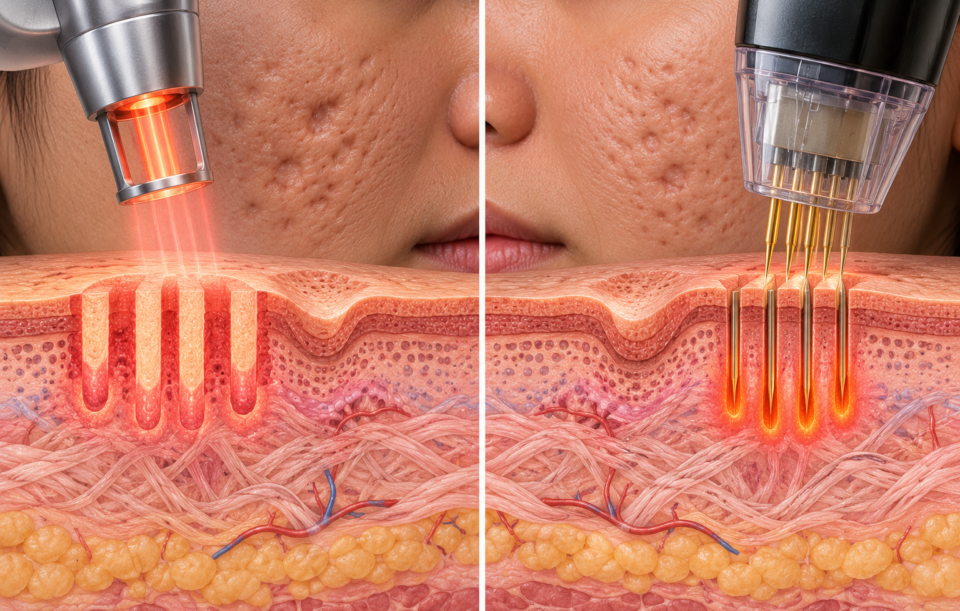
Fractional CO2 laser removes columns of skin to trigger collagen, suiting boxcar and rolling scars but 5 to 7 days of redness and a higher risk of darkening on Indian skin. MNRF delivers radiofrequency through microneedles, with 1 to 3 days of downtime and lower pigment risk. Ice pick scars need TCA CROSS or punch techniques.
How Do CO2 Laser and MNRF Each Rebuild Scarred Skin?
Fractional carbon dioxide (CO2) laser and microneedling radiofrequency (MNRF) are procedures that stimulate collagen remodelling to improve the appearance of depressed acne scars. However, they deliver energy differently, which affects recovery, skin irritation and the risk of post-inflammatory hyperpigmentation (PIH).
Fractional CO2 laser creates microscopic columns of controlled thermal injury in the skin. The surrounding untreated tissue supports healing, while the treatment stimulates collagen remodelling. Depending on the device settings and scar pattern, it can improve selected rolling and boxcar scars, skin texture and unevenness.
Read more about Fractional CO2 laser before deciding whether resurfacing is suitable for your skin.
MNRF uses fine needles to deliver radiofrequency energy into targeted skin layers. The controlled thermal effect stimulates dermal collagen remodelling while limiting direct injury to much of the skin surface. This may make it an option for people who are concerned about pigment changes, although it is not risk-free and can still cause redness, swelling, pain or pigmentation.
Neither procedure instantly removes a scar. Improvement develops gradually as collagen remodels over weeks and months, and results vary with scar depth, skin characteristics, treatment settings and the number of sessions.
A 2026 meta-analysis of eight randomised controlled trials involving 249 patients found that fractional CO2 laser produced greater average improvement in the included studies, but also had higher pain scores, more PIH and longer-lasting redness than MNRF. These findings support individualised treatment rather than a single best procedure for everyone.
Which Works Better for Rolling, Boxcar and Ice Pick Scars?
The shape and depth of a scar are important when choosing a treatment. Acne scars are not all the same, and one device may not adequately address every scar on the same face.
- Rolling scars: These create broad, gently sloping depressions. Subcision may be needed when fibrous bands tether the skin. MNRF or fractional CO2 can be considered for additional texture improvement after assessment.
- Shallow boxcar scars: These have defined edges but are relatively shallow. Fractional CO2 or MNRF may improve their appearance by stimulating collagen and remodelling the skin.
- Deep boxcar scars: These have sharper edges and extend deeper into the skin. They may require a combination of approaches rather than relying on one energy-based treatment.
- Ice pick scars: These are narrow, deep pits. TCA CROSS or selected punch techniques may be more suitable than laser or MNRF alone.
- Hypertrophic scars: These are raised rather than depressed. They need a different treatment strategy, so resurfacing for depressed scars should not automatically be used.
For deeper, sharply edged depressions, review Deep boxcar scar treatment to understand why scar depth influences treatment planning.
Scar-to-tool comparison
| Scar type | Fractional CO2 | MNRF | Subcision | TCA CROSS | Typical downtime |
|---|---|---|---|---|---|
| Rolling | May improve surface texture | May improve texture | Often considered if tethered | Usually not first choice | CO2: about 5–7 days; MNRF: about 1–3 days |
| Shallow boxcar | Can improve texture and edges | Can improve texture | Only if tethering is present | Selected cases | CO2: about 5–7 days; MNRF: about 1–3 days |
| Deep boxcar | May help as part of a plan | May help as part of a plan | If tethered | Selected cases | Depends on combined treatment |
| Ice pick | Often limited as a standalone treatment | Often limited as a standalone treatment | Usually not the main treatment | Commonly considered | Varies by procedure and wound healing |
| Hypertrophic | Not a routine first choice | Not a routine first choice | Generally not indicated for the raised scar itself | Not a routine first choice | Requires a treatment-specific plan |
These are general estimates, not guaranteed recovery times. Treatment depth, device settings, the size of the treated area and individual healing can change downtime. A dermatologist should confirm the likely plan after examining the scars.
How Do Downtime and Pigmentation Risk Compare on Brown Skin?
Post-inflammatory hyperpigmentation occurs when inflammation triggers excess pigment in the skin. It may appear as brown or dark patches after a procedure and can persist longer than the initial redness.
Fractional CO2 laser is an ablative treatment. It creates controlled columns of injury, so redness, swelling, peeling or crusting can occur during recovery. The treatment can be effective, but aggressive settings or inadequate aftercare may increase complications, particularly in pigment-prone skin.
MNRF delivers radiofrequency energy through needles and can limit surface injury compared with ablative resurfacing. Its recovery may be shorter for some patients, but temporary redness, swelling, pinpoint marks, infection, burns or pigment changes remain possible.
Fitzpatrick skin types IV and V are more likely to develop pigment changes after some inflammatory skin procedures. For these patients, a dermatologist may favour MNRF or consider conservative, low-density fractional CO2 settings with appropriate pigment-risk management. The correct option depends on the skin examination, previous pigmentation, active acne, medical history and the clinician’s experience.
The 2026 comparative research also highlights a trade-off between improvement and tolerability: fractional CO2 showed a greater average improvement in one meta-analysis, while a broader review found no statistically significant difference in some overall scar-score outcomes and noted substantial variation between studies. The evidence does not justify promising that one treatment will always outperform the other.
Before treatment, discuss:
- Your history of dark marks after pimples, cuts or procedures.
- Current acne, skin irritation, cold sores or any active infection.
- Recent tanning or significant sun exposure.
- Medicines, skincare products and any history of poor wound healing.
- The expected downtime and the possibility of temporary or persistent pigment changes.
Sun protection and the aftercare plan are important. Do not restart irritating products or use unprescribed bleaching agents on healing skin.
How Many Sessions Does Each Need?
The number of sessions depends on scar type, depth, treatment intensity and the degree of improvement that is realistic. Neither fractional CO2 nor MNRF has one universal session count for every patient.
MNRF is often planned as a series of sessions spaced several weeks apart. Fractional CO2 may also be performed in stages, with enough time between sessions for the skin to recover and for collagen remodelling to become visible. More aggressive treatment is not automatically better, particularly when pigment changes or prolonged recovery are concerns.
At follow-up visits, the clinician can compare photographs, assess texture and decide whether to repeat the same treatment or change the plan. Results should be evaluated after healing rather than immediately after the procedure, when swelling can temporarily affect how scars look.
A useful consultation should clarify the estimated number of sessions, interval between visits, total expected cost, recovery requirements and what degree of improvement is plausible. Ask whether the treatment plan includes separate procedures for tethered rolling scars or deep ice pick scars.
When Are CO2 Laser and MNRF Combined With Subcision or TCA CROSS?
Combination treatment can be helpful because acne scars vary in depth and structure. The aim is to choose a suitable technique for each scar rather than treating every depression in exactly the same way.
Subcision uses a needle or instrument beneath the skin to release fibrous bands pulling a rolling scar downward. It may be considered when tethering is a major part of the depression. MNRF or fractional CO2 may then be considered for residual surface texture, depending on the patient’s skin and recovery needs.
TCA CROSS applies a high concentration of trichloroacetic acid to selected deep, narrow scars. It triggers a controlled local response that can improve some ice pick scars over multiple treatments. It must be performed by a trained professional because incorrect application can cause burns, additional scars or pigment changes.
Punch techniques may be considered for selected deep, sharply defined scars that are unlikely to respond adequately to resurfacing alone.
Treatments may be staged rather than performed together. The sequence depends on the scars, skin tone, active acne and healing response. Combining procedures does not guarantee complete scar removal, and each additional procedure can add recovery time and risk.
Goodman and Baron Acne Scar Grading: Why Assessment Matters
The Goodman and Baron qualitative acne-scar grading system is one approach clinicians use to describe the overall severity of atrophic acne scarring. It classifies scarring according to the type and extent of scars, helping standardise assessment and comparison over time.
Grading is useful, but it does not replace a close examination of individual scars. Two people with a similar overall grade may have different proportions of rolling, boxcar and ice pick scars, and therefore need different treatment plans.
A clinician should record scar type, depth, distribution, skin tone and any active acne or pigment concerns before recommending a procedure. Standardised photographs taken under consistent lighting can help assess change over time, although photographs cannot perfectly capture every contour.
The goal is to improve texture and make scars less noticeable, not to guarantee completely scar-free skin. A realistic plan prioritises safe, measurable improvement and adjusts treatment according to the response.
co2 laser near katargam: What Should You Ask Before Treatment?
Before choosing a procedure, ask the dermatologist to identify your dominant scar types and explain why the proposed treatment suits your skin. If you are considering treatment with a clinic offering this service, confirm the clinician’s qualifications, the device being used, expected downtime and the plan for managing complications.
Questions worth asking include:
- Which of my scars are rolling, boxcar, ice pick or raised?
- Is subcision or TCA CROSS needed before resurfacing?
- What is my personal risk of post-inflammatory hyperpigmentation?
- How many sessions are likely, and when will improvement be assessed?
- What should I stop using before treatment, and what aftercare will I need?
- What are the alternatives if I cannot manage the expected downtime?
A good consultation should explain both the likely benefits and the limitations of each option. Avoid choosing a procedure solely because it is advertised as stronger, newer or faster.
Frequently Asked Questions
Pain varies with device settings, treatment depth, the area treated and the person’s sensitivity. Both procedures may require topical anaesthetic, and either can be uncomfortable. Ask the clinician what pain-control method will be used and what sensations to expect during and after treatment.
Yes. Fractional CO2 can cause post-inflammatory hyperpigmentation, especially in people prone to dark marks or with darker skin tones. Risk depends on settings, skin condition and aftercare. A dermatologist may recommend a conservative approach, another treatment, or pigment-risk management before proceeding.
There is no fixed number for everyone. A course of several sessions may be recommended, with intervals that allow healing and collagen remodelling. Scar depth, the device used and the response after each session influence the plan. Your clinician should reassess progress before recommending further treatment.
Plan well in advance rather than booking close to the event. Redness, peeling, crusting and pigment changes may last longer than expected, and collagen remodelling takes time. Ask your dermatologist how much recovery time to allow and whether a less intensive option would be more appropriate.
Possibly, but the advice depends on the medication, product, procedure and your skin condition. Tell your dermatologist about prescription acne medicines, retinoids, exfoliating acids and all skincare products. Do not stop a prescribed medicine or restart irritating products without guidance from the treating clinician.
Deep acne scars usually cannot be guaranteed to disappear completely. Treatment may soften their edges, improve texture and make them less noticeable, but the outcome depends on scar type, depth, skin response and the combination of procedures used. A realistic treatment plan aims for meaningful improvement rather than perfect skin.


Category
Latest From Blog
Can Facial Ageing Be Treated Without Surgery?
Red Veins On The Face: What Causes Them And Which Vascular Laser Fits
CO2 Laser Or MNRF For Acne Scars: Which Suits Your Scar Type And Skin Tone